
Bosnia & Kosovo · IFOR / SFOR / KFOR · 1995 – early 2000s
PTSD Nexus Letters for Bosnia & Kosovo Veterans
For the peacekeepers of the Balkans — who saw what a war against civilians leaves behind, and were often told they were “only” peacekeeping. Balkans claims are unusual in one specific way: the shortcuts that carry most PTSD claims often do not apply here. That single fact shapes everything about how the opinion has to be written.
Jessica R. Allen, M.D. · Licensed psychiatrist and former VA C&P examiner · Psychiatric IMEs and nexus letters, all 50 states
Quick answer
Can I get a PTSD nexus letter for a Bosnia or Kosovo peacekeeping deployment?
Yes — but the claim is built differently than a combat claim. Guarding a mass grave, working an exhumation site, patrolling densely mined ground, and holding fire against hostile crowds are all recognized traumatic exposures. What changes is the method of proof. Because IFOR, SFOR, and KFOR were not declared combat-with-the-enemy tours, the relaxed stressor pathway under 38 CFR 3.304(f)(2) usually does not reach these deployments, and the fear-of-hostile-activity pathway under 3.304(f)(3) may or may not fit.
That makes the documentary record decisive. A Balkans nexus letter has to construct the stressor out of unit records, duty assignments, and lay statements rather than lean on a presumption — and then meet the VA's at least as likely as not standard on the medical link.
The record
Peacekeeping is not the same as peace
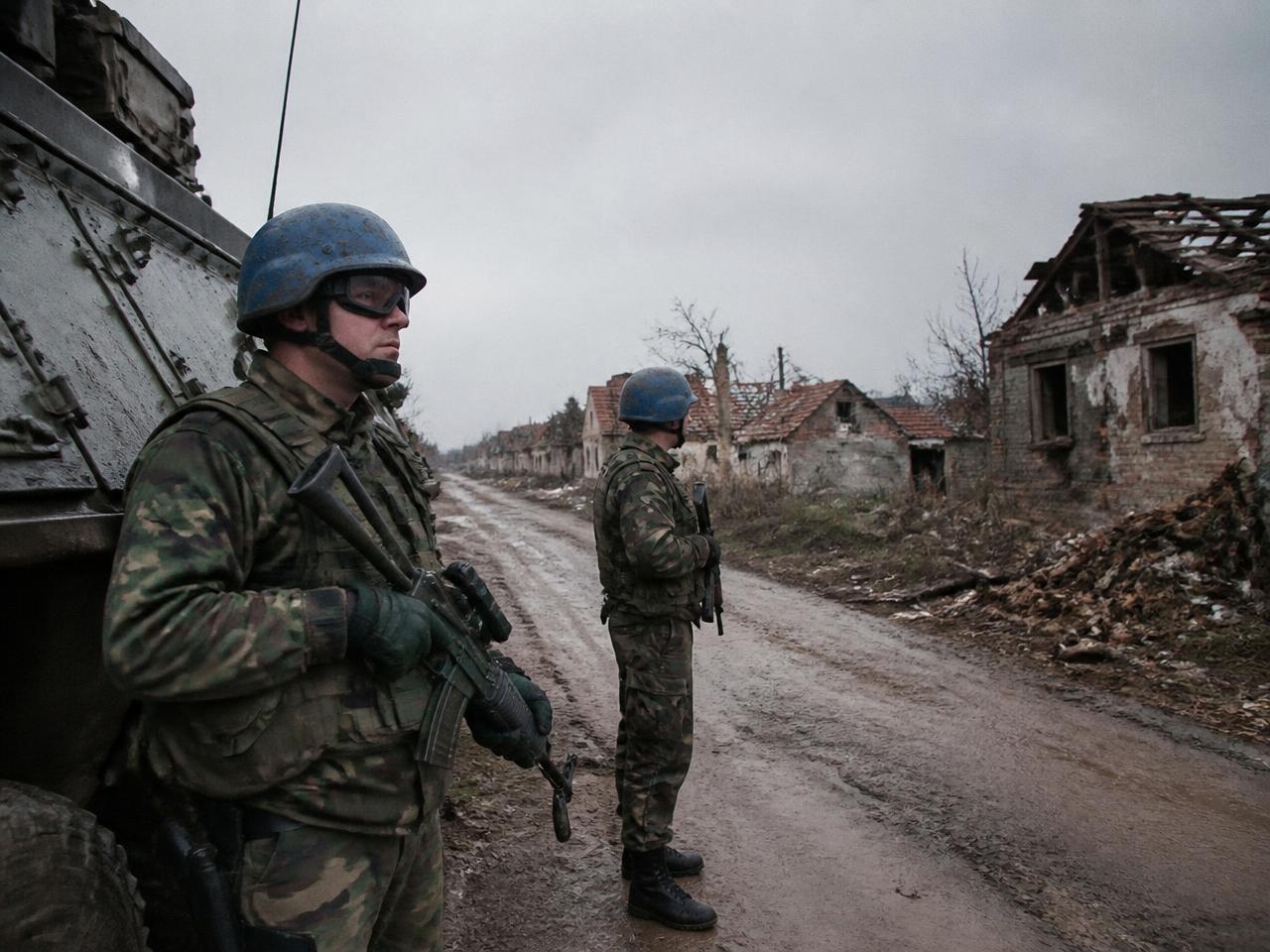
After the Dayton Accords, American forces deployed to Bosnia in December 1995 under Operation Joint Endeavor, leading the NATO IFOR and later SFOR missions. In 1999, Operation Allied Force — the air campaign over Kosovo — was followed by the KFOR ground presence. These were not declared combat tours, and that is precisely why the trauma they produced is so often overlooked.
Service members arrived in the aftermath of ethnic cleansing. They guarded and sometimes helped exhume mass graves, moved through some of the most heavily mined terrain in the world, faced hostile crowds and snipers, and enforced a fragile peace under strict rules of engagement — expected to witness the evidence of atrocity while holding their fire. The stress of restraint under threat, and of bearing witness without being able to act, is its own distinct injury.
If your claim for that service has already been turned down, our page on denied VA claims explains what a decision letter is actually telling you, and how the evaluation process works here, from first call to finished opinion.
Clinical relevance
The trauma signature of Balkans peacekeeping
These stressors do not look like a firefight, and an opinion that reaches for combat vocabulary will describe them badly. Each one below maps onto a recognized feature of PTSD, and a nexus letter should say so in plain clinical terms.
The aftermath of atrocity
Mass graves, exhumations, and the physical evidence of ethnic cleansing are exposure to death and its aftermath in overwhelming form — a recognized traumatic exposure that requires no exchange of fire.
Restraint under threat
Facing hostile crowds and snipers while under orders to hold fire produces sustained threat arousal with no discharge. The body prepares for danger repeatedly and is never permitted to act on it.
The mines
Some of the most densely mined ground in the world made every patrol, every step off a hard surface, a calculated risk — a persistent low-grade threat state rather than a single discrete event.
The “only peacekeeping” problem
Because these were not labeled combat tours, veterans routinely discount their own experience — and examiners may follow their lead. Self-minimization is one of the most common reasons a valid Balkans claim looks thin on paper.
Bearing witness
What it does to a person to watch and not intervene
Most trauma frameworks are built around threat to the self. The Balkans produced something the clinical literature describes differently: injury arising from what a person witnessed, was ordered to permit, or could not prevent.
Standing a cordon while a crowd is turned back. Securing a site where the dead are being counted. Recognizing exactly what happened in a village and having neither the mandate nor the authority to act on it. Service members carried out those orders correctly — and many have carried the residue of them ever since.
That experience is often described as moral injury: the enduring effect of acting, failing to act, or witnessing an act that violates deeply held moral commitments. It is not a separate VA diagnostic code, and it is not a substitute for PTSD. It matters clinically because it shapes the symptom picture — guilt, shame, a loss of trust in institutions, withdrawal, and a sense of having been complicit in something — in a way an examiner scanning for combat hypervigilance may not recognize as trauma at all.
An evaluation that only looks for startle response and nightmares can miss a Balkans veteran entirely. The full symptom picture has to be drawn out and documented, including the criteria covering negative alterations in mood and cognition, where much of this presentation lives.
The layering problem
When a later deployment buried the first one
Many who served in Bosnia or Kosovo were career soldiers who stayed in. Within a few years they deployed again — to Afghanistan, to Iraq, or both. By the time anyone asked about trauma, there were three deployments to account for, and the Balkans one was the oldest, the quietest, and the easiest to leave out.
This creates a specific evidentiary problem. A treatment note or a prior exam may attribute everything to the later, more legible war. The Balkans exposure never enters the record, and a rating decision written years later reflects that absence. It is not that the peacekeeping stressor was weighed and rejected; it was never presented.
A careful evaluation reconstructs the whole deployment history in order and asks what each tour contributed. That matters practically: where a Balkans stressor is documented alongside later service, it can support the claim rather than compete with it. If your later service included Iraq or an airborne element, those pages cover the stressor profiles specific to them.
The standard of proof
Why Balkans claims are proved from the record, not a presumption
This is the defining feature of a Balkans PTSD claim, and it is worth being precise about it.
For many post-9/11 claims, the VA's rules do substantial work for the veteran. Under 38 CFR 3.304(f)(3), a stressor based on fear of hostile military or terrorist activity may be established by the veteran's own testimony when it is consistent with the circumstances of service. That standard fits the Gulf War Scud and chemical-alert environment closely, and it fits the Iraq IED threat environment closely. Peacekeeping is the harder case. A tour spent guarding an exhumation site under a mandate that forbade offensive action does not map neatly onto either the combat provision at 3.304(f)(2) or the hostile-activity provision at 3.304(f)(3).
The practical consequence
Where a presumption does not carry the stressor, the file has to. That is not a weakness in the claim — it is a different construction. Balkans claims that succeed tend to be the ones where the stressor was documented specifically and early, rather than described in general terms and left to the examiner to imagine.
A stressor alone still is not enough. Your current symptoms must also meet the full clinical criteria for PTSD — intrusion, avoidance, negative shifts in mood and thinking, and hyperarousal, persisting and impairing your functioning — and be at least as likely as not connected to that service. A citation to the literature is not, by itself, an opinion about you, which is why medical literature alone is not enough to carry a claim.
Evidence that carries weight in a Balkans claim
- Unit and personnel records placing you with IFOR, SFOR, or KFOR, with dates and location
- Incident and patrol reports, and records of civil-disturbance or crowd-control response
- EOD and de-mining logs, and mine-strike or mine-awareness incident records
- Duty assignments to mass-grave security, exhumation support, or mortuary affairs
- The Armed Forces Expeditionary Medal, Kosovo Campaign Medal, and NATO service medals
- Buddy statements from those who served alongside you, describing what you did and saw
Delayed onset
Twenty-five years without a diagnosis is a pattern, not a contradiction
Most Balkans peacekeepers were never evaluated for PTSD, in service or for a long time after. Some finished a career and separated in the 2000s. Others left earlier and spent two decades working, raising families, and not thinking about it — which is different from not being affected by it.
The DSM-5 formally recognizes PTSD with delayed expression, where the full diagnostic picture is not met until at least six months after the event. In practice the interval is often far longer. What tends to bring it forward is the removal of structure or the arrival of stillness: retirement, a layoff, the end of a marriage, a child reaching the age you were when you deployed, a news cycle returning to that part of the world, or a war-crimes trial concluding decades after the fact and putting the place back in front of you.
The absence of a contemporaneous record does not defeat the claim. A current evaluation can establish the diagnosis now, and the nexus letter supplies the medical reasoning that connects today's symptoms to a deployment that ended a long time ago.
If you are already service-connected and the condition has worsened over those decades, that is a different filing — see PTSD rating increase nexus letters. And if a prior exam concluded depression rather than PTSD, here is what to do about that.
Why the evaluator matters
Corroboration-built claims are decided on how well the record is assembled
Jessica R. Allen, M.D.
Licensed psychiatrist · Former VA C&P examiner
When a claim rests on a presumption, the medical opinion carries most of the load. When it doesn't — as in a Balkans claim — the opinion has to do something more demanding: identify precisely which documents in the file corroborate the stressor, say what each one establishes, and connect that specific exposure to the specific symptoms the veteran has now. A general statement that peacekeeping was stressful will not survive review.
Dr. Allen spent three years as a VA Compensation & Pension examiner before she began writing opinions for veterans, which means she has read these claims from the adjudicating side. She knows which corroboration a rating official finds sufficient, where an opinion goes vague, and how a stressor that was never squarely presented ends up recorded as one that failed.
She reviews the full record herself — service treatment and personnel records, deployment history, lay statements, prior decisions, and C&P exams — and writes every opinion personally, for veterans in all 50 states, by video, from home. More about Dr. Allen
Talk it through
Not sure whether a peacekeeping tour counts? Ask.
A free, confidential phone consultation is the simplest way to find out whether a nexus letter fits your Bosnia or Kosovo claim. Dr. Allen will tell you honestly either way — there's no obligation.
Common questions
Balkans peacekeeping PTSD questions
Schedule a free phone consultation
Jessica Allen, M.D. — licensed psychiatrist and former VA C&P examiner. Independent medical opinions and nexus letters for veterans in all 50 states.
Related reading
- What is a nexus letter?
- PTSD and MST nexus letters
- Rebuttal letters for denied claims
- TDIU nexus letters
- Chronic pain and mental health
- See all nexus letters
This page is educational and general in nature and is not medical or legal advice. An evaluation is a one-time consultation examination, does not create a physician–patient relationship, and no VA outcome is guaranteed. Brightview Psychiatry Solutions PLLC provides independent medical opinions; it does not represent veterans before the VA. All service connection and rating decisions are made solely by the Department of Veterans Affairs.
Related conflicts & events
PTSD nexus letters by conflict
Vietnam War (1965–1973)
Sustained combat and ambushes; trauma often surfacing decades later.
Beirut, Lebanon (1983)
Peacekeeping under fire and the Marine barracks bombing; survivor guilt.
Read moreGrenada — Urgent Fury (1983)
A chaotic, hastily-planned invasion; firefights and helicopter losses.
Panama — Just Cause (1989)
Night airborne assault, urban combat, and a forgotten fight.
Read moreGulf War — Desert Storm (1990–91)
The Scud threat, the chemical-alert environment, the 100-hour ground war.
Read moreBattle of Mogadishu (1993)
Operation Gothic Serpent — sustained urban combat, recovering the fallen.
Read moreBosnia & Kosovo (1995–99)
Peacekeeping trauma: mass graves, mines, restraint under threat.
Read moreUSS Cole (2000)
Shipboard blast, fire, flooding, and entrapment with no way to evacuate.
Afghanistan — OEF (2001–2021)
Mountain firefights, IEDs, insider attacks, cumulative deployments.
Iraq — OIF / New Dawn (2003–2011)
IEDs, urban clearing, an enemy without a uniform; PTSD and TBI overlap.
Read moreInherent Resolve (2014–present)
Anti-ISIS: advise-and-assist, base rocket attacks, and Mosul.