
Airborne & Paratrooper Veterans
PTSD in Airborne Veterans: VA Claims and Nexus Letters for Paratroopers
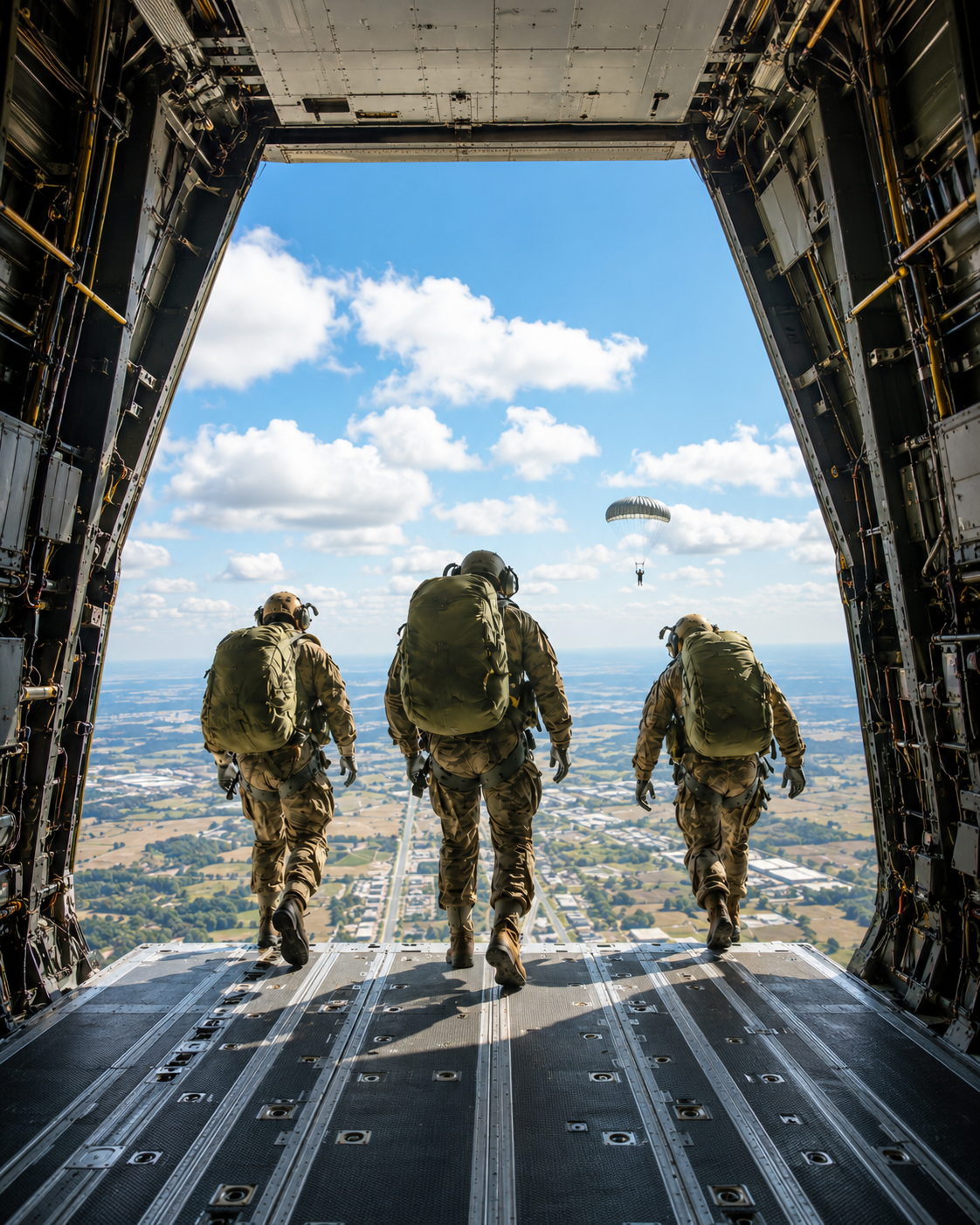
Parachute malfunctions, hard landings, aircraft emergencies, and witnessing a fellow jumper's injury can all cause PTSD. Combat is not required. But airborne training stressors face an evidentiary hurdle that combat stressors do not, and understanding it before you file changes what you should be doing first.
Jessica R. Allen, M.D. · Licensed psychiatrist and former VA C&P examiner · Psychiatric IMEs and nexus letters, all 50 states
Can airborne service cause PTSD, and can I get VA disability for it?
Yes. A parachute malfunction, a violent landing, an aircraft emergency, or witnessing another jumper suffer catastrophic injury can each satisfy the DSM-5 criterion for a traumatic stressor — exposure to actual or threatened death or serious injury, whether experienced directly or witnessed in person. Nothing requires that it happen in combat.
The practical difficulty is different from what most veterans expect. Under 38 C.F.R. § 3.304(f), a PTSD claim requires credible supporting evidence that the stressor actually occurred. Lay testimony alone is enough only in specific situations — combat service, POW status, an in-service PTSD diagnosis, or fear of hostile military or terrorist activity. An airborne training accident falls outside all of them.
That means corroboration is the first battle: jump logs, line-of-duty determinations, accident reports, unit records, buddy statements. A medical opinion supplies the diagnosis and the nexus. It cannot verify that the jump went wrong. Knowing which piece you are missing determines what to do next. If your symptoms have worsened since your last rating, see our page on PTSD rating increase nexus letters.
Airborne events that commonly form the basis of a claim
- Total or partial parachute malfunction requiring reserve deployment
- Canopy collapse, line twists, or entanglement with another jumper
- Hard landing producing fracture, spinal injury, or loss of consciousness
- Being dragged across the drop zone in high wind
- Water landing or tree landing with entrapment
- Night jumps or high-wind jumps conducted despite conditions
- Aircraft mechanical emergency, turbulence, or aborted mission
- Witnessing another paratrooper's serious injury or death
- Mass-casualty drop zone events or landing-zone chaos
- Combat jumps, hostile landing zones, and air assault insertions
A veteran does not need to have been physically injured. Being uninjured while genuinely believing you were about to die still satisfies the criterion, and so does witnessing what happened to someone else.
The real hurdle
Why do airborne PTSD claims get denied for an unverified stressor?
This is the single most important thing on this page, and it is the part most veterans learn about only after a denial.
Service connection for PTSD under 38 C.F.R. § 3.304(f) requires three things: a diagnosis conforming to the DSM, a link established by medical evidence between current symptoms and the claimed in-service stressor, and credible supporting evidence that the claimed stressor actually occurred.
What corroborates an airborne stressor
- Jump logs and jump records showing the date and the mission
- Line-of-duty determinations and safety or mishap investigations
- Service treatment records documenting injury or evaluation after the jump
- Unit records, morning reports, and airborne operation records
- Buddy statements from those on the aircraft, the drop zone, or the recovery
- Parachutist badge and airborne school records establishing status and assignment
- Contemporaneous letters or photographs referencing the incident
- Behavioral evidence from the period — transfer requests, performance decline, disciplinary changes
Being direct about this
What can a nexus letter actually do for an airborne claim?
A medical opinion is powerful for two of the three elements and useless for the third. Knowing which is which will save you money.
What it does: establishes the diagnosis
A psychiatric evaluation conforming to the DSM, as 38 C.F.R. § 4.125 requires, addressing each criterion against your history rather than asserting a conclusion.
What it does: supplies the medical nexus
The reasoned explanation linking your current symptoms to the airborne event — the element a veteran cannot supply himself and an adjudicator is not permitted to infer.
What it does: answers a negative C&P opinion
Where an examiner concluded a training accident was not a qualifying stressor, or that symptoms are unrelated, the rebuttal addresses that reasoning directly.
What it cannot do: verify that the event happened
No physician can establish that your parachute malfunctioned. That is a records question. If the stressor is unverified, the opinion sits on a foundation the VA has not accepted.
What this means practically
If you were denied for lack of a verified stressor, the first step is corroboration, not a medical opinion. If you were denied because the VA questioned the diagnosis, minimized the trauma, or found no medical nexus, that is precisely what an independent opinion addresses. Read your rating decision carefully — the VA states which element failed, and the two situations call for different responses.
Symptoms
What does PTSD look like after airborne trauma?
The presentation is often specific enough that a knowledgeable examiner can recognize its origin, which matters when a claim rests on a single event decades ago.
Airborne veterans commonly report nightmares involving falling, canopy failure, or the ground rushing up; intrusive memories triggered by aircraft noise, rotor sound, or the smell of jet fuel; and avoidance that is unusually concrete — declining flights, avoiding bridges and heights, leaving the room during parachute footage, and skipping unit reunions.
Beyond those, the picture is the familiar one: hypervigilance, exaggerated startle, sleep-maintenance insomnia, irritability and anger, emotional numbing, concentration difficulty, depressed mood, guilt, and social withdrawal. Many veterans function outwardly for years while carrying substantial impairment, which is itself worth documenting rather than minimizing. The same pattern appears in other non-combat trauma populations, including Coast Guard veterans and survivors of military sexual trauma.
A note on how paratroopers describe symptoms
Airborne culture trains people to suppress fear and continue. That training does not switch off at separation, and it produces veterans who systematically understate what they experience — at a C&P examination, to their own providers, and on their own claim forms.
Describing your worst weeks rather than your best days is not exaggeration. It is accuracy, and it is the picture the rating criteria are written to capture.
The other pathway
Can chronic pain from jump injuries cause depression or anxiety?
For many airborne veterans this is the stronger claim, and it avoids the stressor-verification problem entirely.
Repeated parachute landing falls produce a characteristic burden of orthopedic injury: lumbar and cervical degenerative disease, radiculopathy, knee and ankle injury, hip and shoulder damage, and chronic musculoskeletal pain. Many airborne veterans are already service connected for one or more of these.
Where that is true, a psychiatric condition secondary to the service-connected orthopedic condition proceeds under 38 C.F.R. § 3.310 and requires no stressor verification at all. The primary disability is already established. What the opinion must explain is the pathway from chronic pain to psychiatric symptoms — sleep disruption from positional pain, loss of physical identity in someone whose self-concept was built on physical capability, withdrawal from activity, narrowing social world, and the functional losses that follow.
After a denial
What if the VA denied my airborne PTSD claim?
A denial names its reason, and the reason determines the remedy. These are not interchangeable.
| If the VA said | What actually helps |
|---|---|
| No verified stressor | Corroborating evidence — buddy statements, jump logs, LOD reports, unit records. A medical opinion cannot fix this. |
| No current diagnosis, or diagnosis does not conform to the DSM | A psychiatric evaluation addressing each criterion against the documented history |
| No medical nexus between symptoms and service | An independent opinion supplying the reasoned explanation the VA found missing |
| The C&P examiner found the training accident was not a qualifying stressor | A rebuttal addressing the DSM-5 criterion directly, including the removal of the subjective-response requirement |
| Symptoms attributed to a post-service cause | An opinion addressing the alternative explanation rather than ignoring it |
There is also a deadline attached. Filing a supplemental claim, requesting higher-level review, or appealing to the Board within one year of the decision generally preserves your original effective date. Past that year, a later grant may carry a much later date — and that difference is frequently worth more than the opinion itself.
Frequently asked
Questions airborne veterans ask
Why airborne veterans work with Dr. Allen
Evaluations that take airborne trauma seriously
Jessica R. Allen, M.D.
Dr. Allen is a licensed psychiatrist and former VA Compensation and Pension examiner practicing in Wake Forest, North Carolina. She previously performed C&P examinations under contract and now prepares independent medical opinions and psychiatric IMEs for veterans in all 50 states.
Airborne service is not simply a qualification or a badge. It means repeated exposure to high-risk operations where serious injury and death are real possibilities, carried out by people trained to keep going regardless. Dr. Allen's uncle served with the 82nd Airborne Division and completed multiple jump missions, and that family connection informs the seriousness with which she approaches these evaluations.
Having assessed claims from the examiner's side of the file, she writes opinions that address what adjudicators actually ask — including the alternative explanations a reviewer will look for, and a candid account of what the evidence can and cannot establish. Each veteran's records are reviewed and each opinion is written by Dr. Allen personally.
Discuss whether an opinion would help your airborne claim
Consultations are free. If the answer is that you need buddy statements before you need a doctor, that is what you will be told.
Related reading
- PTSD and MST nexus letters
- PTSD rating increase nexus letters
- Chronic pain and mental health claims
- PTSD after witnessing a helicopter crash
- PTSD in Coast Guard veterans
- Responding to a proposed rating reduction
Sources
- 38 C.F.R. § 3.304(f) — Direct service connection; posttraumatic stress disorder, including the combat, POW, in-service diagnosis, and fear of hostile military or terrorist activity provisions.
- 38 C.F.R. § 4.125 — Diagnosis of mental disorders; conformity with the DSM.
- 38 C.F.R. § 3.310 — Disabilities proximately due to, or aggravated by, service-connected disease or injury.
- American Psychiatric Association. Diagnostic and Statistical Manual of Mental Disorders, Fifth Edition, Text Revision.
- Clemons v. Shinseki, 23 Vet. App. 1 (2009).
- Allen v. Brown, 7 Vet. App. 439 (1995).
- Buczynski v. Shinseki, 24 Vet. App. 221 (2011).
- Nieves-Rodriguez v. Peake, 22 Vet. App. 295 (2008).
Educational information only. This page does not constitute medical advice, legal advice, or a treatment relationship. Brightview Psychiatry Solutions PLLC provides independent medical opinions; it does not represent veterans before the VA and cannot predict or guarantee the outcome of any claim. All service connection and rating decisions are made solely by the Department of Veterans Affairs.