
Brightview Psychiatry Solutions
PTSD Nexus Letters for Gulf War Veterans
If you served in the Persian Gulf War and are seeking service connection for PTSD, your nexus letter — the independent medical opinion linking your diagnosis to that deployment — may be the document your claim turns on. This page explains what that letter does, why the particular stressors of the Gulf War matter, and why they are so often underestimated by examiners who picture the war as a short, clean, one-sided victory.
Jessica R. Allen, M.D. · Licensed psychiatrist and former VA C&P examiner · Psychiatric IMEs and nexus letters, all 50 states
The record
A short war with a long shadow
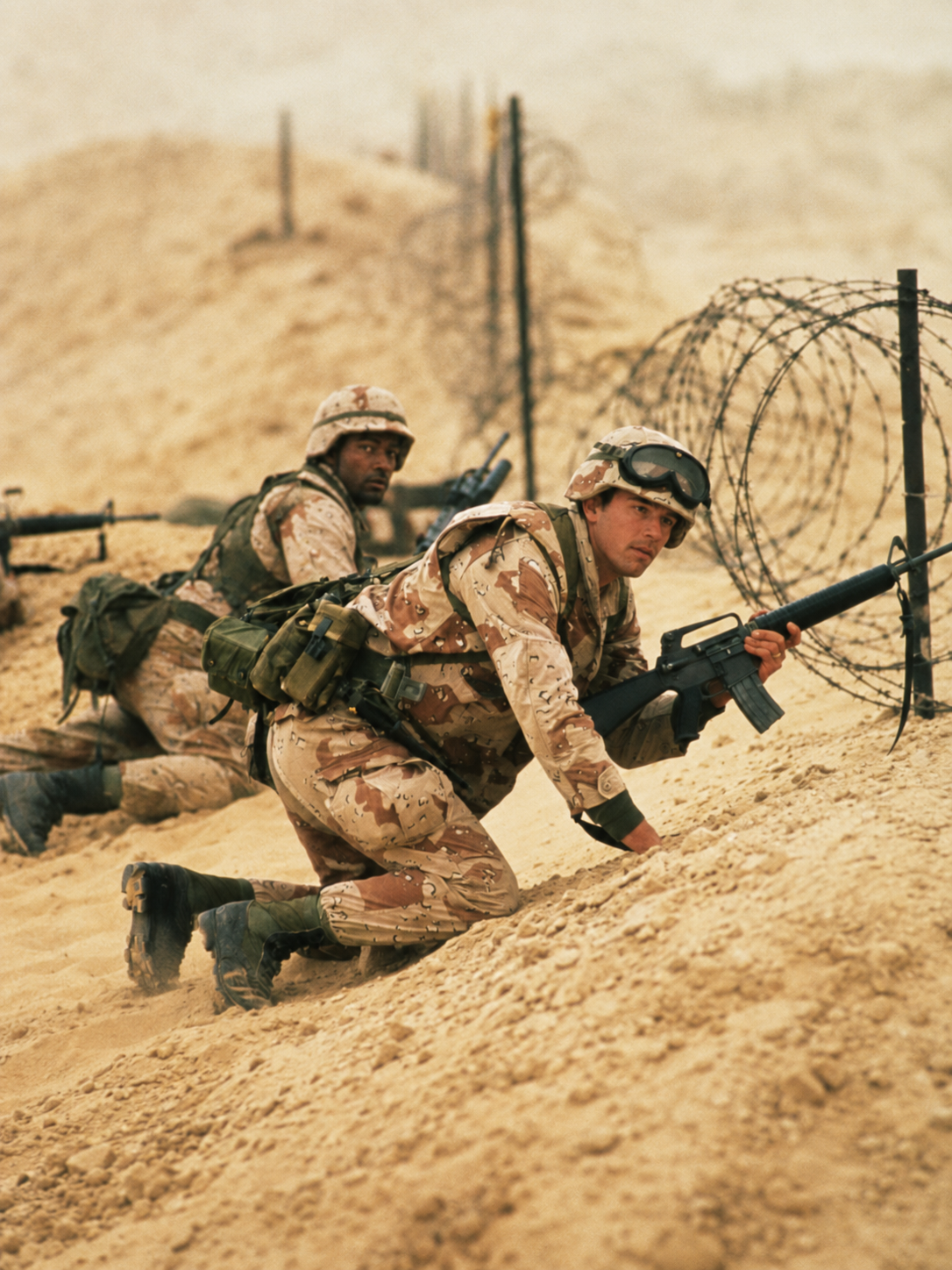
In August 1990, Iraq invaded Kuwait, and the United States began the largest deployment of American forces since Vietnam — roughly 700,000 service members flowed into the desert for Operation Desert Shield. The air campaign opened on January 17, 1991; the ground war began February 24 and was declared over about 100 hours later. On paper, it was fast and decisive.
That framing hides what many who were there actually lived through. Iraqi Scud missiles fell on rear areas that were supposed to be safe — one strike on a barracks in Dhahran killed 28 U.S. soldiers, the single deadliest attack on American forces of the war, with a Pennsylvania Army Reserve water-purification unit, the 14th Quartermaster Detachment, hit hardest. Troops trained and slept in chemical-protective MOPP gear as alarms sounded, never certain whether the next warning was the real one. Advancing units passed the incinerated wreckage of the “Highway of Death,” moved through minefields and unexploded ordnance, and worked under skies blackened by hundreds of burning oil wells. For thousands, the war did not end cleanly — it followed them home as chronic, unexplained illness.
If your claim for that service has already been turned down, our page on denied VA claims explains what a decision letter is actually telling you, and how the evaluation process works here, from first call to finished opinion.
Clinical relevance
The trauma signature of the Gulf War
The stressors of this war have a particular shape, and a nexus letter should name them specifically rather than dissolve them into generic “combat exposure.”
The Scud threat
Ballistic missiles struck rear areas presumed safe. The Dhahran barracks strike showed that no location was truly out of range — a diffuse, unpredictable threat with no front line to face.
The chemical fear
Living and fighting in MOPP gear under repeated alarms produces a specific dread: the belief you may already have been exposed to something you cannot see, smell, or undo.
The aftermath, not the firefight
For many, the defining trauma was what they drove past — the Highway of Death, charred vehicles, human remains — rather than a sustained gunfight. Witnessed aftermath is a recognized stressor.
The poisoned sky
Oil-well fires turned day to night for weeks. Working under that pall, alongside burn-pit and depleted-uranium concerns, ties the psychological and the physical together.
Witnessing counts
You don't have to have been shot at — or shot anyone
This is the single most common misunderstanding among Gulf War veterans, and it stops valid claims from ever being filed. PTSD does not require that you fired a weapon or that a weapon was fired at you. What matters is the nature of the exposure — and witnessing is one of the recognized forms.
The Highway of Death
Many veterans whose trauma traces to this war never traded fire at all
They drove the length of the Highway of Death — the road out of Kuwait — and saw what a retreating army looks like after an air campaign: charred vehicles for miles, human remains, the aftermath of overwhelming force. Others recovered the dead, cleared minefields and unexploded ordnance, or worked beneath skies black with burning oil.
Being there for that is a qualifying kind of trauma. The clinical criteria for PTSD expressly include witnessing traumatic events and confronting their aftermath — not only being personally attacked.
The same is true of the fear of Scud attacks. Living under sirens night after night, sleeping in MOPP chemical gear, never sure whether the next alarm was the real one — that sustained fear is itself a stressor the VA recognizes. Under the VA's rules, a stressor based on fear of hostile military or terrorist activity (38 CFR 3.304(f)(3)) can support a PTSD claim, and the Scud and chemical-alert environment fits that standard closely. If you've ever wondered whether “just” being afraid of the missiles counts — it can.
Whether you served in a transport unit, an airborne or ground-combat element, a quartermaster detachment, or a support role behind the line, the question is the same: what did you experience, and how has it affected you since? A PTSD nexus letter is what documents that connection for the VA. If your service included jump operations, see our page on PTSD in airborne veterans.
Talk it through
Not sure whether your experience counts? Ask.
A free, confidential phone consultation is the simplest way to find out whether a nexus letter fits your Gulf War claim. Dr. Allen will tell you honestly either way — there's no obligation.
Two claims, not one
Gulf War veterans have pathways others don't
The Gulf War is unusual because its veterans often have two intersecting routes to service connection. The first is PTSD from the stressors above. The second is the cluster of chronic, medically unexplained symptoms — fatigue, pain, cognitive and sleep problems — recognized as Gulf War Illness / chronic multisymptom illness, and the presumptive conditions expanded under the PACT Act.
These pathways interact. Chronic pain, disrupted sleep, and cognitive complaints can worsen — and be worsened by — depression, anxiety, and PTSD. A strong evaluation keeps the mental-health claim distinct while acknowledging how it overlaps with these presumptive conditions, rather than pretending PTSD is the only door.
Two overlaps come up constantly for this era: disrupted breathing and sleep, addressed on our sleep apnea nexus letter page, and the relationship between chronic pain and mental health. If the combined effect keeps you from holding steady work, see TDIU nexus letters.
Why it's not too late
Never diagnosed? That does not end the claim.
Many veterans of this era were never evaluated for PTSD during service, and never mentioned it for years afterward. That is the norm, not a red flag. The DSM-5 formally recognizes PTSD with delayed expression, where the full diagnostic picture isn't met until at least six months after the event — and in practice, symptoms often surface or intensify decades later, triggered by retirement, the loss of military structure, aging, illness, an anniversary, or a later loss.
The absence of a contemporaneous record does not defeat a claim. A current evaluation can establish the diagnosis now, and a nexus letter can explain the recognized pattern of delayed presentation and connect today's symptoms back to your service then.
If you are already service connected but the condition has worsened over the decades since, that is a different filing — see PTSD rating increase nexus letters.
The standard of proof
A stressor alone is not enough
Confirming that a Scud alert, a chemical warning, or the Highway of Death happened is only part of a claim. To be service-connected, your current symptoms must also meet the full clinical criteria for PTSD and be, in the VA's language, at least as likely as not connected to your service. Tying that complete clinical picture to a Southwest Asia deployment is what a nexus letter is built to do.
A citation to the literature is not, on its own, an opinion about you. That distinction is why medical literature alone is not enough to carry a claim, and why the letter has to apply the evidence to your specific record.
And if you were denied because the exam found no PTSD diagnosis — often calling it depression instead — that can be answered. Here's what to do when a C&P examiner says depression, not PTSD.
Where the examiner's reasoning is the problem rather than the evidence, a rebuttal letter answers that opinion point by point. And if the trauma you are describing is military sexual trauma, see our PTSD and MST page.
The Gulf War fits the “fear of hostile activity” standard especially well
Many who served were in rear areas the classic “engaged in combat with the enemy” route may not reach — but under 38 CFR 3.304(f)(3), a stressor based on fear of hostile military or terrorist activity, such as the Scud threat or the constant chemical-alert environment, may be established by your own testimony when it is consistent with the circumstances of your service.
Evidence that helps
- The Southwest Asia Service Medal on your DD-214
- Unit and duty-station records placing you in the threat area
- Alert logs and MOPP-level records from your unit
- Buddy statements from those who served alongside you
About the evaluator
An evaluation from a physician who understands this history
Jessica R. Allen, M.D.
Dr. Jessica Allen is a licensed psychiatrist and former VA Compensation & Pension examiner. She writes independent medical opinions for veterans in all 50 states, by video, from home. She reviews the full record — service treatment and personnel records, deployment history, lay statements, prior decisions, and C&P exams — and writes the opinion herself.
Common questions
Gulf War PTSD questions
Schedule a free phone consultation
Jessica Allen, M.D. — licensed psychiatrist and former VA C&P examiner. Independent medical opinions and nexus letters for veterans in all 50 states.
Related reading
- PTSD and MST nexus letters
- PTSD in airborne and paratrooper veterans
- PTSD rating increase nexus letters
- The C&P examiner said depression, not PTSD — what now?
- Rebuttal letters for denied claims
Educational information only. This page does not constitute medical advice, legal advice, or a treatment relationship. Brightview Psychiatry Solutions PLLC provides independent medical opinions; it does not represent veterans before the VA and cannot predict or guarantee the outcome of any claim. All service connection and rating decisions are made solely by the Department of Veterans Affairs.