
By event · 23 October 1983
PTSD nexus letters for Beirut barracks bombing veterans
If you survived the bombing of the Marine barracks in Beirut and are seeking service connection for PTSD, the nexus letter—the independent medical opinion linking your diagnosis to that morning—is often the most consequential document in the file.
Jessica R. Allen, M.D. · Licensed psychiatrist and former VA C&P examiner · Psychiatric IMEs and nexus letters, all 50 states
The record
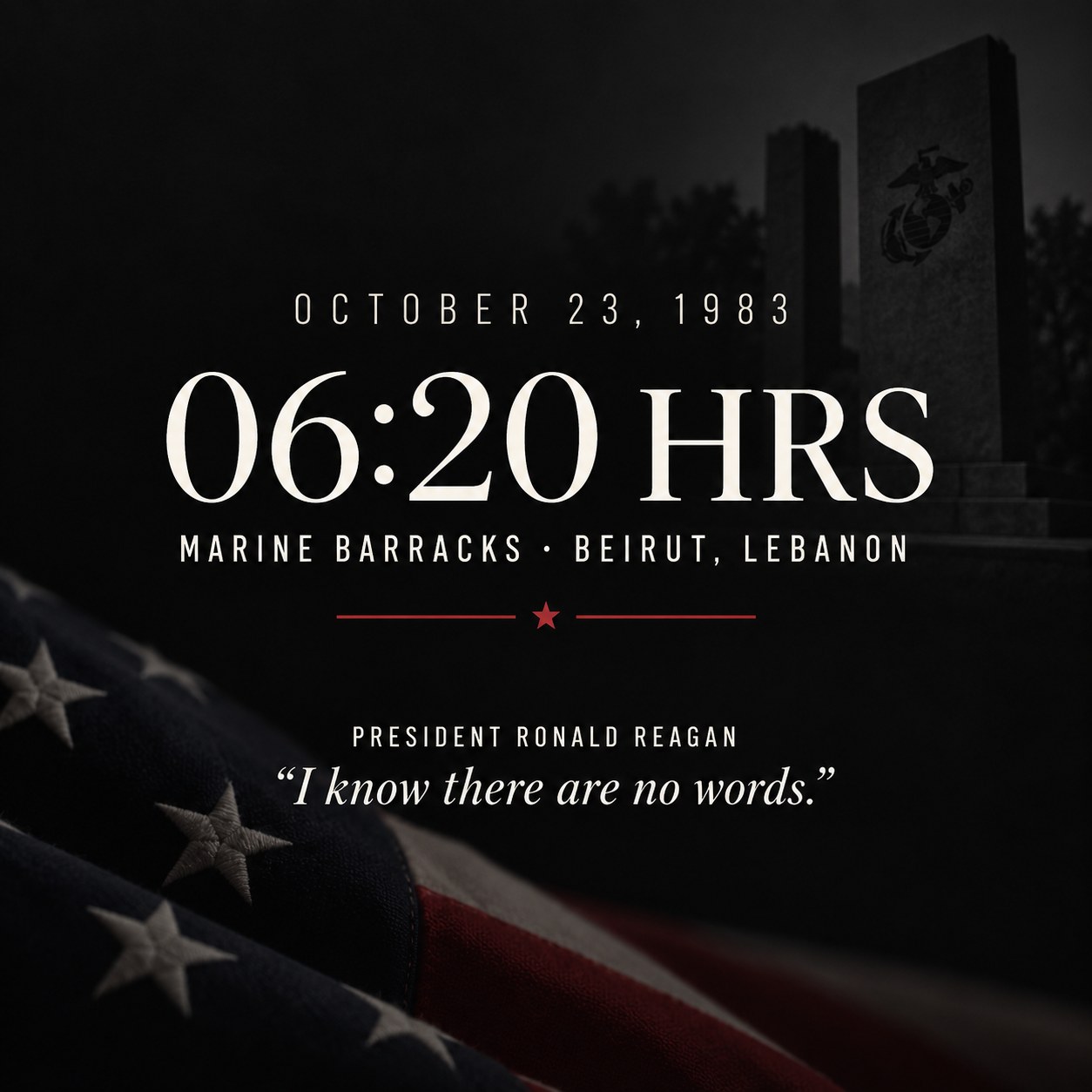
What happened on 23 October 1983
It was a Sunday, just after dawn. Most of the men of Battalion Landing Team 1/8, deployed with the 24th Marine Amphibious Unit as peacekeepers with the Multinational Force in Lebanon, were still asleep in the four-story barracks at Beirut International Airport. At 6:22 a.m., a truck carrying explosives drove through the perimeter and detonated. The blast lifted the building off its foundation and collapsed it into rubble.
Two hundred forty-one American service members were killed—220 Marines, 18 sailors, and 3 soldiers. More than 100 others were wounded. For the men who lived, the hours and days that followed were spent digging through concrete by hand, listening for the trapped, and carrying out friends they had eaten beside the day before.
Why this matters to a claim
Beirut is one of the most thoroughly documented events in modern Marine Corps history. For a veteran who was there, the stressor itself is rarely the weak link—the weak link is usually the medical opinion connecting a present-day diagnosis to that morning.
Clinical relevance
The trauma signature of the barracks bombing
The trauma of Beirut is not the trauma of a long firefight or a year of patrols. It is the trauma of a single, total, instantaneous catastrophe. Dr. Allen writes that profile precisely rather than folding it into generic “combat stress.”
Catastrophic suddenness
No firefight, no buildup—asleep one second, buried the next. Trauma that arrives without warning can produce a durable startle response and a settled conviction that safety is an illusion.
A whole community lost at once
Most veterans lose friends one at a time, with space between each loss. Here, scores of brothers were gone in an instant. Grief without a sequence may never be processed as grief at all.
Recovery done by hand
Survivors spent days in the rubble pulling out the dead and dying. Handling remains and participating in rescue and recovery are traumatic exposures in their own right, apart from the blast.
Survivor guilt and the peacekeeping paradox
Those posted elsewhere that night, or who walked out with minor wounds, may carry decades of guilt. A peacekeeping mission adds another layer: being exposed without being permitted to defend.
The standard
What the VA requires to service-connect PTSD
Under 38 C.F.R. § 3.304(f), service connection for PTSD generally requires three things. A nexus letter speaks primarily to the third.
- 1
A current diagnosis that meets the criteria
A PTSD diagnosis consistent with the criteria the VA applies, made by a qualified clinician. Anxiety or insomnia alone will not carry a PTSD claim, though either may support another mental health claim.
- 2
Credible evidence that the stressor occurred
For Beirut survivors, this is usually straightforward. Unit assignment to BLT 1/8 or the 24th MAU during the deployment, reflected in a DD-214, personnel file, or unit records, generally establishes presence at a well-documented event.
- 3
A medical link between the stressor and the diagnosis
This is the nexus. It must be stated to the correct standard—that the current condition is at least as likely as not related to the in-service stressor—and supported by reasoning a rater can follow.
Service connection and rating are separate decisions
A nexus letter addresses whether the condition is connected to service. The VA separately assigns a percentage under 38 C.F.R. § 4.130 based on occupational and social impairment.
Records gaps
When symptoms surfaced decades later
Many Beirut survivors were never evaluated for PTSD in 1983. The diagnosis did not carry the recognition it does now, the culture of the Corps did not invite it, and most men went back to work. Four decades later, a service treatment record that says nothing about psychiatric symptoms is a common obstacle.
That silence is not fatal. The trauma occurred in service; what may be delayed is its expression. Delayed presentation is recognized in the clinical literature, and retirement, bereavement, medical illness, or an anniversary can bring forward symptoms suppressed for years.
- Lay and buddy statements from family, spouses, and fellow Marines can establish continuity where the medical record is silent.
- Employment history—job changes, conflicts with supervisors, or periods of unemployment—can document impairment the clinical record never captured.
- Post-service treatment for alcohol use, sleep disturbance, or depression may be the first documented trace of an untreated trauma response.
- A physician can explain delayed presentation directly, so the rater is not left to draw an adverse inference from the gap.
Who writes your opinion
A psychiatrist who has sat on the other side of the table
Jessica R. Allen, M.D.
Psychiatrist · Former VA C&P examiner
Dr. Allen spent three years performing Compensation and Pension examinations for the VA. She has written the examination reports raters rely on and knows what makes one persuasive—and what makes one easy to set aside.
Every opinion is written by Dr. Allen personally after review of the service records, treatment history, and lay evidence. She is a physician, which matters when a claim involves medication history, co-occurring medical conditions, or a differential diagnosis that must be reasoned through.
She will also tell a veteran when the evidence does not support an opinion. An honest assessment given early is worth more than a letter that cannot withstand review. More about Dr. Allen
Quality control
What makes a nexus letter weak
- A one-line conclusion with no medical reasoning behind it.
- The wrong standard of proof—“possible” or “could be” instead of “at least as likely as not.”
- No review of the service and medical records.
- No citation to peer-reviewed medical literature.
- Written by someone outside the relevant specialty.
- Built on an inaccurate version of the veteran's history.
- Ignoring the alternative explanations a rater will raise.
- Boilerplate language visibly copied between veterans.
- A promise of an outcome no clinician can make.
If you already have a letter and are unsure whether it will hold up, Dr. Allen offers a standalone nexus letter review.
Common questions
Questions Beirut veterans ask
References
Sources
- 38 C.F.R. § 3.304(f)—Service connection for post-traumatic stress disorder.
- 38 C.F.R. § 4.130—Schedule of Ratings, Mental Disorders.
- Andrews B, Brewin CR, Philpott R, Stewart L. Delayed-onset posttraumatic stress disorder: a systematic review. American Journal of Psychiatry. 2007;164(9):1319–1326.
- Solomon Z, Mikulincer M. Trajectories of PTSD: a 20-year longitudinal study. American Journal of Psychiatry. 2006;163(4):659–666.
- American Psychiatric Association. Diagnostic and Statistical Manual of Mental Disorders, Fifth Edition, Text Revision. 2022.
Related
Other conflicts and events covered in depth
This page is educational and general in nature. It is not medical or legal advice, does not create a physician–patient relationship, and does not guarantee a VA claim outcome. Brightview provides independent medical opinions; it does not represent veterans before the VA. The VA makes all service-connection and rating decisions.
Related conflicts & events
PTSD nexus letters by conflict
Vietnam War (1965–1973)
Sustained combat and ambushes; trauma often surfacing decades later.
Beirut, Lebanon (1983)
Peacekeeping under fire and the Marine barracks bombing; survivor guilt.
Read moreGrenada — Urgent Fury (1983)
A chaotic, hastily-planned invasion; firefights and helicopter losses.
Panama — Just Cause (1989)
Night airborne assault, urban combat, and a forgotten fight.
Read moreGulf War — Desert Storm (1990–91)
The Scud threat, the chemical-alert environment, the 100-hour ground war.
Read moreBattle of Mogadishu (1993)
Operation Gothic Serpent — sustained urban combat, recovering the fallen.
Read moreBosnia & Kosovo (1995–99)
Peacekeeping trauma: mass graves, mines, restraint under threat.
Read moreUSS Cole (2000)
Shipboard blast, fire, flooding, and entrapment with no way to evacuate.
Afghanistan — OEF (2001–2021)
Mountain firefights, IEDs, insider attacks, cumulative deployments.
Iraq — OIF / New Dawn (2003–2011)
IEDs, urban clearing, an enemy without a uniform; PTSD and TBI overlap.
Read moreInherent Resolve (2014–present)
Anti-ISIS: advise-and-assist, base rocket attacks, and Mosul.