
Brightview Psychiatry Solutions
PTSD Nexus Letters for Iraq War Veterans
If you served in Operation Iraqi Freedom and are seeking service connection for PTSD, your nexus letter — the independent medical opinion linking your diagnosis to that deployment — may be the document your claim turns on. This page explains what that letter does, why the particular conditions of the Iraq War matter, and why the most common assumption about who “saw combat” leaves so many valid claims unfiled.
Jessica R. Allen, M.D. · Licensed psychiatrist and former VA C&P examiner · Psychiatric IMEs and nexus letters, all 50 states
Quick answer
Can I get a PTSD nexus letter for Iraq if I had a support job and was never in direct combat?
Yes. In Iraq there was no rear area — IEDs struck convoys, mortars and rockets fell on bases, and support troops faced the same threat environment as combat units. Under the VA's “fear of hostile military or terrorist activity” standard (38 CFR 3.304(f)(3)), a PTSD stressor can be established by your own testimony when it is consistent with the circumstances of your service — no Purple Heart or documented firefight required. A nexus letter from a qualified physician links your PTSD diagnosis to that deployment in the language the VA uses.
The record
A war with no front line
In March 2003, twelve years after the Gulf War, U.S. and coalition forces invaded Iraq again. Major combat was declared over within weeks — but the war that followed lasted nearly nine years, until the last American troops left in December 2011. More than a million U.S. service members deployed, many of them two, three, or four times.
What defined that war was not a line on a map. There was no massed enemy army to face across open ground. The threat was everywhere and nowhere: improvised explosive devices buried in roads and rubble, suicide car bombs, mortars and rockets falling on bases, snipers, and ambushes in crowded streets. The IED became the signature weapon of the war and the leading cause of American casualties — and it did not care what your job was.
If your claim for that service has already been turned down, our page on denied VA claims explains what a decision letter is actually telling you, and how the evaluation process works here, from first call to finished opinion.
No safe ground
In Iraq, there was no rear area — and that matters for your claim
This is the single most important thing an Iraq veteran should understand about a PTSD claim, and it's where many valid claims quietly die: you did not have to be an infantryman kicking in doors to have been exposed to trauma. In Iraq, the front line was everywhere.
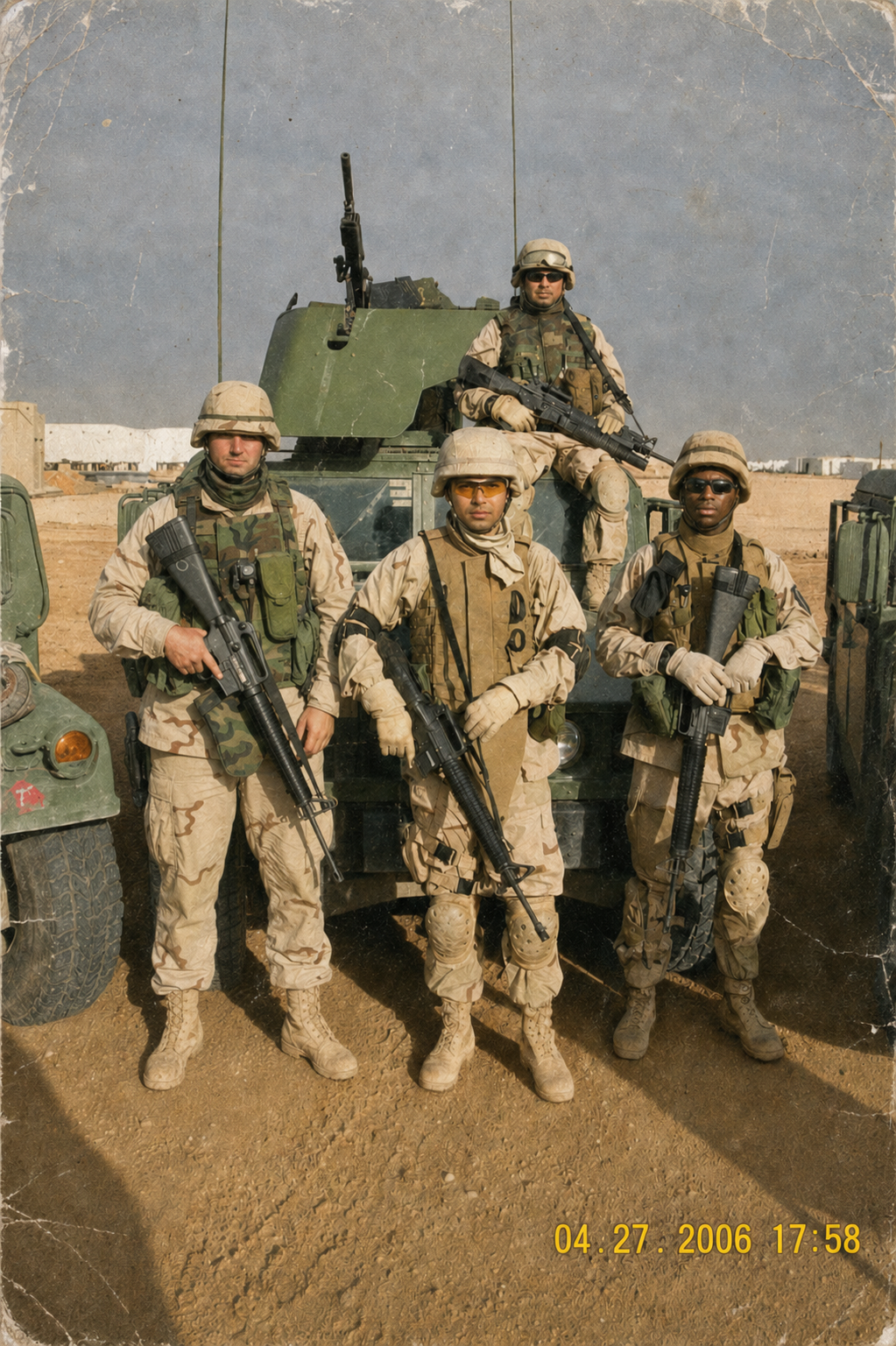
Truck drivers and convoy escorts were among the most frequent targets of IEDs. Cooks, mechanics, fuelers, and clerks lived on bases that took mortar and rocket fire without warning. Medics and mortuary-affairs soldiers handled the aftermath. Military police ran checkpoints where any approaching car could be a bomb. Gate guards, interpreters, and civil-affairs teams operated among a population in which the enemy was indistinguishable from civilians. A support job was not a safe job.
The VA's own rules recognize this. Under 38 CFR 3.304(f)(3), a PTSD stressor based on fear of hostile military or terrorist activity — the constant threat of IEDs, incoming mortars, or ambush — can be established by your own testimony when it is consistent with the circumstances of your service. You do not need a Purple Heart or a documented firefight. You need a deployment to the threat environment and a diagnosis connected to it.
Whether you served in an infantry line company, a transport unit, an airborne element, or a support role on a forward operating base, the question is the same: what did you experience, and how has it affected you since? Witnessing counts, too — seeing a vehicle struck, an aircraft go down, or casualties recovered can be the qualifying stressor even if you were never the one under fire. A PTSD nexus letter is what documents that connection for the VA.
Clinical relevance
The trauma signature of the Iraq War
The stressors of this war have a particular shape, and a nexus letter should name them specifically rather than dissolve them into generic “combat exposure.”
The roadside bomb
IEDs made every road a potential kill zone. The hypervigilance that follows — scanning shoulders, trash, and overpasses — often persists for years after coming home.
The base under fire
Mortars and rockets fell on forward operating bases without warning, day or night. The randomness — that death could arrive while you slept or ate — is its own form of sustained stress.
The faceless enemy
Suicide bombers, ambushes, and an enemy who blended into the civilian population meant no one could ever fully stand down. Threat came from anyone, anywhere.
Tour after tour
Many served multiple deployments, returning to the same danger again and again — trauma from one tour compounding into the next, with little time to recover in between.
Cumulative exposure
Multiple deployments, cumulative trauma
Iraq veterans frequently deployed more than once — two, three, or four tours was common. That creates a pattern the VA does not always account for: trauma that accumulates. An examiner may ask “which deployment caused it,” as though the answer must be a single event on a single date. Often it isn't. Repeated exposure — each tour adding to the last, with brief and uneasy periods at home in between — can itself produce or worsen PTSD. A strong evaluation looks at the whole deployment history, not one incident in isolation.
The toll wasn't only psychological, either. Blast injuries, and the back, knee, and shoulder damage of carrying heavy loads over multiple tours, left many Iraq veterans with chronic pain — which can, in turn, drive depression secondary to chronic pain that may itself be service-connected. If the combined effect keeps you from holding steady work, see TDIU nexus letters.
Talk it through
Not sure whether your experience counts? Ask.
A free, confidential phone consultation is the simplest way to find out whether a nexus letter fits your Iraq claim. Dr. Allen will tell you honestly either way — there's no obligation.
Why it's not too late
Never diagnosed? That does not end the claim.
Many veterans of this era were never evaluated for PTSD during service. Some pushed through to stay with their unit, feared the stigma or the effect on a career, or simply did not recognize the symptoms until they were home and the structure of the military was gone. That is common, not a red flag.
The DSM-5 recognizes PTSD with delayed expression, and symptoms often surface or intensify months or years later. A current evaluation can establish the diagnosis now, and a nexus letter can explain the recognized pattern of delayed onset and connect today's symptoms back to your service then.
The standard of proof
A stressor alone is not enough
Confirming that IEDs, mortar attacks, or ambushes happened is only part of a claim. To be service-connected, your current symptoms must also meet the full clinical criteria for PTSD and be, in the VA's language, at least as likely as not connected to your service. Tying that complete clinical picture to an OIF deployment is what a nexus letter is built to do. A citation to the literature is not, on its own, an opinion about you — which is why medical literature alone is not enough to carry a claim.
And if you were denied because the exam found no PTSD diagnosis — often calling it depression instead — that can be answered. Here's what to do when a C&P examiner says depression, not PTSD. Where the examiner's reasoning is the problem rather than the evidence, a rebuttal letter answers that opinion point by point. And if you are already service-connected for PTSD but rated lower than your symptoms warrant, a current evaluation can support a PTSD rating increase.
The Iraq War fits the “fear of hostile activity” standard especially well
Under 38 CFR 3.304(f)(3), a stressor based on fear of hostile military or terrorist activity — IEDs, indirect fire, or ambush — may be established by your own testimony when it is consistent with the circumstances of your service.
Evidence that helps
- The Iraq Campaign Medal on your DD-214
- Unit and deployment records placing you in country
- Convoy or guard-duty assignments
- Incident and casualty-evacuation logs, and buddy statements
Why the evaluator matters
An opinion from someone who sat on the VA's side of the table
Jessica R. Allen, M.D.
Dr. Jessica Allen is a licensed psychiatrist and a former VA Compensation & Pension examiner. Before she wrote nexus letters for veterans, she wrote the very kind of opinion the VA weighs claims against — so she knows, from the inside, what a rating official actually reads, what makes one opinion more persuasive than another, and the exact standard a PTSD claim has to meet.
In her work with Iraq veterans, Dr. Allen has found that the hardest part is often getting the story out at all. Many have carried what they saw for years without speaking about it — the nature of what they witnessed, whether a convoy strike, casualties, or the aftermath of a blast, can make it almost impossible to put into words to a stranger, let alone to a government examiner in a brief appointment. A guarded, incomplete history is one of the most common reasons a valid claim looks weak on paper.
There is a second, less-recognized reason the history can be hard to assemble. Because IEDs were the signature weapon of the war, many Iraq veterans also carry concussions or traumatic brain injury from blast exposure — which can affect memory and make recalling specific dates, sequences, and details genuinely difficult. An examiner who treats those gaps as inconsistency, rather than as a recognized consequence of blast exposure, can wrongly undercut a claim.
This is why the evaluator matters. Dr. Allen takes the time to draw out a guarded history with patience, recognizes how trauma and blast exposure shape the way it is told, and documents it in the language the VA actually uses. She reviews the full record herself — service treatment and personnel records, deployment history, lay statements, prior decisions, and C&P exams — and writes every opinion personally, for veterans in all 50 states.
Common questions
Iraq War PTSD questions
Schedule a free phone consultation
Jessica Allen, M.D. — licensed psychiatrist and former VA C&P examiner. Independent medical opinions and nexus letters for veterans in all 50 states.
Related reading
- PTSD and MST nexus letters
- PTSD nexus letters for Gulf War veterans
- PTSD in airborne and paratrooper veterans
- Traumatic brain injury (TBI) nexus letters
- PTSD rating increase nexus letters
- Rebuttal letters for denied claims
This document is educational and general in nature and is not medical or legal advice. An evaluation is a one-time consultation examination and does not create a physician–patient relationship, and no VA outcome is guaranteed. For questions about appeals, deadlines, or claim strategy, consult a VA-accredited attorney, claims agent, or VSO.