
PTSD nexus letters for aircraft rescue and mishap response
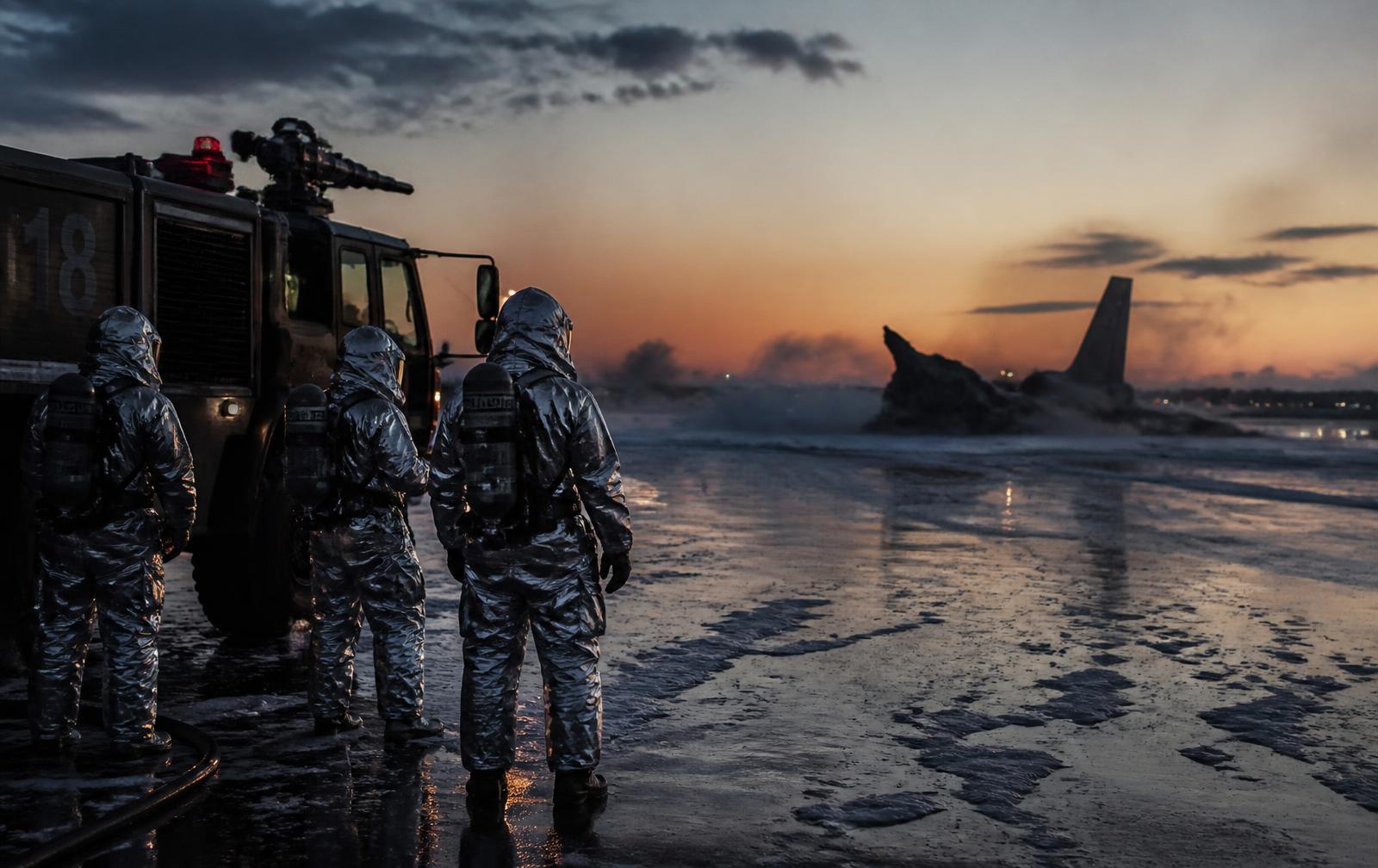
You were trained to pull people out. Most of the time there was no one to pull out — and the shift did not end when the site was cleared. Crash crews, flight deck salvage, rescue swimmers, pararescue, aeromedical crews, and the maintainers and squadron members who watched it happen.
Quick answer
Can responding to an aircraft crash support a PTSD claim?
Yes. Neither a combat deployment nor a physical injury is required. Responding to an aircraft mishap involves direct exposure to death and its aftermath, and the DSM-5 expressly recognizes repeated or extreme exposure to the aversive details of traumatic events as a qualifying route into the diagnosis, naming first responders who recover human remains as its example.
This applies to more people than the crash truck crew. Flight deck salvage teams, rescue swimmers, pararescue, aeromedical crews, mishap recovery and mortuary personnel, and the maintainers and squadron members who were on the ramp when it happened were all exposed. What the claim requires is documentation of the mishap and a clinical opinion connecting it to your symptoms now.
For how Dr. Allen approaches PTSD opinions generally, combat and non-combat, see PTSD nexus letters. Aircraft mishaps generate an unusually complete paper trail — safety investigation boards, accident investigation boards, unit histories, and press releases. That is an advantage most stressor claims do not have, and it is covered further down.
Who responds
A mishap pulls in far more people than the crash crew
Claims are often filed by only one category of responder because the others assume the exposure “belongs” to someone else. It does not.
Crash rescue and ARFF
USAF 3E7X1 · USMC 7051 · Army 12M
First on scene, trained to enter and search regardless of what the site looks like on arrival.
Flight deck crash and salvage
Navy ABH · Aviation Boatswain's Mate
Responding to a mishap on a moving deck, with ordnance, fuel, and turning aircraft still on it, and the ship's operations continuing around the site.
Search and rescue
Navy rescue swimmer · USCG AST
Water recovery, often at night and in weather, where the outcome is determined long before the swimmer reaches the survivor or does not.
Pararescue and personnel recovery
USAF PJ · CRO · SERE
Recovery of downed aircrew under operational conditions, frequently with a medical role added to the retrieval.
Mishap recovery and mortuary
Recovery teams · Mortuary affairs
Site clearance, wreckage recovery, and the handling and identification of remains — often over days, and often the last people at the site.
Aircrew, maintainers, squadron
Witnesses · Not on the response crew
The people who watched it from the ramp, the tower, or the flight line, and who knew the crew by name.
Crash rescue is covered in more depth on our military firefighters page.
The core of it
Trained to rescue, sent to recover
This is the specific injury of aircraft mishap response, and it is the part most often left out of a claim because it is hard to put into words.
Every element of the training is built around saving the crew: response times measured in seconds, the sequence for opening a canopy, the number of minutes a person can survive inside a fire. The whole discipline is organized around arriving in time. In the reality of most aircraft mishaps, the outcome is settled on impact, and the crew that arrives in ninety seconds is performing a recovery rather than a rescue.
The work still gets done correctly, which is part of what makes it durable. People go in, search, clear, and document, knowing what they will find. Afterward there is often no framework for what to do with that. The mission was accomplished. Nobody was saved.
Clinically this presentation is easy to miss. An examiner listening for panic and startle may not hear trauma in a calm, procedural account of a recovery. Much of the symptom picture in this population lives in the diagnostic criteria covering negative alterations in mood and cognition — persistent guilt, a sense of futility about the work, emotional numbing, and detachment — rather than in dramatic hyperarousal. The evaluation has to look for it there.
Clinical relevance
What makes an aircraft mishap different from other trauma exposure
You knew the crew
On a flight line or a boat, the aircrew are people whose names are on the schedule and whose families you have met. That removes the professional distance responders elsewhere are trained to keep, and it is closely tied to survivor guilt.
The site is catalogued, not just cleared
Aircraft mishap sites are worked slowly and deliberately for the investigation. Responders spend prolonged time in close contact with the aftermath rather than turning it over and leaving.
The investigation is a second exposure
Safety and accident boards require walking the site again, describing what you saw, and often reviewing imagery. Necessary for flight safety, and a structured re-exposure occurring before anyone has processed the first one.
You go back to the same runway
Unlike a deployment stressor you eventually leave behind, the flight line is the workplace. The next shift is spent at the site, watching the same aircraft type get airborne.
Witnesses
You do not have to have touched the wreckage
Witnessing a traumatic event in person is a recognized form of exposure, and so is learning of the violent or accidental death of a close friend. That much is covered in detail in our article on PTSD after witnessing a helicopter crash, which also includes a reference table of major military helicopter mishaps if you are trying to locate the incident you were present for. What follows is the part specific to serving in an aviation unit.
The maintainer's version is its own problem. A crew chief or maintainer who released that aircraft carries something a bystander does not: the question of whether the mishap traced back to work he signed for. Whether or not the investigation ever pointed his way, the self-directed version of that question is persistent, and it maps onto the diagnostic criteria for distorted blame and persistent negative beliefs about oneself. It is rarely volunteered in an examination, and almost never appears in the record unless someone asks.
Tower, radio, and operations personnel occupy a related position — hearing it happen in real time, running the response from a console, and in many cases being the last person the crew spoke to. Squadron members who knew the crew are covered under the close-friend route, and often go on to escort duty, notification, or the memorial. Each of these is a qualifying exposure, and each is routinely left out of the claim on the assumption that it belongs to whoever went into the wreckage. Our article on PTSD from witnessing a traumatic event in service works through that route in general terms.
Not sure your role counts?
That is one of the most common reasons a valid claim never gets filed. A free phone call will tell you either way — no obligation.
Proving the stressor
Aircraft mishaps leave a paper trail most stressors do not
This is a real advantage in these claims. A firefight or a convoy strike may exist only in memory and a unit history. An aircraft mishap generates a formal, dated, investigated record because flight safety requires one.
- Safety Investigation Board and Accident Investigation Board records, and the resulting reports
- Aviation mishap classification records and unit safety files
- Command histories, unit newsletters, and base or ship newspapers covering the event
- Contemporaneous press coverage, which fixes the date, aircraft, and unit even when your records do not
- Your duty and assignment records placing you with that unit on that date
- Flight or maintenance logs, watch bills, and crash-response run sheets
- Buddy statements from those who responded, watched, or worked the site with you
You do not need to have the investigation report itself. What matters is establishing that the mishap occurred, that you were there, and in what capacity — and public and unit-level records frequently do that on their own. A personal statement supplies what only you can: where you were, what you did, and what you saw.
If you were denied
Two denials that come up repeatedly
“The stressor is not corroborated.” For an aircraft mishap this is often answerable, because the event itself is documented somewhere even if your presence at it is not. The task is connecting you to a mishap that demonstrably happened, which duty records and buddy statements usually accomplish. Our page on denied VA claims covers what a decision letter is telling you, and a rebuttal letter answers an unfavorable opinion point by point.
“Your PTSD is from your post-service career.” Many crash crews and rescue personnel went into civilian firefighting, EMS, or aviation after service, and rating decisions frequently credit the later career instead. That denial has a specific structure and a specific answer, worked through in detail in what to do when the VA blames your civilian career — the short version is that service connection has never required in-service trauma to be the sole or largest cause.
One more thing worth raising. A mishap is often not the only in-service stressor in a file, and it can be the one that gets claimed because it is the easiest to document. Where other trauma occurred during the same service — including military sexual trauma, which has its own evidentiary framework under 38 C.F.R. § 3.304(f)(5) and its own reasons for going unreported — a complete evaluation should identify it rather than stop at the stressor that already has a paper trail. Nothing has to be raised before you are ready to raise it.
And if a prior exam concluded depression rather than PTSD, see what to do about that. For deadlines and lane selection, work with a VA-accredited attorney, claims agent, or VSO; the medical opinion is the part Dr. Allen writes, and it is often the piece the file is missing.
Related conditions
What else tends to travel with this history
Several of these can be claimed secondary to a service-connected psychiatric condition under 38 C.F.R. § 3.310, on either a causation or an aggravation theory.
Sleep. Disrupted sleep is close to universal here, and obstructive sleep apnea secondary to PTSD is among the most frequently claimed secondary conditions. Alert-status and flight-operations schedules compound it.
Hearing. Flight line and flight deck noise exposure is among the most severe in the military and commonly supports tinnitus and hearing loss claims, which can in turn support a secondary psychiatric claim.
Burns and scarring. Where a burn is service-connected, resulting scarring or disfigurement can support a psychiatric claim in its own right — see depression secondary to skin conditions and disfigurement.
Chronic pain. Deck and flight line work over a career produces back, knee, and shoulder injury, and depression caused by chronic musculoskeletal pain is a well-recognized secondary pathway running in both directions.
If the combined effect keeps you from holding steady work, see TDIU nexus letters. A fuller list is on the conditions secondary to PTSD page.
Why the evaluator matters
A procedural account of a recovery can read as no trauma at all
Jessica R. Allen, M.D.
Licensed psychiatrist · Former VA C&P examiner
People trained for mishap response describe it the way they were trained to report it: sequence, timings, actions taken. In a brief examination that flat delivery can be recorded as an absence of distress rather than as the composure the job required. The presentation most common in this population — guilt, numbing, detachment, a settled belief that the work was futile — sits in the diagnostic criteria an examiner scanning for startle and nightmares may not reach.
Dr. Allen spent three years as a VA Compensation & Pension examiner before she began writing opinions for veterans, so she knows how these histories get recorded and where the gaps open up. She takes the time to draw out an account that a rating official can actually weigh, and documents it in the language the VA uses.
She reviews the full record herself — service treatment and personnel records, deployment history, lay statements, prior decisions, and C&P exams — and writes every opinion personally, for veterans in all 50 states, by video, from home. More about Dr. Allen →
Educational information only. This article is provided for general educational purposes and does not constitute medical advice, legal advice, or a treatment relationship. Reading it does not establish a physician–patient relationship with Dr. Allen or Brightview Psychiatry Solutions PLLC. No outcome in any VA claim is promised or implied; the VA determines service connection and assigns all disability evaluations. Veterans should consult their own treating providers regarding medical care and an accredited representative, agent, or attorney regarding claims. If you are in crisis, the Veterans Crisis Line is available 24/7: dial 988 and press 1, or text 838255.
FAQ
Aircraft mishap response PTSD questions
I responded to a crash but was never injured. Can that be a qualifying stressor?
Most of our responses were recoveries, not rescues. Does that make the claim weaker?
I watched a crash from the flight line but wasn't on the response crew. Do I have a claim?
I was interviewed by the safety investigation board afterward. Is that relevant?
I don't remember the exact date or the aircraft's tail number. Is that a problem?
It happened decades ago and I never mentioned it. Is it too late?
Can a nexus letter guarantee my claim is approved?
Related reading
- PTSD nexus letters for military firefighters
- If the VA says your condition has improved
- PTSD nexus letters — combat and non-combat
- PTSD after witnessing a helicopter crash — includes a major-mishap reference table
- PTSD from witnessing a traumatic event in service
- Military sexual trauma nexus letters
- What is a nexus letter?
- Rebuttal letters for denied claims
- Conditions claimed secondary to PTSD
- PTSD rating increase nexus letters
- Understanding the PCL-5 in your PTSD claim
- All nexus letters
Get Started
Still not sure whether your role supports a claim?
One free, confidential phone call is usually enough to find out. Dr. Allen will tell you honestly either way — there's no obligation.