
Independent psychiatric evaluations · Proposed rating reductions
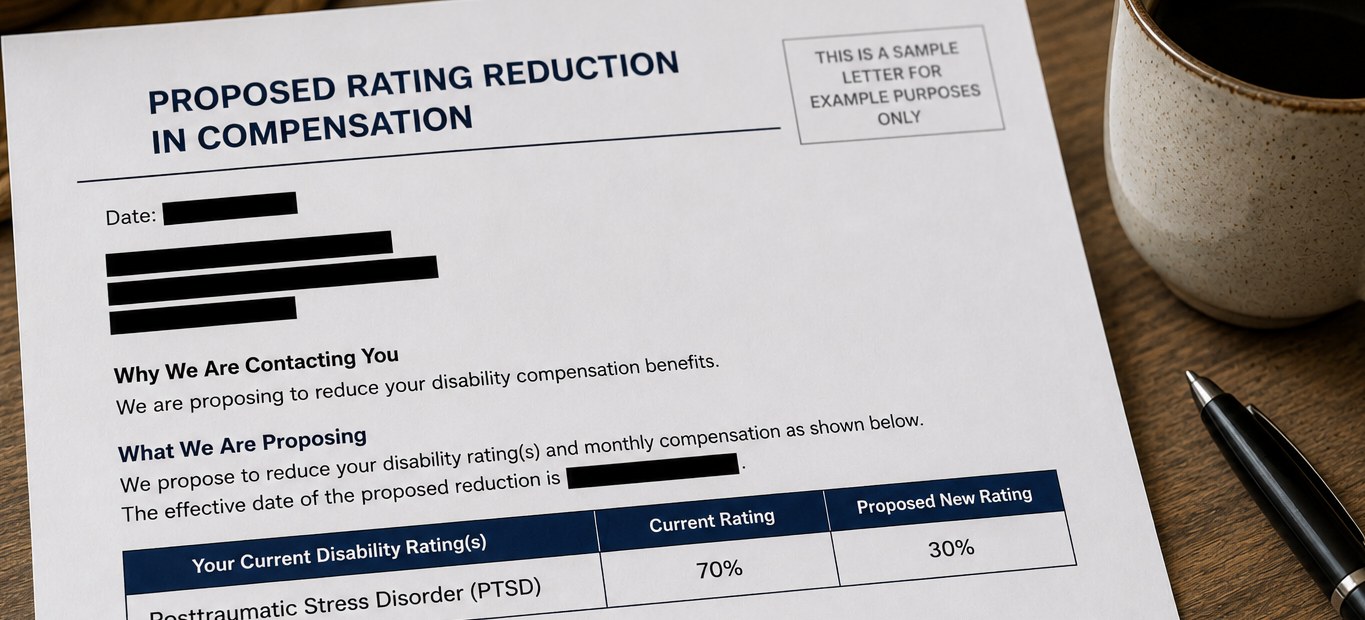
The VA proposed cutting your mental health rating. You may have only 60 days to respond with evidence.
The deadline is already running. A proposed reduction is not final, and the VA does not have to hear from only its own C&P examiner.
The VA says your PTSD, depression, or anxiety improved. Dr. Jessica Allen independently evaluates the medical evidence and, when the record supports it, provides a psychiatric opinion explaining why the proposed reduction is not supported by sustained improvement in your condition and your functioning.
What the notice gives you
- 60 days
- To submit evidence showing why your compensation should stay where it is.
- 30 days
- To request a predetermination hearing. A timely request generally holds payment at the current level while the VA finishes deciding.
Both periods run from the date of the notice. 38 C.F.R. § 3.105(e). Deadlines and hearing strategy are legal questions for a VA-accredited attorney, claims agent, or VSO.
Not every proposed reduction needs an independent opinion. Send us the reduction notice first. Dr. Allen's team will determine whether the medical issue is something her evaluation can meaningfully address before you commit to anything.
Quick answer
The VA has proposed a reduction in my disability rating. What should I do?
A proposed reduction is not a final reduction. The notice starts two clocks under 38 C.F.R. § 3.105(e), both running from the date on the letter: 60 days to submit evidence and 30 days to request a predetermination hearing. A timely hearing request generally holds your payment at the current level while the VA finishes deciding.
- Find the effective date of your current rating. Five, ten, and twenty years each trigger different protections, and this one date changes what the VA has to show.
- Take the procedural questions to an accredited representative. Deadlines, the hearing request, and appeal strategy are legal questions for a VA-accredited attorney, claims agent, or VSO.
- Answer the medical question with medical evidence. The VA is claiming your condition improved. Under Brown v. Brown it must show actual improvement and that the improvement reflects an improved ability to function under the ordinary conditions of life and work. An independent psychiatric evaluation can address whether the record supports that.
Do not spend the whole window gathering records. Start with the notice itself.
Jessica R. Allen, M.D.
Psychiatrist · Former VA C&P examiner
Dr. Allen performed Compensation and Pension examinations for three years before founding Brightview Psychiatry Solutions. She has written the mental health DBQs and opinions that reductions are built on, and she reads them accordingly. Independent medical opinions for veterans nationwide.
This evaluation may be useful when the VA says:
- Your new C&P examination shows fewer symptoms.
- Your treatment records say you are stable or doing better.
- Medication has improved some of your symptoms.
- You are functioning better socially or occupationally.
- Your current impairment is lower than when your rating was granted.
- Your condition no longer supports your 50%, 70%, or 100% evaluation.
Those are medical conclusions. Dr. Allen independently evaluates whether the longitudinal psychiatric evidence supports them.
How a proposed-rating-reduction evaluation works
- 1
Send us your VA reduction notice.Send the letter first. Include the C&P examination and prior rating decision if you already have them, but do not delay because you are waiting on records.
- 2
We determine whether a psychiatric opinion can help.Dr. Allen's team reviews the reason the VA gave and determines whether the dispute involves a medical question an independent evaluation can address.
- 3
Dr. Allen evaluates the alleged improvement.She reviews the relevant psychiatric history and evaluates whether the evidence demonstrates actual and sustained improvement in your condition and functioning.
- 4
You receive an independent psychiatric medical opinion.When supported by the evidence, the written opinion responds directly to the medical basis the VA is using to justify the proposed reduction.
What do I actually receive?
A written independent psychiatric medical opinion specifically addressing the VA's claimed improvement. Not a generic nexus letter.
Depending on the evidence, the opinion can address:
- Actual improvement — whether the psychiatric condition changed, not simply whether fewer symptoms were documented at the latest examination
- Functional improvement — whether you have actually become more capable occupationally and socially
- Sustained improvement — whether a favorable period in a fluctuating disorder has been mistaken for durable change
- Consistency with the record — whether the C&P examination matches your treatment history, medication history, work history, and prior examinations
- The circumstances of the improvement — whether demands were tolerated or removed
- Ordinary conditions of life and work — and, for stabilized ratings, whether improvement is reasonably certain to continue
Reduction cases are handled on an expedited basis. Free consultation, no obligation.
What kind of "improvement" is the VA actually asking about?
Two veterans, both calmer than they were three years ago.
Veteran A
Improved while the demands stayed on him
- Kept working full time
- Still in the marriage
- Goes out, sees people, takes his kid places
- Absorbs stress at work without coming apart
- Has held it for two years, not two months
Veteran B
Improved after the demands were removed
- Stopped working
- Marriage strained; little contact outside the house
- Groceries delivered, appointments only
- Life rebuilt so nothing triggers him
- Calmer because less is being asked of him
Both may honestly report feeling better. But only Veteran A clearly demonstrates greater ability to function while the ordinary demands of life remain in place.
A condition can look better on paper because the veteran removed the demands that used to expose how bad it was.
The VA says
You reported that you are doing better than you were.
The medical question
Better compared to what, and under what conditions? Improvement that follows a veteran leaving work and leaving the house is a different finding from improvement that held while life kept asking things of him.
What Dr. Allen does
Examines the circumstances around the apparent improvement and states whether the demands on you were tolerated or removed.
If the VA's reason for reducing you is a medical conclusion, it can be answered with medical evidence.
Send the reduction notice. We will tell you whether this is a case a psychiatric opinion can address before you commit to anything.
What if the C&P exam is the whole reason for the reduction?
The VA says
Your new C&P examination shows fewer symptoms than the last one.
The medical question
Does a shorter examination on a single day establish that the condition improved and that you function better in ordinary life and work?
What Dr. Allen does
Compares the reduction examination against the longitudinal record, the prior examination where available, and your treatment and work history, then states whether the evidence supports the examiner's conclusion.
Worth asking about the exam behind your proposed reduction:
- Was it in person or by video? A video exam removes travel from the encounter entirely, so avoidance never happens where anyone can observe it. An in-person exam raises its own question: who drove, who came with you, and could you have made the trip alone?
- Did the examiner have your treatment records, and is there any sign in the report they were read?
- Was your longitudinal history discussed, or only the last few months?
- Did anyone ask about work in specific terms: absences, discipline, accommodations, why you work from home now?
- Did the report explain why functioning had improved, or only assert that it had?
C&P examinations may also miss maladaptive coping behaviors, including increased alcohol use and other compulsive behaviors, that provide important context about how a veteran is actually managing psychiatric distress. When clinically relevant, Dr. Allen evaluates these behaviors as part of the broader longitudinal picture. Diagnostic disagreement matters too: when the VA uses that exam to propose a reduction, the label the examiner chose can drive the whole decision.
Why does "stable" in your chart keep showing up in these letters?
Because it reads like improvement to someone who does not treat psychiatric patients. Clinical notes run on shorthand: stable, doing well, no acute distress, mood improved, sleep somewhat better. Those phrases are written to hand off to the next clinician, not to set a disability evaluation. Stable means the trajectory is flat. It says nothing about the level it is flat at, and a patient can be stable at a level of impairment that makes employment impossible.
My medications are helping. Does that mean my rating should go down?
Treatment-related improvement can matter. But improvement in one symptom is not necessarily improvement in the psychiatric disability as a whole. Medication may reduce nightmares while a veteran continues to have severe avoidance, impaired stress tolerance, depression, irritability, concentration problems, isolation, or occupational dysfunction.
Dr. Allen evaluates the overall psychiatric and functional picture with treatment in place, rather than assuming that improvement in one symptom establishes improvement sufficient to support a lower mental health evaluation.
The sentence that causes the most damage
"I'm doing better."
You may be doing better than the worst year of your life. That is true and worth something. But the rating question is not whether you have improved relative to your own low point. It is what level of occupational and social impairment your condition produces now, and whether the evidence shows durable improvement.
What does the VA have to prove to reduce you?
A reduction is not the same question as a claim for an increase. When you file for an increase, you are trying to show your condition meets the criteria for a higher evaluation. Here the VA already awarded the rating and is trying to take part of it back. It does not get to treat that like a fresh claim.
In Brown v. Brown, the Court of Appeals for Veterans Claims set out three questions that have to be answered before a reduction is proper:
- Did the disability actually change? Not the descriptive terms, not the thoroughness of the write-up. The condition itself.
- Were the examinations showing that change thorough?
- Does the improvement reflect an improved ability to function under the ordinary conditions of life and work?
These principles are not limited to ratings protected by the five-year rule. Even when § 3.344(a) does not apply, the VA must still determine that actual improvement occurred and that the improvement reflects an improved ability to function under the ordinary conditions of life and work.
That third question often becomes central in psychiatric reduction cases, and an independent psychiatric evaluation can provide medical evidence directly addressing it.
How long has your rating been in place?
This determines which protections are in play. Pull the decision that awarded your current percentage and find the effective date.
Rated at the same level for 5 years or more
38 C.F.R. § 3.344 applies. The VA has to consider your whole history, has to show improvement that has held rather than a good stretch, and should not lean on an examination that is thinner than the one your rating was built on.
What this means for youA single reexamination may not answer the medical questions the VA must consider. An independent psychiatric opinion can evaluate whether the longitudinal record demonstrates sustained improvement.
Service connected for 10 years or more
38 C.F.R. § 3.957 protects service connection itself after ten years, absent fraud or certain service-related errors. It does not freeze your percentage.
What this means for youYour condition stays service connected, but the rating can still move. The percentage is what you defend, and you defend it with medical evidence about severity.
Rated at or above the same level for 20 years
38 C.F.R. § 3.951 protects the evaluation. A disability continuously rated at or above a given level for twenty years generally cannot go below that level except on a showing that the rating was based on fraud.
What this means for youIf your dates line up, this is the strongest position on the page. Confirm the continuous period against your rating history before assuming it applies.
Currently rated 100%
38 C.F.R. § 3.343 requires an examination showing material improvement before a total rating is reduced, weighed against the rest of the record and against whether the improvement holds under the ordinary conditions of life.
What this means for youMaterial improvement is a demanding standard and it is a medical judgment. This is where an independent psychiatric evaluation matters most.
Rated less than 5 years
The VA still cannot treat a reduction like a fresh claim for a lower rating. The evidence must establish actual improvement in the disability and improvement in your ability to function under the ordinary conditions of life and work.
What this means for youA psychiatric opinion is just as relevant here. The question is still whether what the VA calls improvement shows up in your everyday functioning.
Do I need a nexus letter to fight a rating reduction?
You may hear veterans call it a nexus letter, but technically the medical question is different. The issue in a reduction is severity: has your psychiatric disability actually improved enough, and in a sustained enough way, to support a lower evaluation? Dr. Allen therefore prepares an independent psychiatric evaluation and medical opinion addressing the claimed improvement, rather than a causation opinion that does not answer the issue the VA is deciding. If your condition has worsened instead, see PTSD rating increase opinions.
What else belongs in your response?
The medical opinion is one piece. The rest you or your representative assemble:
- Treatment records covering the years around the rating, not just recent months
- Medication history, especially increases, switches, and augmentation
- Employment documentation: attendance, write-ups, accommodation requests, reduced schedules, resignation letters
- Lay statements from a spouse, adult child, or close friend who sees the nights and the aftermath of a bad day
- Statements from supervisors or coworkers about reliability, conflict, and concentration
- The prior C&P examination that supported your current rating, if you can obtain it in time
What if the VA already reduced you?
A completed reduction is a different posture, and the procedural options are a legal question. An accredited attorney, claims agent, or VSO can tell you which review lane fits and what deadlines apply. The same is true after any adverse decision, including a denied VA claim.
The medical question does not change. Whether the record demonstrates improvement in your psychiatric condition and your functioning is the same question before and after the decision.
About Dr. Allen
Jessica R. Allen, M.D. is a licensed psychiatrist and former VA Compensation and Pension examiner. She performed C&P examinations for three years before founding Brightview Psychiatry Solutions and previously worked as a Social Security disability examiner. She trained at Eastern Virginia Medical School, completed psychiatry residency at the Brody School of Medicine at East Carolina University, and completed an addiction psychiatry fellowship at the Medical University of South Carolina.
Every opinion is written and personally reviewed by Dr. Allen. No contractor network, no ghostwritten opinions, no template letters.
Former C&P examinerShe has written the mental health DBQs and opinions that reductions are built on.
Physician-writtenEvaluations performed by a psychiatrist, from the standpoint of psychiatric diagnosis and functional impairment.
Individual record reviewGrounded in your actual treatment, work, and rating history.
Expedited for reduction casesReduction files run on a short clock and are scheduled accordingly.
Common questions about VA mental health rating reductions
What do I actually receive from a reduction evaluation?
A written independent psychiatric medical opinion addressing the VA's claimed improvement, not a generic nexus letter. Depending on the evidence it can address whether actual psychiatric improvement occurred, whether functioning improved, whether any improvement is sustained, whether the C&P examination is consistent with the longitudinal record, the circumstances that produced any apparent improvement, and for stabilized ratings whether improvement is reasonably certain to continue under the ordinary conditions of life.
What does the VA have to prove to reduce my rating?
Under Brown v. Brown, three things: that the disability actually changed, that the examinations showing the change were thorough, and that the improvement reflects an improved ability to function under the ordinary conditions of life and work. These principles come from 38 C.F.R. §§ 4.1, 4.2, 4.10, and 4.13 and are not limited to ratings protected by the five-year rule. Section 3.344 adds further protections for ratings held five years or more.
How fast can I get an evaluation for a proposed reduction?
Reduction cases run on a short clock from the date of the notice, and Brightview handles them on an expedited basis for that reason. Send the reduction notice as soon as you have it, without waiting for the rest of your records.
Can the VA reduce my PTSD rating from 70% to 50%?
Yes, when the requirements for a reduction are met. But a newer examination with fewer symptoms checked does not by itself establish that a reduction is warranted. How long the rating has been in place, what the full record shows about occupational and social impairment, and whether any improvement is sustained all matter.
Does the 10-year rule protect my rating?
Not the percentage. Under 38 C.F.R. § 3.957, after service connection has been in effect for ten years, service connection itself is protected except in limited circumstances such as fraud. The rating percentage assigned to that condition can still change.
What does the 20-year rule protect?
Under 38 C.F.R. § 3.951, a disability continuously rated at or above a given level for twenty years or more generally cannot be reduced below that level except on a showing that the rating was based on fraud.
Can the VA reduce my PTSD rating if I am over 55?
Being over 55 is not the same as having a protected rating. Under 38 C.F.R. § 3.327, routine future examinations generally are not scheduled for veterans over 55 except in unusual circumstances. That provision addresses routine reexaminations. It is not a bar on reevaluation or reduction.
My psychiatrist wrote that I am stable. Can the VA use that to reduce me?
The VA can consider treatment records, and the word does turn up in proposed reductions. But stable describes the trajectory of a condition, not its severity. A patient can be stable at a severe level of impairment. What matters is the degree of occupational and social impairment the condition produces, not the adjective in the note.
My medications are helping. Does that mean my rating should go down?
Not necessarily. Improvement in one symptom is not necessarily improvement in the psychiatric disability as a whole. Medication may reduce nightmares while the veteran continues to have severe avoidance, impaired stress tolerance, depression, irritability, concentration problems, isolation, or occupational dysfunction. Dr. Allen evaluates the overall psychiatric and functional picture rather than assuming that improvement in one symptom establishes improvement sufficient to support a lower evaluation.
The C&P examiner never asked about my drinking or other coping behaviors. Does that matter?
It can. Maladaptive coping behaviors, including increased alcohol use and other compulsive behaviors, give important context about how a veteran is actually managing psychiatric distress, and they are rarely volunteered or asked about in a compensation exam. Silence in the report is a gap in the record rather than a finding that the behaviors are absent.
Do I need a nexus letter to fight a rating reduction?
You may hear veterans call it a nexus letter, but technically the medical question is different. If the VA is proposing to reduce your rating, service connection has usually already been established. The issue is severity: whether your psychiatric disability has improved enough, and in a sustained enough way, to support a lower evaluation.
Is a rating reduction the same as severance of service connection?
No. A reduction lowers the percentage assigned to a condition that remains service connected. Severance removes service connection itself, and different rules apply. A veteran facing proposed severance should speak with a VA-accredited attorney, claims agent, or Veterans Service Organization about the legal issues.
You do not have to let the C&P examination be the last medical word.
The VA may be relying on one examiner's conclusion that you improved. You can submit additional medical evidence during the proposed-reduction period.
Send us:
- Your proposed reduction letter
- The C&P examination, if available
- The decision that established your current rating, if available
Do not delay contacting us because you do not have every record yet.
Related reading
- You made it to the exam. Nobody asked how you got there. Why avoidance and agoraphobia rarely appear in a C&P report.
- Behaviors veterans never mention. Coping behaviors that shape functioning and almost never reach the record.
- The C&P examiner said I have depression, not PTSD. Why psychiatric diagnoses shift during examinations.
- PTSD rating increase opinions. For veterans whose condition has worsened rather than improved.
- Substance use secondary to PTSD. How substance use disorders are evaluated as secondary to a psychiatric condition.
- CUE for insomnia secondary to tinnitus. How clear and unmistakable error works when a prior VA decision got something wrong.
- Denied VA claims. Finding what the VA actually decided and what evidence it thought was missing.
Veterans Crisis Line
A proposed reduction can land hard, and money and stability are part of health. If you are struggling right now, please reach out. The Veterans Crisis Line is available 24 hours a day — dial 988 and press 1, or text 838255. Our crisis resources page lists additional options.