
PTSD nexus letters for military firefighters
USAF 3E7X1 · Army 12M · USMC 7051 · Navy DC and ABH · USCG DC. You ran toward the fire, pulled people out of the wreckage, and did it again the next shift. Then you did the same job as a civilian — and the VA credited your PTSD to the second career instead of the first.
Quick answer
The VA says my PTSD came from my civilian fire career, not my service. What do I do?
This denial usually rests on a mistake about the legal standard. Service connection does not require that your in-service trauma be the only cause of your PTSD, or even the largest one. It requires that the condition was incurred in service and that the medical link is at least as likely as not. A later civilian fire career that worsened an already-injured system does not undo an in-service origin.
Three things answer this denial: a timeline showing symptoms that predate your civilian career, a clinical account of what your intrusive memories and nightmares are actually about, and an opinion addressing the examiner's reasoning directly rather than restating your history. Where the contributions genuinely cannot be separated, VA regulation resolves that doubt in your favor.
The job
Fire protection in uniform is not the same job as a municipal engine company
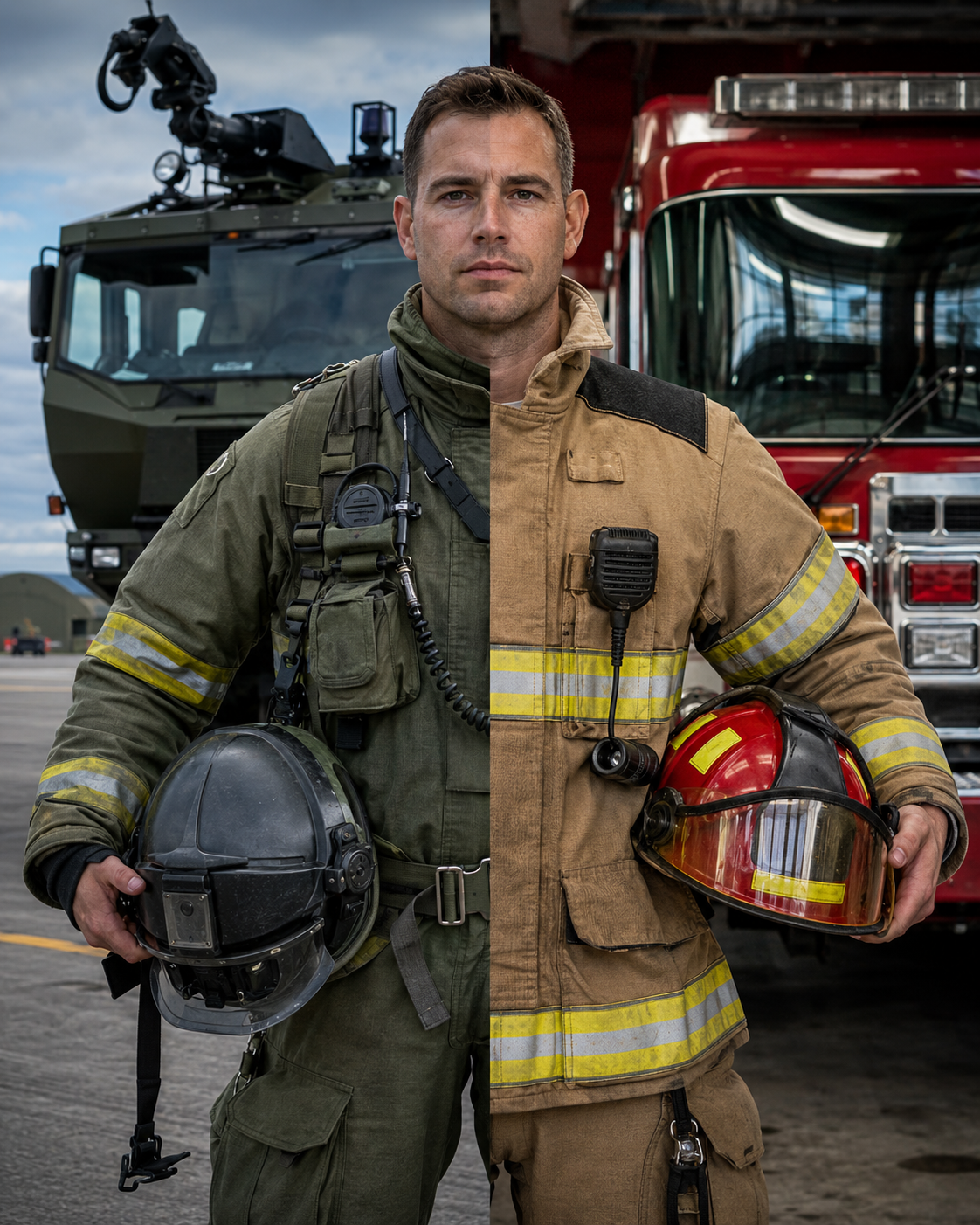
Military firefighters work in a narrower and often more violent set of circumstances than their civilian counterparts. Air Force fire protection specialists and Marine Corps ARFF crews stand crash rescue on active flight lines, where the emergency arrives at approach speed with a full fuel load. Navy Damage Controlmen fight fire inside a steel hull at sea, where there is no perimeter to fall back to and no mutual aid coming. Aviation Boatswain's Mates work a flight deck where a single mishap involves aircraft, ordnance, and fuel at once. Army firefighters have covered airfields, ammunition storage, and forward bases in deployed environments.
Three features distinguish the work from civilian firefighting, and each one matters clinically. The casualties are frequently people you know by name. There is often no option to withdraw. And the operational tempo does not accommodate a stand-down after a bad call — the next alarm is on the same shift.
Clinical relevance
The trauma signature of military fire protection
Fire protection produces a pattern of exposure the DSM-5 addresses directly. Its Criterion A expressly contemplates repeated or extreme exposure to the aversive details of traumatic events, naming first responders who recover human remains as the example. This is a recognized route into the diagnosis, not an unusual argument.
Crash rescue and recovery
Arriving at an aircraft mishap to find that survival was already decided before the truck rolled. Crash crews are trained to enter and search regardless, which means being the person who confirms it.
Fire inside a hull
Shipboard firefighting removes the exit. Heat, smoke, and flooding in a confined compartment with the only route out running through the casualty — conditions strongly associated with later claustrophobia and avoidance.
Knowing the casualty
On a base or a ship, the person in the wreckage is often someone from your unit. That collapses the professional distance civilian responders are trained to maintain and is closely tied to survivor guilt.
Repetition without recovery
Cumulative exposure with no decompression between events. DSM-5 Criterion A contemplates exactly this pattern, and it can look less like one memory than like a permanent change in baseline.
The attribution problem
“Your PTSD is from your civilian fire career” — where that reasoning breaks down
A very large number of military firefighters go straight into civilian fire service after separating. It is the obvious use of the training. It also creates the single most common obstacle in these claims: an examiner looks at twenty years of municipal calls next to four years of military service and attributes the condition to the larger number.
This reasoning appears in real decisions. In one Board case, an examiner acknowledged that the veteran's in-service firefighting involved chronic traumatic exposure given the calls he responded to, then set that aside on the basis that it was not the stressor he had formally claimed, and located his chronic exposure in his post-service career instead. The in-service exposure was recognized and then routed around.
Four things that answer it
The standard was never “sole cause”
Service connection requires that the disability was incurred in or caused by service, at a level of at least as likely as not. Nothing in that standard requires the in-service trauma to be the only cause, the first cause, or the biggest one. An opinion reasoning “he had more exposure later, therefore it is not service-related” has substituted a comparison for the actual legal test.
Later worsening does not erase an in-service origin
If PTSD was incurred during service, subsequent civilian exposure that made it worse does not sever the connection to service. The relevant question is whether the condition began in service — not whether anything afterward also affected it. This is the distinction most often collapsed in an unfavorable opinion.
Where the causes cannot be separated, doubt runs in your favor
38 C.F.R. § 3.102 and the reasoning in Mittleider v. West, 11 Vet. App. 181 (1998), establish that where service-connected and non-service-connected contributions cannot be medically separated, the benefit of the doubt requires attributing them to the service-connected condition. An examiner who says the two exposures cannot be disentangled has not defeated your claim.
The content of the symptoms is evidence
Intrusive memories and nightmares have specific content. If what recurs is a flight line, a hangar deck, a compartment aboard ship, or a person in a uniform you recognize — and not the structure fires and motor vehicle accidents of a twenty-year civilian career — that is clinically meaningful evidence about where the injury originated.
Ready to have Dr. Allen look at the reasoning in your denial?
A free, confidential phone call is usually enough to tell whether a nexus letter or a rebuttal fits your claim.
Evidence
What builds the timeline that answers an attribution denial
- Separation exam and any screening endorsements you made at the time
- Records from the interval between separation and the start of your civilian career — primary care, marriage counseling, an ER visit
- Statements from a spouse or partner describing what changed after service and before the second career started
- Statements from fellow service members describing the specific incidents you responded to and how you were afterward
- Unit and duty records: crash-response logs, mishap reports, casualty-response documentation, and your MOS or rating history
- Workers' compensation or department records from your civilian career, which frequently document a symptom history predating the calls being blamed for it
A personal statement is where you explain what you carried out of service and why you never reported it. Buddy letters from people who served with you corroborate the incidents themselves.
Procedurally
What to file after this kind of denial
Which lane fits depends on why the claim was denied, and the distinction matters.
Where the decision turned on missing evidence — no timeline, no corroboration of the in-service incidents, no medical opinion addressing origin — a Supplemental Claim with that new evidence is generally the route, and an independent medical opinion is new evidence.
Where the evidence was there and the reasoning was the problem — the examiner applied a sole-cause test, or found the contributions inseparable and then decided against you anyway — that is an error in how the record was weighed. A rebuttal letter answers an unfavorable opinion point by point. Our page on denied VA claims explains what a decision letter is actually telling you, and what to do when a C&P examiner says depression, not PTSD covers a related failure mode.
For deadlines, lane selection, and appeal strategy, work with a VA-accredited attorney, claims agent, or VSO. That is a legal decision, not a medical one, and it is outside what an independent medical opinion covers. The medical opinion is the part Dr. Allen writes, and it is often the piece the file is missing.
Related conditions
What else tends to travel with this history
Fire protection leaves more than one mark, and several of these conditions can be claimed secondary to a service-connected psychiatric condition under 38 C.F.R. § 3.310, on either a causation or an aggravation theory.
Sleep. Disrupted sleep is close to universal in this population, and obstructive sleep apnea secondary to PTSD is among the most frequently claimed secondary conditions. Years of alarm-response shift work compound it.
Hearing. Apparatus sirens, aircraft on the line, and shipboard machinery produce noise exposure that commonly supports tinnitus and hearing loss claims, which in turn can support a secondary psychiatric claim.
Burns and scarring. Burn injury is the occupational hazard most specific to this career field, and its psychiatric consequences are frequently left unclaimed. Where a burn is service-connected, the resulting scarring or disfigurement can support a secondary psychiatric claim in its own right — the mechanism running through altered appearance, avoidance of being seen, withdrawal from social and intimate contact, and the daily reminder a visible scar provides. Burns to the hands, face, and neck matter disproportionately because they are the areas that cannot be covered. Our page on depression secondary to skin conditions and disfigurement covers how that pathway is established.
Chronic pain. Structural firefighting in full gear over a long career produces back, knee, and shoulder injury, and contracture and graft sites cause persistent pain long after healing. Depression caused by chronic musculoskeletal pain is a well-recognized secondary pathway, and the relationship runs in both directions.
Why the evaluator matters
Answering an unfavorable opinion requires reading it closely first
Jessica R. Allen, M.D.
Licensed psychiatrist · Former VA C&P examiner
An attribution denial is not answered by asserting the opposite conclusion more confidently. It is answered by identifying the specific reasoning error — a sole-cause test applied where the standard is at least as likely as not, an inseparability finding resolved against the veteran, an in-service exposure acknowledged and then set aside on a technicality — and addressing it on its own terms.
Dr. Allen spent three years as a VA Compensation & Pension examiner before she began writing opinions for veterans. She has written the kind of opinion these claims are weighed against, which is a practical advantage when the task is to explain why a particular one does not hold up.
She reviews the full record herself — service treatment and personnel records, deployment history, lay statements, prior decisions, and C&P exams — and writes every opinion personally, for veterans in all 50 states, by video, from home. More about Dr. Allen →
Educational information only. This article is provided for general educational purposes and does not constitute medical advice, legal advice, or a treatment relationship. Reading it does not establish a physician–patient relationship with Dr. Allen or Brightview Psychiatry Solutions PLLC. No outcome in any VA claim is promised or implied; the VA determines service connection and assigns all disability evaluations. Veterans should consult their own treating providers regarding medical care and an accredited representative, agent, or attorney regarding claims. If you are in crisis, the Veterans Crisis Line is available 24/7: dial 988 and press 1, or text 838255.
FAQ
Military firefighter PTSD questions
The VA said my PTSD is from my civilian fire career. Is that the end of my claim?
Does it hurt me that my civilian fire department already accepted a PTSD claim?
What if my worst calls in service and after service genuinely blur together?
I never had a single catastrophic call — it built up over hundreds of responses. Does that count?
I was a Damage Controlman and never left the ship. Can I still have a qualifying stressor?
I was never diagnosed while I was in. Is it too late?
Can a nexus letter guarantee my claim is approved?
Get Started
Still not sure whether your claim is answerable?
One free, confidential phone call is usually enough to find out whether a nexus letter or a rebuttal fits. Dr. Allen will tell you honestly either way — there's no obligation.