
PTSD Nexus Letters for Medics and Corpsmen
Everyone else got to leave the casualty. You had your hands in it. Research on deployed medical personnel found the medical exposure hit harder than the combat exposure — and that is the part of a medic's service that almost never makes it into a claim file.
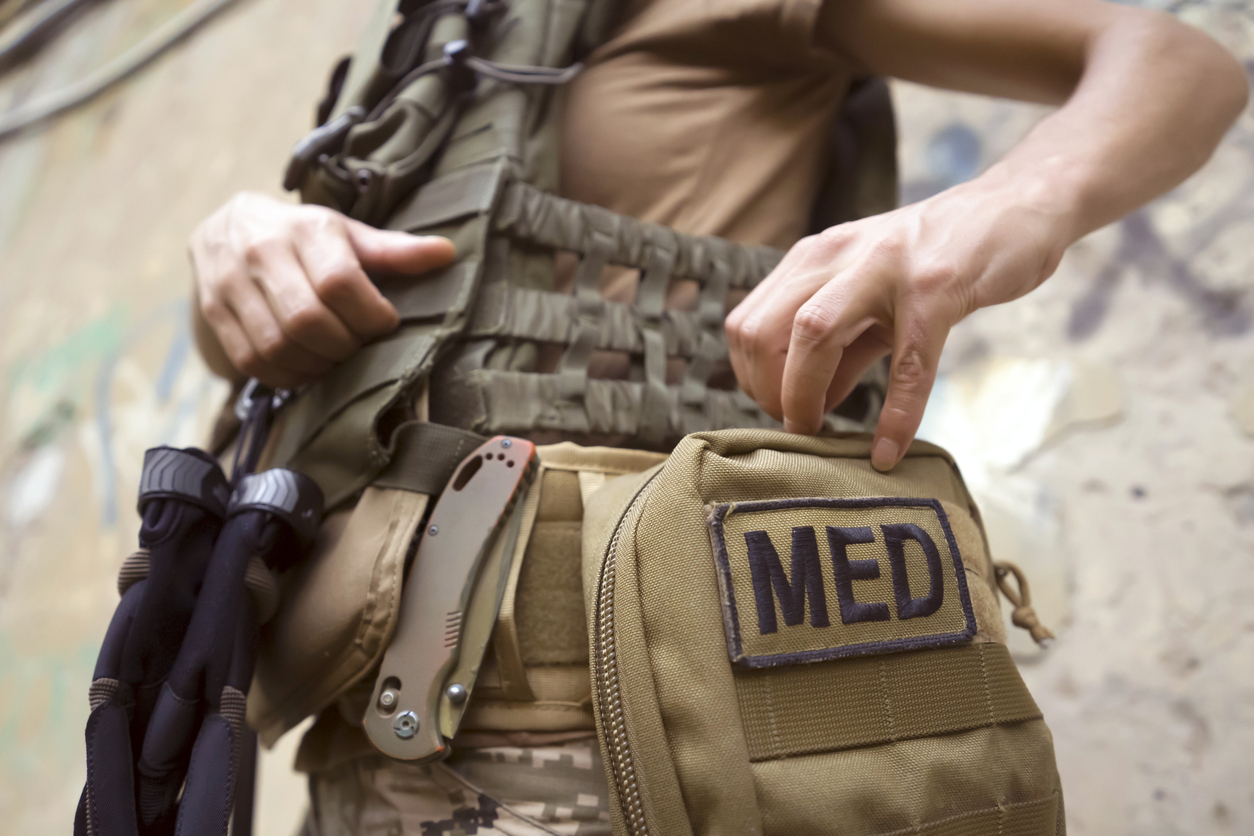
Can a medic or corpsman claim PTSD for treating casualties?
Yes. Under DSM-5, Criterion A is met by witnessing death or serious injury and by repeated exposure to the aftermath of traumatic events in the course of professional duty. Treating combat casualties satisfies that. PTSD in this population does not depend on having been shot at, though many medics and corpsmen were.
The distinctive problem is that a medic's worst moments are usually clinical rather than tactical. The airway that could not be secured. The tourniquet that went on too late. The friend who was still talking when you started and was not when you finished. Those events rarely appear in an incident report, and a veteran describing them may not recognize them as stressors at all — because at the time, they were the job.
Three routes to service connection — which fits your service?
Route 1 · Direct
You treated the casualties
Amputations, burns, penetrating trauma, patients who died under your hands. Repeated exposure to the aftermath of traumatic events meets DSM-5 Criterion A.
How medical exposure is developed →Route 2 · Moral injury
You decided who got treated first
Triage calls, expectant categorization, or a patient you believe you failed. Guilt and shame rather than fear, often presenting as depression.
How moral injury is assessed →Route 3 · Wounded
You were hit while working on someone
A combat injury sustained while rendering aid. Injured corpsmen carry measurably higher psychiatric risk, and the injury itself documents the stressor.
How injury supports the claim →These are not alternatives you have to choose between, and more than one often applies. Which conditions are service connected, and at what evaluation, is decided by VA.
Medic and corpsman exposure may include
- Treating traumatic amputations, gaping wounds, and severe burns
- Rendering aid under fire or during an ongoing attack
- Losing a patient despite doing everything correctly
- Treating a friend, a squadmate, or someone from your own unit
- Mass casualty events requiring triage under time pressure
- Handling remains, or continuing care on someone already expectant
Why this duty causes injury
What makes medical duty different from combat exposure?
There is now direct evidence on this question, and it points somewhere veterans and adjudicators rarely look. Medical duty carries its own category of stressor, distinct from combat, and for this population it appears to be the more consequential one.
The medical exposure hit harder than the combat exposure
A study of 1,138 U.S. military medical personnel deployed to Iraq between 2004 and 2011 measured combat stressors and healthcare stressors separately. Eighteen percent reported combat experiences that had a significant impact on them. More than three times as many — 67 percent — reported medical-specific stressors that did, such as exposure to traumatic amputations, gaping wounds, and severe burns. Healthcare stressor scores were more strongly associated with post-traumatic stress symptoms than combat stressor scores were, and about 10 percent of those surveyed screened positive for PTSD. For a claim, the implication is direct: the stressor statement should describe the patients, not only the firefights.
Losing a patient is a stressor even when nothing was done wrong
Medics are trained to a standard and then held to it, first by others and permanently by themselves. A veteran who ran a textbook resuscitation on someone who was never going to survive may still carry it as a personal failure. That belief is clinically significant and it is also, frequently, why the event never gets reported — a medic who thinks he failed does not describe the case as something that happened to him. It has to be asked about directly.
Triage decisions are a moral injury, not a memory problem
Mass casualty triage requires deciding who is treated first and who is categorized expectant. Someone has to make that call, and in a small unit it is often a junior enlisted medic or corpsman. Moral injury describes the lasting harm that can follow perpetrating, failing to prevent, or bearing witness to acts that transgress deeply held moral beliefs. It centers on guilt and shame rather than fear, and it often presents as depression rather than as classic PTSD. Because the presentation differs, the distinction between PTSD and other trauma- and stressor-related disorders can matter to how the claim is developed. The same pattern appears in the mass-casualty response after the Beirut barracks bombing, where corpsmen treated hundreds of wounded Marines in a single morning.
Corpsmen who were wounded while treating others
A study of 2,025 Navy corpsmen compared 405 who were combat injured with 1,620 who were not. Injured corpsmen had substantially greater risk of PTSD (risk ratio 2.45), and also of anxiety, adjustment, mood, and substance use disorders. More severe injuries carried stronger associations still. A corpsman with a service-connected physical injury from the same event therefore has both a documented stressor and an established starting point for the psychiatric claim.
Medic and corpsman roles & codes
- Army Combat Medic Specialist (68W), including flight medics
- Navy Hospital Corpsman (HM)
- Field Medical Service Technician (NEC 8404), corpsmen with Marine units
- Air Force Aerospace Medical Service (4N0X1)
- Independent Duty Corpsman and Special Amphibious Reconnaissance Corpsman
- Battalion aid stations, forward surgical teams, and casualty collection points
Patient care records, unit casualty rosters, and MEDEVAC logs often establish what a medic treated far better than the personnel file does.
A medic's worst day is usually clinical, not tactical. A psychiatric opinion can put the patient care history in front of the adjudicator in the terms VA evaluates. See how it works.
Symptoms & impairment
What symptoms do medics and corpsmen report?
Medics and corpsmen most often describe intrusive clinical imagery — a specific wound, a specific face — paired with guilt about an outcome they could not have changed. The guilt is usually the part they have never said out loud.
- Intrusive images of specific wounds, patients, or faces
- Nightmares of being unable to reach, treat, or save someone
- Guilt about a patient who died, including where care was correct
- Hypervigilance and scanning for injuries or hazards in ordinary settings
- Startle response to alarms, sirens, or the smell of blood or antiseptic
- Avoidance of hospitals, emergency scenes, or medical work entirely
- Emotional numbing, detachment, and difficulty with intimacy
- Depression, hopelessness, and substance use
Many medics and corpsmen went into civilian EMS, nursing, or firefighting after service, where the exposure continues. Others left medicine entirely, which is itself evidence of occupational impairment.
Evidence that helps a medic or corpsman claim
- Unit casualty rosters and after-action reports for the relevant period
- MEDEVAC logs, patient care records, and battalion aid station records
- MOS, NEC, and additional skill identifier documentation
- Combat Medical Badge, FMF qualification, or unit awards
- Buddy statements from others in the aid station or on the same mission
- Service treatment records for any injury sustained while rendering aid
A common misunderstanding
Does "I was just doing my job" mean the trauma does not count?
Medics and corpsmen minimize more consistently than almost any other group. The reasoning is always some version of the same thing: the wounded had it worse, the infantry had it worse, and treating casualties was the job they trained for and asked to do. Some also carry a quieter version — that a person who could not handle it should not have been doing it.
None of that is how service connection works, and none of it is how trauma works. Being trained for an exposure does not confer immunity to it. The published research on this population points the other way: medical stressors were reported as more impactful than combat stressors by the people who experienced both. A medic who performed well and was affected anyway is describing the ordinary course of the injury, not an exception to it. Veterans in this position are also sometimes told at the examination that what they have is depression rather than PTSD — what that means for a claim is worth understanding beforehand.
What veterans have said
In their words
“The worst day of my life occurred when we treated a soldier who had lost multiple limbs in an IED. This has stayed with me every day and I never knew there was a name for it — PTSD. Dr. Allen was compassionate and understanding during my appointment.”
“I felt guilty about having PTSD because I took care of the soldiers who were wounded. Dr. Allen addressed those feelings… after working with her, I started receiving treatment.”
Shared with permission. Individual experiences vary, and no outcome can be predicted or promised. Service connection and evaluation are determined solely by VA.
Who writes your opinion
Who writes your medical opinion?
Medic and corpsman claims are routinely underdeveloped because the stressor statement describes the deployment instead of the patients. Jessica R. Allen, M.D. — a licensed psychiatrist and former VA C&P examiner — understands the psychiatric criteria for repeated exposure to the aftermath of trauma, for moral injury, and for injury-related psychiatric conditions, along with the medical-legal standards VA raters evaluate: diagnosis, stressor exposure, symptom development, chronicity, impairment, and medical nexus. She is also a physician, and clinicians are famously poor at treating themselves as patients. The instinct to keep working, to rank your own distress below the person in front of you, and to treat needing help as a professional failure is familiar territory rather than something that has to be explained. More about Dr. Allen and the practice, or see all nexus letter services.
- Former VA Compensation & Pension examiner
- Applies the VA “at least as likely as not” standard
- Addresses moral injury as well as fear-based trauma
- Writes nexus letters for veterans in all 50 states
How each PTSD opinion is written
How does Dr. Allen write a PTSD nexus letter?
Every PTSD opinion follows the same order of work and ends in a clear medical conclusion. Nothing is templated, and nothing is drafted by AI. Dr. Allen is a psychiatrist, and she reads each file and writes each letter personally.
- 1
Your stressor and your service record
The stressor as you describe it, read against your personnel file, service treatment records, and post-service care. Where a patient encounter went unreported, the letter identifies the corroborating markers already sitting in your record.
- 2
A diagnosis that conforms to DSM-5
The VA requires a PTSD diagnosis that conforms to the DSM-5. The letter documents yours criterion by criterion rather than asserting the label — and it is made by a psychiatrist, not inferred from a screening score.
- 3
The link to the stressor
How your current symptoms connect to that specific in-service exposure, with the clinical reasoning written out. Where events before or after service are part of the picture, the letter addresses them rather than leaving them for a rater to raise.
- 4
More than one diagnosis, when the record supports it
Some veterans are denied for PTSD while clearly meeting criteria for depression, anxiety, or an adjustment disorder. A claim is not limited to the label you filed under, and the letter says so where your record supports it.
The standard applied
The letter closes in the standard the VA actually applies: your condition is at least as likely as not connected to service — a probability of 50 percent or greater. Where the evidence for and against a claim sits in balance, the benefit of the doubt belongs to the veteran. That is why the threshold is 50 percent or greater, and not more than 50 percent.
VA disability ratings for PTSD
How the VA rates PTSD
PTSD is rated under the General Rating Formula for Mental Disorders (38 C.F.R. § 4.130, DC 9411). The rating is based on occupational and social impairment — how much your symptoms interfere with work, relationships, and daily life — not on the number of symptoms or a screener score.
General Rating Formula for Mental Disorders — 38 C.F.R. § 4.130
| Evaluation | Level of occupational and social impairment |
|---|---|
| 100% | Total occupational and social impairment |
| 70% | Deficiencies in most areas — work, school, family relations, judgment, thinking, or mood |
| 50% | Reduced reliability and productivity |
| 30% | Occasional decrease in work efficiency and intermittent periods of inability to perform occupational tasks |
| 10% | Mild or transient symptoms, or symptoms controlled by continuous medication |
| 0% | A diagnosed condition, but symptoms not severe enough to interfere with functioning or require continuous medication |
These rating levels apply to all mental disorders rated under the General Rating Formula, including PTSD. Individual results vary, and no rating outcome can be predicted or guaranteed.
Frequently asked questions
Medic and corpsman PTSD nexus letter questions
Tell us about your deployments and your prior VA decision
We'll explain whether a nexus letter can help your claim. Reach the office at (984) 237-8044 or book online.
Related pages for medic and corpsman veterans
Sources
- Peterson AL, Baker MT, Moore BA, et al. Deployed Military Medical Personnel: Impact of Combat and Healthcare Trauma Exposure. Mil Med. 2019;184(1-2):e133–e142. doi:10.1093/milmed/usy147
- MacGregor AJ, Zouris JM, Dougherty AL, Dye JL. The Psychological Consequences of Combat Injury Among U.S. Navy Health Care Personnel. Mil Med. 2024;189(3-4):742–747. doi:10.1093/milmed/usac298
- Litz BT, Stein N, Delaney E, et al. Moral injury and moral repair in war veterans: a preliminary model and intervention strategy. Clin Psychol Rev. 2009;29(8):695–706. doi:10.1016/j.cpr.2009.07.003
- American Psychiatric Association, Diagnostic and Statistical Manual of Mental Disorders, Fifth Edition — PTSD Criterion A.
- 38 C.F.R. § 4.130 — General Rating Formula for Mental Disorders.
Educational information only. This page does not constitute medical advice, legal advice, or a treatment relationship. Brightview Psychiatry Solutions PLLC provides independent medical opinions; it does not represent veterans before the VA and cannot predict or guarantee the outcome of any claim. All service connection and rating decisions are made solely by the Department of Veterans Affairs.