
PTSD Nexus Letters for Military Chaplains
Chaplains stand at the center of everyone else's worst moments — combat deaths, suicides, and years of trauma counseling — and are the one person in the unit with nowhere to take it. A nexus letter may help explain how those duties, not the job title, contributed to your current condition.
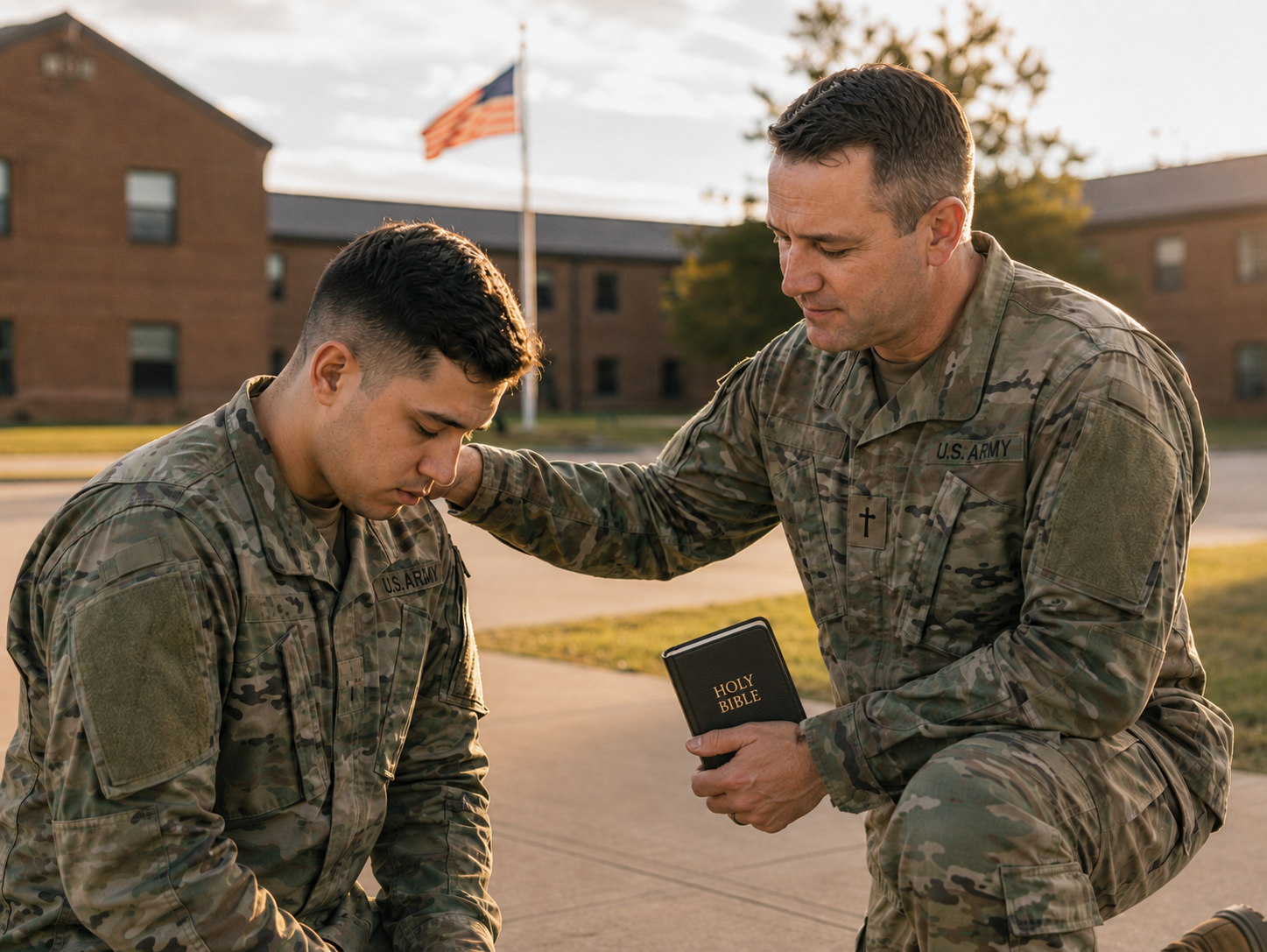
Can a military chaplain develop PTSD?
Yes. Nothing in VA law requires a combat role, a weapon, or a combat MOS to establish service connection for PTSD. Chaplains and religious affairs specialists may develop PTSD, depression, anxiety, or moral injury from duties that place them at the center of everyone else's worst moments.
Praying over the dead after a firefight. Responding to a suicide in the barracks. Standing on the ramp at a dignified transfer. Sitting with a family during a death notification. Absorbing hundreds of traumatic disclosures over a career, from service members who will tell no one else. For most chaplains the injury is not one event but the accumulation — and the expectation, held by everyone including themselves, that they would be the one who could carry it.
Two routes to service connection — which fits your service?
Route 1 · Direct
You were there when it happened
A combat death, a suicide, a mass casualty event. Witnessing death or serious injury meets DSM-5 Criterion A regardless of whether you carried a weapon.
How direct exposure is developed →Route 2 · Cumulative
You absorbed it one counseling session at a time
Years of traumatic disclosures with no single worst event. Secondary traumatic stress is documented in this population and is developed as a pattern rather than an incident.
How cumulative exposure works →These are not alternatives you have to choose between, and for most chaplains both apply. Moral injury is addressed further down the page and is often part of the picture in either route. Which conditions are service connected, and at what evaluation, is decided by VA.
Chaplain trauma exposure may include
- Praying over the dead and handling remains after combat deaths
- Responding to suicides, suicide attempts, and acute suicidal crises
- Supporting a unit through a mass casualty event
- Performing or accompanying casualty death notifications
- Conducting memorial services, ramp ceremonies, and dignified transfers
- Years of counseling service members after combat, MST, and loss
Why this duty causes injury
What kinds of trauma does chaplain duty involve?
Chaplain exposure is unusual because three distinct mechanisms operate at once, and they are developed differently in a claim. Under DSM-5, Criterion A is met not only by direct personal danger but by witnessing death or serious injury and by repeated exposure to the aftermath of traumatic events in the course of professional duty.
Primary trauma: present for the death itself
Chaplains are not behind the line. They are called forward to the casualty collection point, to the aid station, to the scene of a suicide, and to the aircraft on the ramp. Witnessing death or serious injury directly satisfies Criterion A, and a chaplain who prayed over remains, held a dying service member, or was first into a room after a suicide has a stressor in exactly the sense the regulation contemplates — whatever the MOS says.
Secondary traumatic stress from years of disclosures
Because chaplains offer confidential support outside the clinical record, service members tell them what they will tell no one else. Over a career a chaplain may absorb hundreds of detailed traumatic accounts and begin to carry the images, fear, and grief of the people they counseled — including service members disclosing military sexual trauma. This is described in the literature as secondary traumatic stress, vicarious trauma, or compassion fatigue. It develops cumulatively, which means many chaplains cannot point to a single worst event.
How a cumulative claim is built without a single date
VA development is designed around discrete stressors: a date, a place, an incident. A chaplain asked to identify one is being asked the wrong question, and answering it badly — by naming an arbitrary event that was not in fact the worst — can narrow the claim to that single incident. The better approach is to document the pattern rather than an episode. That means establishing the assignment history and the length of each deployment, the unit's casualties and suicides during the period served, the volume and nature of the counseling performed, and the circumstances that made the exposure continuous rather than occasional. Buddy statements from service members who were counseled, and from others on the unit ministry team, corroborate what individual personnel records do not capture. A medical opinion then addresses whether that cumulative exposure is adequate to support the diagnosis, rather than resting the analysis on one event. Where a specific incident does stand out, it can be pled alongside the pattern rather than in place of it.
Moral injury strikes faith and identity at the same time
Moral injury refers to the lasting psychological, spiritual, and social harm that can follow perpetrating, failing to prevent, or bearing witness to acts that transgress deeply held moral beliefs. It centers on guilt, shame, betrayal, and loss of trust rather than on fear, and it frequently presents as depression rather than as classic PTSD. For a chaplain it can land on the core of vocation and faith — the conviction that they should have been able to bear this, or that what they saw cannot be reconciled with what they believed. The VA National Center for PTSD recognizes moral injury as a distinct source of distress. Because the presentation often does not fit the PTSD template, the difference between PTSD and other trauma- and stressor-related disorders can matter to how the claim is developed.
The confidant with nowhere to process it
The role carries an expectation, held by the unit and usually by the chaplain, that they are the steady one. Research interviewing chaplains who developed PTSD identified guilt, a sense of personal weakness, and stigma as prominent themes, alongside heavy deployment demands. That expectation delays care, and the resulting absence of in-service treatment records should not be read as evidence that the exposure was insignificant. It does mean lay evidence carries more weight than usual.
Chaplain and religious affairs assignments
- Army Chaplain (56A) and Religious Affairs Specialist (56M)
- Navy Chaplain Corps (4100) and Religious Program Specialist (RP)
- Air Force Chaplain (52RX) and Religious Affairs (5R0X1)
- Marine Corps units served by Navy chaplains and RPs
- Casualty assistance, mortuary support, and family readiness duties
A chaplain's stressor is usually invisible from the MOS alone, which is why duty logs, ceremony records, and unit casualty records matter more here than on most claims.
Chaplain exposure rarely looks like a stressor claim on paper. A psychiatric opinion can separate direct exposure, cumulative secondary trauma, and moral injury, and address each in the terms VA evaluates.
Symptoms & impairment
What symptoms do chaplain veterans report?
Chaplain veterans often describe a mental health picture and a spiritual one at the same time — intrusive memories of the dead alongside a loss of the faith that made the work possible. The second is rarely asked about, and rarely volunteered.
- Nightmares of funerals, ramp ceremonies, notifications, or crisis scenes
- Intrusive memories of the dead, the wounded, or those they counseled
- Avoidance of funerals, hospitals, ceremonies, or religious settings
- Emotional numbing and difficulty feeling connected to a congregation or family
- Loss of faith, spiritual distress, or a changed sense of calling
- Guilt, shame, or a sense of having failed the people they served
- Irritability, hypervigilance, and sleep disturbance
- Depression, hopelessness, and withdrawal after leaving service
Many chaplains left ministry entirely after service, which is itself worth documenting as evidence of occupational impairment. Where a condition is already service connected and has since worsened, that is a rating increase claim rather than a new service connection claim.
Evidence that helps a chaplain claim
- Chaplain duty logs, unit ministry team records, and personnel files
- Memorial service, ramp ceremony, and dignified transfer records or orders
- Casualty assistance and death notification assignments
- Unit records of losses, suicides, or mass casualty events
- Buddy statements from service members the chaplain supported
- Mental health treatment records and prior VA decisions
A common misunderstanding
Does "I was just doing ministry" mean the trauma does not count?
Many chaplains never file, because the events happened during duties they volunteered for and believed they were called to. They say it was the ministry. They say they were there to carry others, not to be carried. They say their faith should have been enough, and that saying otherwise sounds like a failure of it.
Being called to a ministry does not make a person immune to trauma. A chaplain can have served faithfully and well and still have developed PTSD, depression, or moral injury from it. Praying over the dead, responding to suicides, absorbing years of disclosures, and standing in the middle of grief again and again can have lasting psychological effects, and none of that reflects on the quality of the service or the strength of the faith. Chaplains are also sometimes told at the examination that what they have is depression rather than PTSD — what that means for a claim is worth understanding beforehand.
Who writes your opinion
Who writes your medical opinion?
Chaplain trauma is routinely misread by adjudicators looking for a combat role and finding a religious one. Jessica R. Allen, M.D. — a licensed psychiatrist and former VA C&P examiner — understands the psychiatric criteria for direct exposure, secondary traumatic stress, and moral injury, and the medical-legal standards VA raters evaluate: diagnosis, stressor exposure, symptom development, chronicity, impairment, and medical nexus. More about Dr. Allen and the practice, or see all nexus letter services.
- Former VA Compensation & Pension examiner
- Applies the VA “at least as likely as not” standard
- Addresses primary trauma, secondary trauma, and moral injury
- Writes nexus letters for veterans in all 50 states
How each PTSD opinion is written
How does Dr. Allen write a PTSD nexus letter?
Every PTSD opinion follows the same order of work and ends in a clear medical conclusion. Nothing is templated, and nothing is drafted by AI. Dr. Allen is a psychiatrist, and she reads each file and writes each letter personally.
- 1
Your stressor and your service record
The stressor as you describe it, read against your personnel file, service treatment records, and post-service care. Where an event went unreported, the letter identifies the corroborating markers already sitting in your record.
- 2
A diagnosis that conforms to DSM-5
The VA requires a PTSD diagnosis that conforms to the DSM-5. The letter documents yours criterion by criterion rather than asserting the label — and it is made by a psychiatrist, not inferred from a screening score.
- 3
The link to the stressor
How your current symptoms connect to that specific in-service event, with the clinical reasoning written out. Where events before or after service are part of the picture, the letter addresses them rather than leaving them for a rater to raise.
- 4
More than one diagnosis, when the record supports it
Some veterans are denied for PTSD while clearly meeting criteria for depression, anxiety, or an adjustment disorder. A claim is not limited to the label you filed under, and the letter says so where your record supports it.
The standard applied
The letter closes in the standard the VA actually applies: your condition is at least as likely as not connected to service — a probability of 50 percent or greater. Where the evidence for and against a claim sits in balance, the benefit of the doubt belongs to the veteran. That is why the threshold is 50 percent or greater, and not more than 50 percent.
VA disability ratings for PTSD
How the VA rates PTSD
PTSD is rated under the General Rating Formula for Mental Disorders (38 C.F.R. § 4.130, DC 9411). The rating is based on occupational and social impairment — how much your symptoms interfere with work, relationships, and daily life — not on the number of symptoms or a screener score.
General Rating Formula for Mental Disorders — 38 C.F.R. § 4.130
| Evaluation | Level of occupational and social impairment |
|---|---|
| 100% | Total occupational and social impairment |
| 70% | Deficiencies in most areas — work, school, family relations, judgment, thinking, or mood |
| 50% | Reduced reliability and productivity |
| 30% | Occasional decrease in work efficiency and intermittent periods of inability to perform occupational tasks |
| 10% | Mild or transient symptoms, or symptoms controlled by continuous medication |
| 0% | A diagnosed condition, but symptoms not severe enough to interfere with functioning or require continuous medication |
These rating levels apply to all mental disorders rated under the General Rating Formula, including PTSD. Individual results vary, and no rating outcome can be predicted or guaranteed.
Frequently asked questions
Chaplain PTSD nexus letter questions
Tell us about your chaplain service and prior VA decision
We'll explain whether a nexus letter can help your claim. Reach the office at (984) 237-8044 or book online.
Related pages for chaplain veterans
Sources
- Whitworth JD, O'Brien CN, Stewart C. Understanding Post-Traumatic Stress Responses among Military Chaplains: Implications for Military Behavioral Health. J Mil Soc Work Behav Health Serv. 2021;9(4):390–403. doi:10.1080/21635781.2021.1900956
- Litz BT, Stein N, Delaney E, et al. Moral injury and moral repair in war veterans: a preliminary model and intervention strategy. Clin Psychol Rev. 2009;29(8):695–706. doi:10.1016/j.cpr.2009.07.003
- VA National Center for PTSD — Moral Injury.
- American Psychiatric Association, Diagnostic and Statistical Manual of Mental Disorders, Fifth Edition — PTSD Criterion A.
- 38 C.F.R. § 3.310 — Disabilities that are proximately due to, or aggravated by, service-connected disease or injury.
Educational information only. This page does not constitute medical advice, legal advice, or a treatment relationship. Brightview Psychiatry Solutions PLLC provides independent medical opinions; it does not represent veterans before the VA and cannot predict or guarantee the outcome of any claim. All service connection and rating decisions are made solely by the Department of Veterans Affairs.