
Aviation Ordnance PTSD Nexus Letters
PTSD Nexus Letters for Aviation Ordnancemen
IYAOYAS. Red shirts work the most dangerous industrial workspace in the world, and then keep working it through the next launch cycle after something goes wrong. Some carry what they saw on the deck. Some carry what the ordnance did after it left the rail.
Jessica R. Allen, M.D. · Licensed psychiatrist and former VA C&P examiner · Psychiatric IMEs and nexus letters, all 50 states
Can flight deck duty cause PTSD?
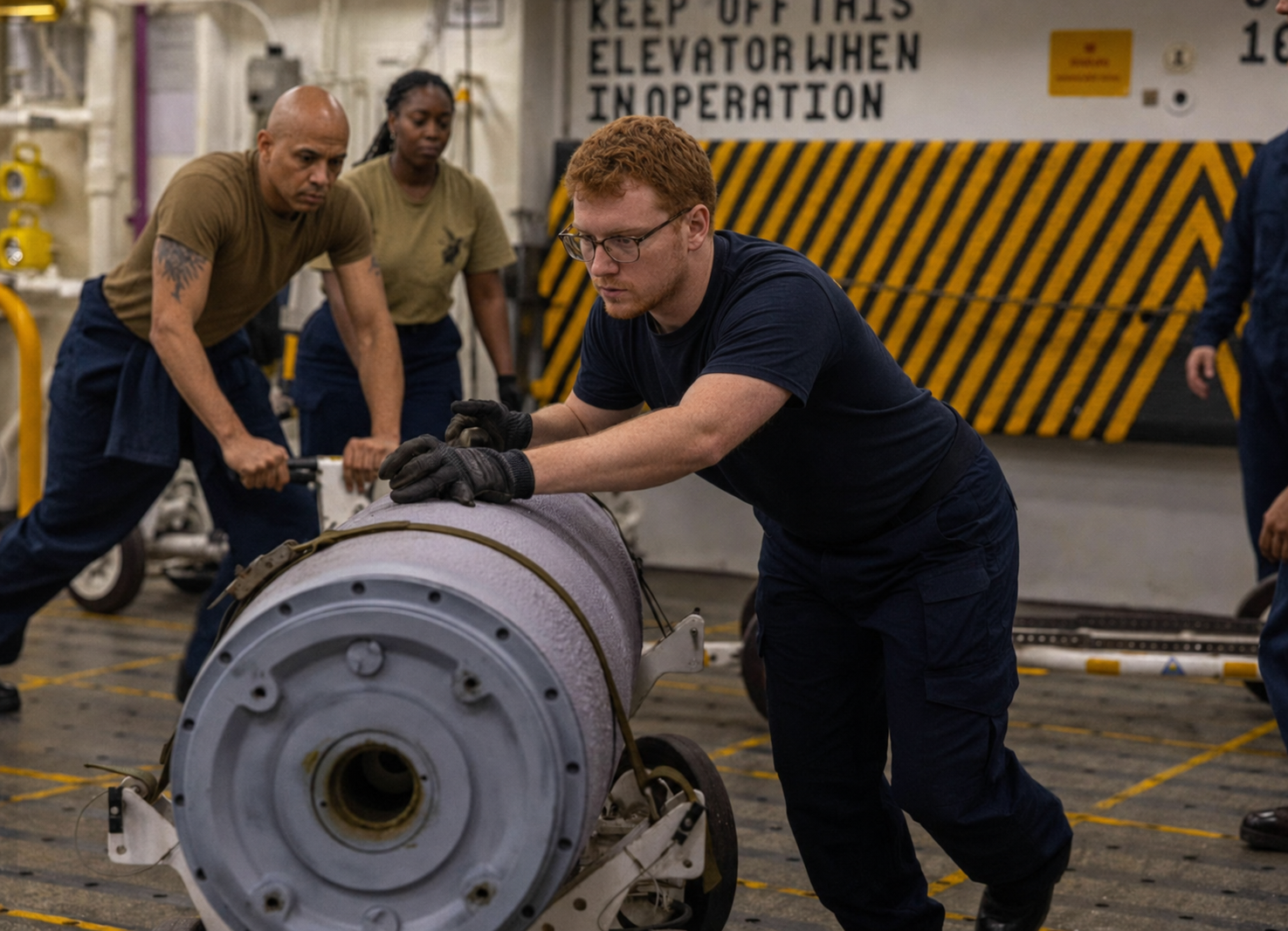
Yes. The carrier flight deck combines catastrophic noise, moving aircraft, live ordnance, jet intakes, and arresting gear inside roughly four and a half acres, and aviation ordnancemen work in the middle of it. An aviation ordnanceman in the Navy, an aviation ordnance technician in the Marine Corps, and an aircraft armament systems specialist in the Air Force all share the same core exposure. PTSD can follow a single mishap witnessed at close range, and it can follow years of working an environment where a moment of inattention is fatal.
There is a second exposure that ordnance veterans rarely raise and that almost never appears in a claim file. The rate exists to arm aircraft. Some veterans who built, loaded, and armed those weapons carry a durable and specific distress about what the ordnance did after the aircraft left the deck — a form of injury the literature describes as moral injury.
Three routes to service connection — which fits your service?
Route 1 · Direct
You witnessed something on the deck
A mishap, a fire, or a fatality during flight operations. Witnessing an event involving death or serious injury meets DSM-5 Criterion A regardless of where the ship was.
Route 2 · Secondary
You already have a tinnitus rating
Tinnitus or hearing loss is already service connected, and anxiety or depression developed afterward. This route runs through 38 CFR 3.310 and does not require a stressor.
Route 3 · Moral injury
You carry what the ordnance did
Durable guilt or shame connected to arming aircraft, rather than fear-based symptoms. It presents differently and is evaluated on its own terms.
These are not alternatives you have to choose between, and more than one often applies. Which conditions are service connected, and at what evaluation, is decided by VA.
Aviation ordnance exposure may include
- Witnessing a flight deck mishap, fire, or fatality at close range
- Personnel blown over the side, into an intake, or struck by an aircraft
- Working the next launch cycle immediately after a casualty on deck
- Handling live ordnance, fuzes, and explosives in a confined deck environment
- Magazine and weapons elevator work below decks
- Arming aircraft for strike missions and knowing the result
Why this duty causes injury
What makes the flight deck different from other hazardous work?
Two mechanisms operate here, and they are not the same. One is exposure to sudden, violent, and often fatal events in an environment that does not stop to absorb them. The other is the moral weight of the work itself.
The deck does not pause
When something goes wrong during flight operations, the cycle continues. Aircraft are airborne and have to be recovered; the deck has to be cleared and made ready. A veteran who watched a shipmate die may have been back on the job within the hour, with no opportunity to process what happened and considerable pressure not to. That pattern — witnessing a death and immediately resuming the task — is described repeatedly by flight deck veterans.
Measured noise exposure that is difficult to overstate
Personal noise monitoring aboard a Nimitz-class carrier found flight deck launch and recovery personnel averaging 100.6 dBA over a full 24 hours, with a maximum measured level of 126.5 dBA, and 93 percent of all personnel monitored exceeded the 80 dBA 24-hour exposure limit. An earlier study of carrier flight deck occupational groups found permanent hearing threshold shifts in 38 percent of flight deck personnel, compared with 11 percent of administrative personnel.
Tinnitus and hearing loss open a secondary route
Hearing loss and tinnitus are among the most frequently service-connected disabilities in the VA system, and this rate sits at the top of the exposure distribution. Where tinnitus is service connected and a psychiatric condition developed afterward, anxiety or depression secondary to tinnitus is a separate theory of service connection that does not depend on establishing a stressor at all. The same reasoning supports depression secondary to other service-connected conditions.
Moral injury is a distinct injury, not a softer word for PTSD
Moral injury refers to the lasting psychological, spiritual, and social harm that can follow perpetrating, failing to prevent, or bearing witness to acts that transgress deeply held moral beliefs. It presents with guilt, shame, and loss of trust rather than with fear-based symptoms, and it frequently looks like depression rather than classic PTSD. An ordnanceman who armed aircraft for strikes, and later learned or concluded what those strikes did, may be describing this rather than a Criterion A stressor. It should be evaluated on its own terms. The difference between PTSD and other trauma- and stressor-related disorders matters here, because the presentation often does not fit the PTSD template.
Aviation ordnance ratings & codes
- Navy Aviation Ordnanceman (AO)
- Marine Corps Aviation Ordnance Technician (6531)
- Marine Corps Aviation Ordnance Systems Technician (6541)
- Air Force Aircraft Armament Systems (2W1X1)
- Weapons department, magazines, and weapons elevators
- Flight deck red shirts, including ordnance handling crews
Squadron and ship deployment records, along with mishap investigation reports, are often the most direct route to documenting a specific flight deck event.
Flight deck exposure and moral injury are developed differently
A psychiatric opinion can identify which applies, and address both where the history supports it. Reach the office at (984) 237-8044 or book online.
Symptoms & impairment
What symptoms do aviation ordnance veterans report?
Aviation ordnance veterans typically describe one of two patterns, and sometimes both: intrusive imagery tied to a specific event on the deck, and guilt or shame connected to the ordnance itself. The two look different clinically and are developed differently in a claim.
- Intrusive images of a mishap, a fire, or a shipmate who was killed
- Nightmares of the deck, of being unable to warn someone, or of an intake
- Startle response to sudden noise, alarms, or low-flying aircraft
- Hypervigilance and constant threat scanning in ordinary environments
- Guilt or shame connected to the ordnance itself and its use
- Loss of meaning, spiritual distress, or a changed sense of self
- Irritability, emotional numbing, and withdrawal from family
- Depression, hopelessness, and rumination about the deployment
Guilt-based and shame-based presentations are easy to misread as ordinary depression when the moral dimension is never asked about.
Evidence that helps an aviation ordnance claim
- Squadron and ship deployment records covering the relevant period
- Mishap investigation reports and safety findings
- Deck logs and command chronologies for the date of the event
- Rating and NEC documentation establishing ordnance duty
- Buddy statements from others on the deck or in the shop
- Audiometric records and any existing tinnitus rating
A common misunderstanding
Does "I never fired a shot" mean there is nothing to claim?
Ordnance veterans frequently discount their own experience because they were not infantry, were not shot at, and in many cases never left the ship. Some carry the opposite problem and will not raise the moral dimension at all, because saying it out loud sounds like a complaint about having done the job.
Neither position reflects how service connection works. Witnessing a violent death meets DSM-5 Criterion A regardless of where the deck was. And moral injury is a recognized construct in the clinical literature, not a character flaw. A veteran who cannot reconcile what the ordnance did is describing something with a name. Veterans who raise it are sometimes told at the examination that what they have is depression rather than PTSD — what that means for a claim is worth understanding beforehand. If a prior claim was already denied, a rebuttal opinion may be appropriate.
Who writes your opinion
Who writes your medical opinion?
Flight deck trauma and moral injury are both routinely missed, the first because the veteran never deployed ashore and the second because nobody asked. Jessica R. Allen, M.D. — a licensed psychiatrist and former VA C&P examiner — understands the psychiatric criteria for both, and the medical-legal standards VA raters evaluate: diagnosis, stressor exposure, symptom development, chronicity, impairment, and medical nexus. More about Dr. Allen and the practice.
- Former VA Compensation & Pension examiner
- Applies the VA “at least as likely as not” standard
- Addresses moral injury as well as fear-based trauma
- Writes nexus letters for veterans in all 50 states
VA disability ratings for PTSD
How the VA rates PTSD
PTSD is rated under the General Rating Formula for Mental Disorders (38 C.F.R. § 4.130, DC 9411). The rating is based on occupational and social impairment — how much your symptoms interfere with work, relationships, and daily life — not on the number of symptoms or a screener score.
General Rating Formula for Mental Disorders — 38 C.F.R. § 4.130
| Evaluation | Level of occupational and social impairment |
|---|---|
| 100% | Total occupational and social impairment |
| 70% | Deficiencies in most areas — work, school, family relations, judgment, thinking, or mood |
| 50% | Reduced reliability and productivity |
| 30% | Occasional decrease in work efficiency and intermittent periods of inability to perform occupational tasks |
| 10% | Mild or transient symptoms, or symptoms controlled by continuous medication |
| 0% | A diagnosed condition, but symptoms not severe enough to interfere with functioning or require continuous medication |
These rating levels apply to all mental disorders rated under the General Rating Formula, including PTSD. Individual results vary, and no rating outcome can be predicted or guaranteed.
Frequently asked questions
Aviation ordnance PTSD nexus letter questions
Related reading
- PTSD and MST nexus letters
- PTSD nexus letters for Seabee veterans
- Depression nexus letters
- Denied VA claims and rebuttal opinions
- View all nexus letter types
- Responding to a proposed rating reduction
Sources
- Schaal NC, Salaam RA, Stevens ME, Stubner AH. Living at Work: 24-hour Noise Exposure Aboard US Navy Aircraft Carriers. Ann Work Expo Health. 2019;63(3):316–327. doi:10.1093/annweh/wxz005
- Rovig GW, Bohnker BK, Page JC. Hearing health risk in a population of aircraft carrier flight deck personnel. Mil Med. 2004;169(6):429–432. doi:10.7205/MILMED.169.6.429
- Litz BT, Stein N, Delaney E, et al. Moral injury and moral repair in war veterans: a preliminary model and intervention strategy. Clin Psychol Rev. 2009;29(8):695–706. doi:10.1016/j.cpr.2009.07.003
- 38 C.F.R. § 3.310 — Disabilities that are proximately due to, or aggravated by, service-connected disease or injury.
- 38 C.F.R. § 4.130 — General Rating Formula for Mental Disorders.
Educational information only. This page does not constitute medical advice, legal advice, or a treatment relationship. Brightview Psychiatry Solutions PLLC provides independent medical opinions; it does not represent veterans before the VA and cannot predict or guarantee the outcome of any claim. All service connection and rating decisions are made solely by the Department of Veterans Affairs.