
Sleep Apnea Claims
What your sleep study numbers mean for a VA claim
Your polysomnogram is a page of acronyms and numbers. Here is what each one means, and which of them actually carry weight once the report becomes evidence, which is not the one most veterans focus on.
Direct answer
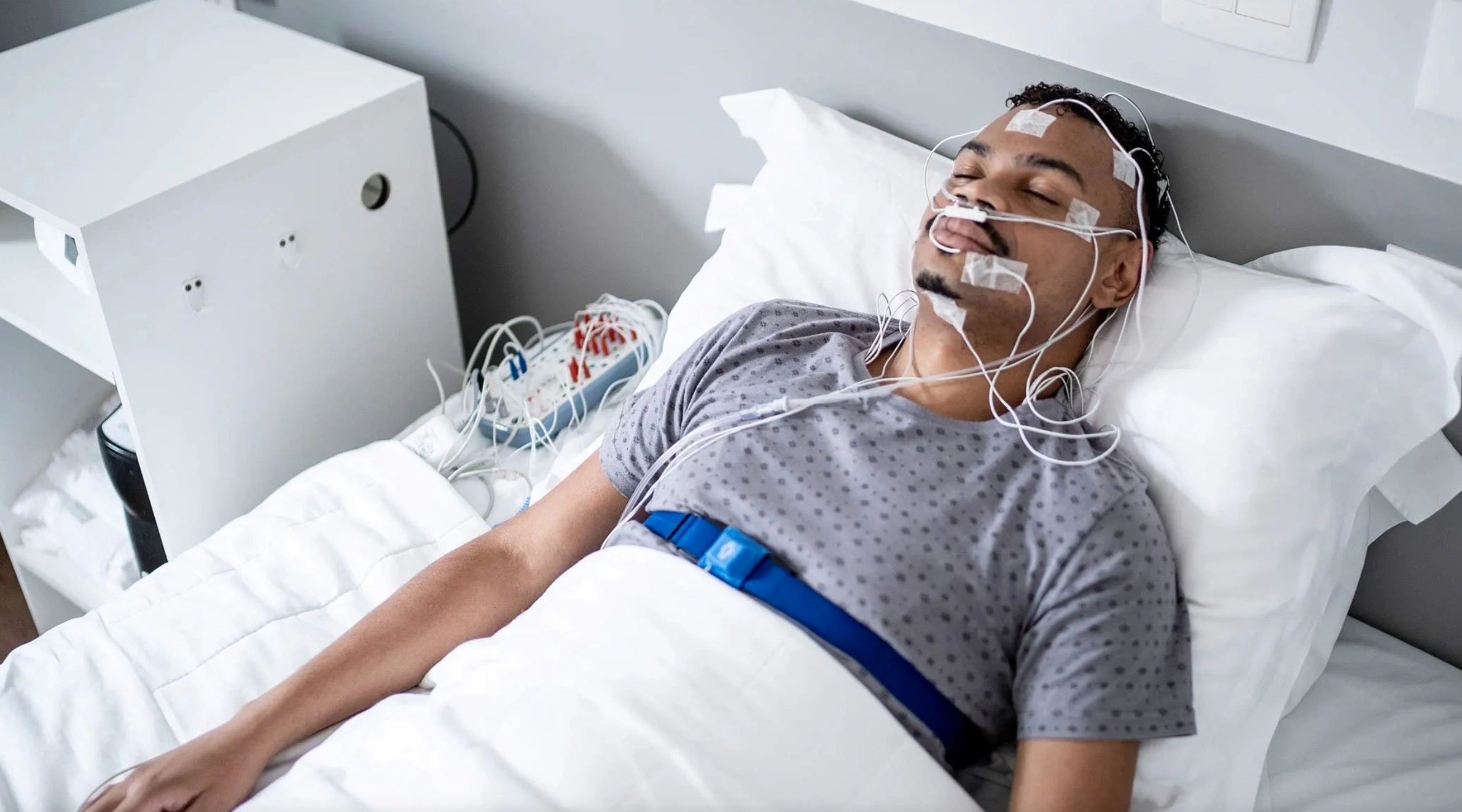
A polysomnogram, or PSG, is an overnight sleep study that records brain activity, breathing, oxygen levels, heart rhythm, and movement. The number most people look for is the AHI — apneas and hypopneas per hour of sleep — because it determines whether sleep apnea is called mild, moderate, or severe. But for a VA claim the AHI is often not the most useful figure on the page. Oxygen desaturation measures, arousal frequency, and what the report says about therapy frequently matter more.
If you are here because a report arrived and none of it made sense, start with the tables. If you are here because you are building a sleep apnea claim, the section on which numbers matter is the one to read.
The glossary
What the abbreviations on a polysomnogram mean
| Abbreviation | Meaning |
|---|---|
| AHI | Apnea-Hypopnea Index — total apneas plus hypopneas per hour of sleep |
| OAI | Obstructive Apnea Index — obstructive apneas per hour |
| CAI | Central Apnea Index — central apneas per hour, caused by brain signaling rather than airway obstruction |
| MAI | Mixed Apnea Index — episodes with both obstructive and central features |
| HI | Hypopnea Index — partial airway obstructions per hour |
| RDI | Respiratory Disturbance Index — apneas, hypopneas, and respiratory effort-related arousals per hour. Usually higher than the AHI |
| RERA | Respiratory Effort-Related Arousal — increased breathing effort that disrupts sleep without meeting criteria for an apnea or hypopnea |
| SpO₂ | Blood oxygen saturation during sleep |
| Nadir SpO₂ | The lowest oxygen saturation recorded during the study |
| ODI | Oxygen Desaturation Index — oxygen drops per hour, usually counted at a 3 or 4 percent threshold |
| T90 / TST90 | Time spent with oxygen saturation below 90 percent |
| TST | Total Sleep Time — time actually spent asleep during the study |
| Sleep latency | Time from lights out to falling asleep |
| WASO | Wake After Sleep Onset — time spent awake after first falling asleep |
| Sleep efficiency | Total sleep time as a percentage of time in bed |
| Arousal index | Arousals per hour of sleep, from any cause |
| REM | Rapid Eye Movement sleep stage |
| NREM | Non-REM sleep stages, including N1, N2, and N3 |
| PLMS | Periodic Limb Movements in Sleep |
| ESS | Epworth Sleepiness Scale — a questionnaire scored from 0 to 24 measuring daytime sleepiness |
| PSG | Polysomnogram — a full in-laboratory sleep study |
| HSAT | Home Sleep Apnea Test — a limited study performed at home |
| CPAP / APAP / BiPAP | Continuous, automatic, and bilevel positive airway pressure devices |
Grading
How is sleep apnea severity graded?
By the AHI — how many apneas and hypopneas occur per hour of sleep.
| AHI range | Severity |
|---|---|
| 5–14 | Mild obstructive sleep apnea |
| 15–29 | Moderate obstructive sleep apnea |
| 30 or above | Severe obstructive sleep apnea |
An AHI below 5 is generally considered within normal limits in adults.
Two things about that number are worth knowing before you draw conclusions from it.
Mild does not mean minor. Even mild sleep apnea can meaningfully affect mood, concentration, cardiovascular health, and daytime functioning, and severity on a sleep study does not track neatly with how a person actually feels. Some veterans with an AHI of 8 are exhausted; some with an AHI of 40 report relatively little.
Home studies can undercount. A home sleep apnea test does not measure brain activity, so it cannot distinguish sleep from quiet wakefulness. Events get divided across total recording time rather than actual sleep time, which tends to pull the index down. A veteran whose home study showed mild apnea may score differently on an in-laboratory study.
The part that matters for a claim
Which numbers actually matter in a VA sleep apnea claim?
Most guides stop at the AHI. In a disability claim, several other figures on the same report frequently do more work.
Nadir SpO₂, ODI, and T90. These describe how far and how often oxygen dropped, and for how long it stayed down. In secondary claims, where the argument is that sleep apnea contributed to another condition, the hypoxemia measures often carry the mechanism. An AHI tells you how many events occurred; the oxygen measures tell you what those events did.
Arousal index and RDI. Sleep fragmentation drives much of the daytime impairment, and a veteran can have a modest AHI alongside a high arousal index or RDI. If the report shows frequent RERAs, that is disrupted sleep the AHI does not capture.
Sleep architecture. Reports usually break down time in each stage and note the AHI within REM separately, since respiratory events are often more pronounced in that stage. Where a veteran's events cluster in REM, that belongs in the analysis rather than being averaged away.
Residual AHI on therapy. Not from the original study, but from the CPAP machine itself, which records the event rate during treatment. This is the figure that answers an examiner who says the sleep apnea has been treated, and it is almost never in the file.
The study date, above all. A sleep study establishes when the condition was documented, not when it began. The interval between the first reported symptoms and the study is frequently the most important part of the timeline in a secondary claim.
Not sure what your report supports?
Send your sleep study and rating decision. Dr. Allen will tell you what the numbers show and whether they support the theory you are pursuing, including when they do not.
No fee, no obligation. Dr. Allen is a member of the American Academy of Sleep Medicine.
Kinds of study
What kind of sleep study did I have?
The report will say, and the difference matters when the numbers are being interpreted.
In-laboratory polysomnogram
The full study, with EEG, breathing, oxygen, cardiac, and movement recording. It measures actual sleep time, so the indices are calculated against sleep rather than time in bed.
Home sleep apnea test
A limited study with fewer channels and no EEG. Convenient and useful, but it can underestimate severity for the reason described above.
Split-night study
Diagnostic recording in the first half of the night, then CPAP titration in the second half once significant apnea is confirmed. The diagnostic AHI here comes from a shorter recording period.
Titration study
Performed to find the pressure that controls events. This report tells you what pressure was needed and what the residual event rate was at that setting.
In a claim
Where these numbers show up in a nexus opinion
A sleep study is one of the few pieces of objective evidence in a sleep apnea claim, which is why a medical opinion should engage with the actual figures rather than referring to "a diagnosis of OSA."
Brightview prepares sleep apnea nexus letters for veterans pursuing both direct and secondary service connection. The pathways where these numbers do the most work:
- Sleep apnea secondary to a psychiatric condition. Where the argument runs through sleep fragmentation, nocturnal hyperarousal, or treatment-related weight change — see sleep apnea secondary to PTSD.
- Sleep apnea secondary to nasal and sinus disease. Where chronic obstruction contributes to the picture — see sleep apnea and sinusitis.
- Conditions claimed secondary to sleep apnea. Here the hypoxemia and fragmentation measures often supply the mechanism for what came downstream.
Sleep apnea is one of many conditions Dr. Allen writes on; the full list of nexus letters covers the rest.
Common questions
Frequently asked questions
What does AHI mean on a sleep study?
AHI stands for Apnea-Hypopnea Index — the number of apneas (complete breathing pauses) and hypopneas (partial obstructions) per hour of sleep. In adults, an AHI of 5 to 14 is mild obstructive sleep apnea, 15 to 29 is moderate, and 30 or above is severe. An AHI below 5 is generally considered within normal limits.
What is the difference between AHI and RDI?
The RDI, or Respiratory Disturbance Index, counts apneas and hypopneas like the AHI does, but also includes respiratory effort-related arousals — breathing disruptions that wake you without meeting the technical criteria for an apnea or hypopnea. The RDI is therefore usually the higher of the two. A veteran with a modest AHI and a substantially higher RDI has disrupted sleep the AHI alone does not capture.
What is ODI, and why does it matter?
The Oxygen Desaturation Index counts how many times per hour blood oxygen dropped by a set amount, usually 3 or 4 percent. Along with the nadir SpO₂ — the lowest saturation recorded — and T90, the time spent below 90 percent, it describes what the breathing events actually did to your oxygen levels. In claims where sleep apnea is argued to have contributed to another condition, these figures often carry more of the mechanism than the AHI does.
My AHI is only mild. Does that hurt my claim?
Severity on a sleep study and the VA rating are two different things — DC 6847 turns on symptoms and treatment requirements, not on the AHI. Mild sleep apnea can still produce significant daytime impairment, and the arousal index, oxygen measures, and symptom history may tell a fuller story than the AHI alone. Note also that a home study can undercount, because it divides events across total recording time rather than actual sleep time.
Why is my home sleep test different from my lab study?
A home sleep apnea test uses fewer channels and does not record brain activity, so it cannot distinguish sleep from lying awake. Events are divided across total recording time rather than sleep time, which tends to lower the calculated index. An in-laboratory polysomnogram measures actual sleep time and generally produces a more complete picture, including sleep staging and arousal data.
What is a residual AHI?
The event rate recorded by your CPAP machine while you are using it — as distinct from the diagnostic AHI from your original sleep study. It matters because it answers whether therapy is actually controlling the condition. Machines log it continuously along with nightly usage hours, and your sleep clinic or equipment supplier can produce a report. It is rarely in the file a VA examiner reviews.
Does the sleep study date show when my sleep apnea started?
No, and this is a common and consequential misunderstanding. A sleep study documents the condition on the night it was performed. Sleep apnea is diagnosed when someone finally orders a study, which is often years after symptoms began. Establishing the earlier interval — from symptom history, statements from anyone who observed your sleep, and earlier records mentioning snoring, witnessed apneas, or daytime somnolence — is frequently the most important part of the timeline.
Do I need my full sleep study report for a nexus letter?
The full report is more useful than a summary line in a treatment note. The complete study contains the indices, the oxygen data, the sleep architecture, and the technologist's observations — all of which may matter to the analysis. If you also have a titration study, a repeat study, or CPAP therapy reports, those are worth gathering as well.
Related reading
Keep reading
About the author
Jessica R. Allen, M.D.
Licensed psychiatrist · Former VA Compensation and Pension examiner · Member, American Academy of Sleep Medicine · Brightview Psychiatry Solutions PLLC, Wake Forest, North Carolina
Dr. Allen spent three years conducting Compensation and Pension examinations for the VA, and has spent the six years since writing independent medical opinions for veterans. In sleep apnea claims, the figures that decide the case are usually already in the report; they have simply never been read against the rest of the file. More about Dr. Allen.
Have your sleep study reviewed
Free consultation, no obligation. Dr. Allen will tell you what your report supports and whether a medical opinion would help.
No fee, no obligation. Dr. Allen is a member of the American Academy of Sleep Medicine.
Educational information only. This article is provided for general educational purposes and does not constitute medical advice, legal advice, or a treatment relationship. Reading it does not establish a physician–patient relationship with Dr. Allen or Brightview Psychiatry Solutions PLLC. No outcome in any VA claim is promised or implied; the VA determines service connection and assigns all disability evaluations. Veterans should consult their own treating providers regarding medical care and an accredited representative, agent, or attorney regarding claims. If you are in crisis, the Veterans Crisis Line is available 24/7: dial 988 and press 1, or text 838255.