
Major Depressive Disorder Secondary to Cervical Strain: VA Claims
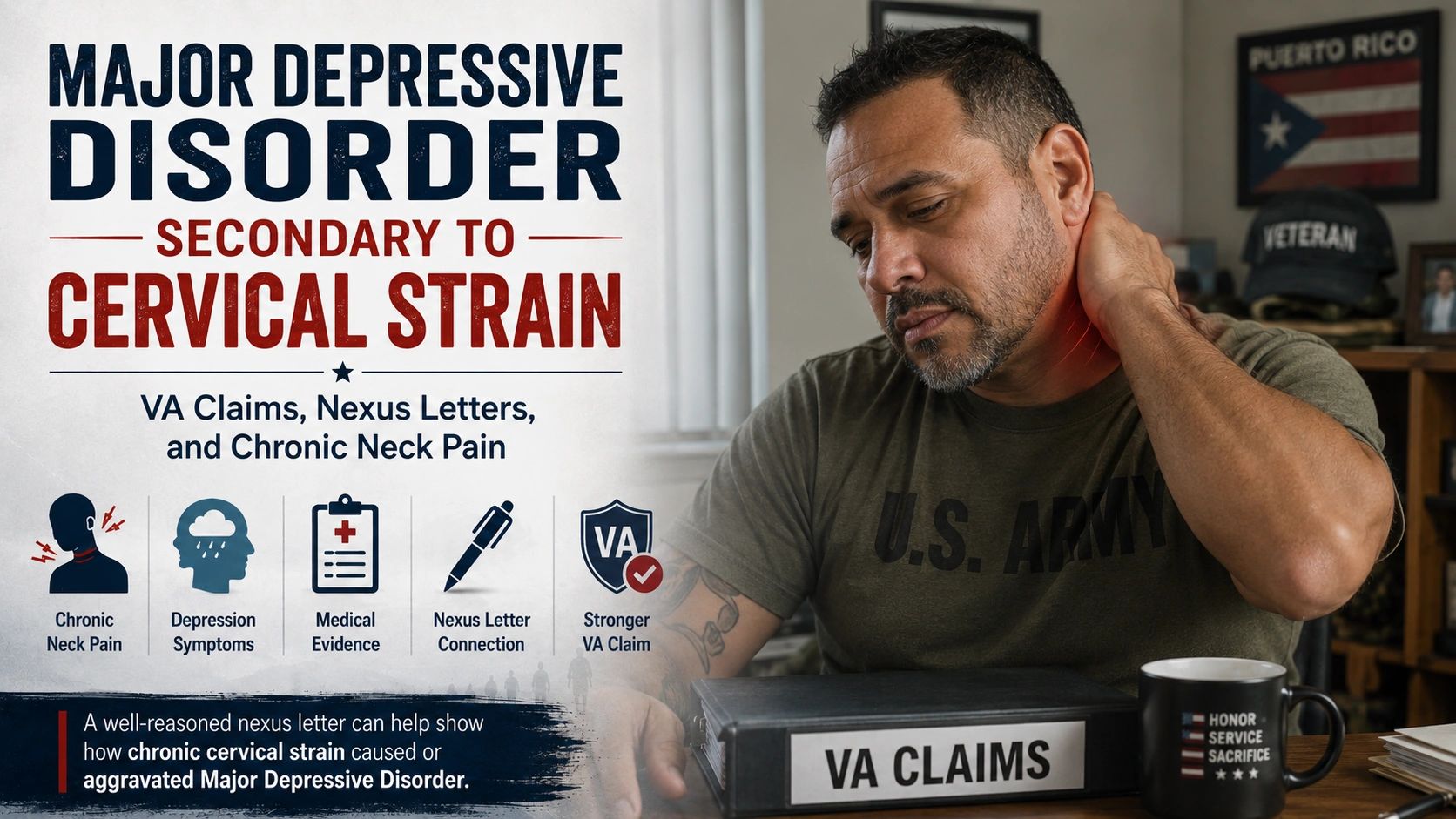
Major Depressive Disorder Secondary to Cervical Strain: VA Claims, Nexus Letters, and Chronic Neck Pain
Author: Jessica R. Allen, M.D. | Psychiatrist & Former VA C&P Examiner
Reviewed: July 2026
To discuss your case with Dr. Allen, book a free phone consultation or call our office (984) 237-8044.
Quick Answer: Can a Nexus Letter Help With Major Depressive Disorder Secondary to Cervical Strain?
Yes. A nexus letter for Major Depressive Disorder secondary to cervical strain can help explain how a veteran’s service-connected neck condition caused or aggravated depression. Chronic cervical strain may contribute to depression through persistent pain, sleep disruption, reduced activity, occupational impairment, medication side effects, and loss of quality of life.
For VA secondary service connection, cervical strain does not have to be the only cause of Major Depressive Disorder. The key question is whether it is at least as likely as not that the service-connected cervical strain caused or worsened the veteran’s depressive disorder. A strong claim often includes a current mental health diagnosis, documentation of chronic cervical spine symptoms, treatment records, lay statements, and a well-reasoned psychiatric nexus letter.
Can You Claim Depression Secondary to Cervical Strain?
Yes. Veterans who are already service connected for cervical strain may be able to claim Major Depressive Disorder secondary to cervical strain if the evidence supports that chronic neck pain caused or aggravated their depression.
For many veterans, cervical strain is not just occasional neck discomfort. Chronic cervical spine pain can interfere with sleep, work, driving, physical activity, family life, hobbies, and overall quality of life. Over time, those limitations can contribute to depressive symptoms, hopelessness, irritability, withdrawal, low motivation, and loss of interest in once-meaningful activities.
This is where a nexus letter for depression secondary to cervical strain may become important. VA often needs a clear medical explanation connecting the service-connected neck condition to the claimed mental health condition.
To discuss your case with Dr. Allen, book a free phone consultation or call our office (984) 237-8044.
What Does “Major Depressive Disorder Secondary to Cervical Strain” Mean?
A secondary claim means the veteran is not necessarily arguing that Major Depressive Disorder began during active-duty service. Instead, the veteran is arguing that a condition VA has already service connected — in this case, cervical strain— caused or aggravated the depressive disorder.
In plain language, this type of claim may look like this:
A veteran injured their neck in service, received service connection for cervical strain, and later developed depression because chronic pain, reduced mobility, poor sleep, and loss of independence began affecting their mental health.
For many veterans, depression develops not from one single event, but from the cumulative impact of living with chronic pain every day. The veteran may no longer be able to work the same way, sleep comfortably, exercise, drive long distances, help around the house, or enjoy hobbies they once relied on for stress relief.
A Major Depressive Disorder secondary to cervical strain nexus letter can help explain this connection in clinical terms.
How Cervical Strain Can Contribute to Depression
Cervical strain can become a chronic, functionally limiting condition. Veterans with cervical spine problems may experience neck pain, stiffness, muscle spasms, headaches, reduced range of motion, difficulty turning the head, radiating pain, numbness, poor sleep, and difficulty with prolonged sitting or standing.
Over time, these symptoms can affect both physical and emotional functioning. A veteran may begin to feel less independent, less useful, less active, and less like themselves. That gradual decline in quality of life can be clinically significant when evaluating whether chronic neck pain contributed to Major Depressive Disorder.
Cervical strain may contribute to depression through several pathways:
1) Chronic Pain Burden
Persistent pain can wear down emotional resilience. A veteran who wakes up in pain, works in pain, drives in pain, and goes to sleep in pain may begin to feel frustrated, demoralized, irritable, or hopeless.
Chronic pain can also create a sense of helplessness. When pain does not fully resolve despite treatment, physical therapy, medications, injections, or lifestyle changes, veterans may begin to feel trapped by their symptoms.
2) Sleep Disruption
Neck pain can make it difficult to find a comfortable sleeping position. Veterans may wake up repeatedly during the night, sleep in a recliner, avoid certain positions, or wake up feeling unrefreshed.
Poor sleep can worsen depression by affecting mood, energy, motivation, concentration, memory, and emotional regulation. A veteran who is already struggling with chronic pain may become even more vulnerable to depression when sleep is consistently disrupted.
3) Reduced Activity and Loss of Enjoyment
Many veterans define themselves by what they can do: work, exercise, hunt, fish, play sports, travel, maintain their home, help their family, or stay physically active.
When cervical strain limits those activities, the veteran may lose important sources of identity, enjoyment, and stress relief. This loss of activity can contribute to anhedonia, which is the reduced ability to experience pleasure.
4) Occupational Impairment
Cervical strain can affect work in many ways. A veteran may have difficulty sitting at a desk, using a computer, driving, lifting, carrying, looking up or down, turning the head, concentrating through pain, or completing physically demanding tasks.
When chronic pain affects job performance, attendance, reliability, or confidence, it can also worsen depression. Veterans may feel like they are falling behind, letting others down, or losing their sense of purpose.
5) Social Withdrawal
Chronic neck pain can make social activities feel exhausting. A veteran may avoid family events, restaurants, church, travel, sporting events, or gatherings because sitting too long, driving, or turning the head worsens pain.
Over time, this avoidance can lead to isolation. Social withdrawal is both a symptom of depression and a factor that can make depression worse.
6) Medication Side Effects
Some veterans take medications for pain, muscle spasms, sleep, or nerve symptoms. Depending on the medication and the individual, side effects may include sedation, fatigue, cognitive slowing, low motivation, dizziness, or emotional dulling.
Medication side effects do not have to be the sole cause of depression to be relevant. They may still contribute to the overall functional decline that worsens mood.
To discuss your case with Dr. Allen, book a free phone consultation or call our office (984) 237-8044.
Do You Need a Nexus Letter for Depression Secondary to Cervical Strain?
You may benefit from a nexus letter for Major Depressive Disorder secondary to cervical strain if VA has denied your claim, questioned the connection between your neck pain and depression, or stated that your depression is due to non-service-related stressors.
A strong nexus letter should explain more than the fact that the veteran has both cervical strain and depression. It should describe how the veteran’s chronic neck pain, limited range of motion, sleep problems, reduced physical activity, occupational limitations, and loss of quality of life contributed to the development or worsening of Major Depressive Disorder.
For many veterans, the strongest medical opinion addresses both possible theories:
Causation: The cervical strain caused the veteran to develop Major Depressive Disorder.
Aggravation: The veteran may have had depression from another cause, but the service-connected cervical strain made the depression worse beyond its natural course.
This distinction matters because VA may deny a claim if the medical opinion only discusses direct causation and fails to address aggravation.
How VA Rates Major Depressive Disorder
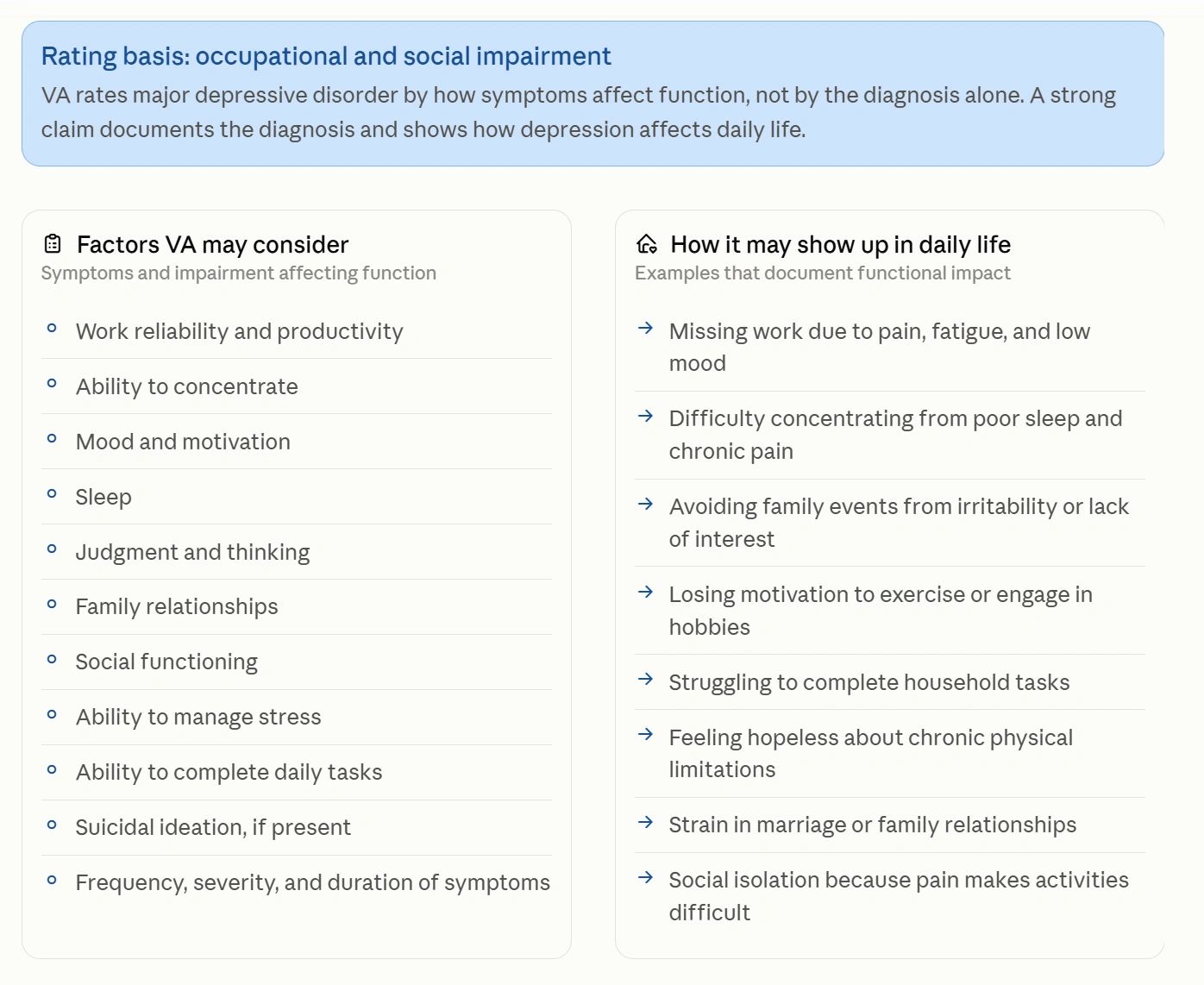
When to Consider a Nexus Letter After a VA Denial
If VA denied your claim for depression secondary to cervical strain, review the denial letter carefully. The reason for denial often reveals what evidence VA believes is missing.
You may want to consider a nexus letter if the VA denial says:
- There is no link between cervical strain and depression
- The mental health condition is unrelated to the service-connected disability
- Depression is due to other life stressors
- There is no evidence of depression during service
- The medical opinion did not support secondary service connection
- The evidence does not show aggravation
- The claim lacks a persuasive rationale
A psychiatric nexus letter may help by directly addressing the denial rationale and explaining the medical relationship between chronic cervical pain and Major Depressive Disorder.
To discuss your case with Dr. Allen, book a free phone consultation or call our office (984) 237-8044.
How a Psychiatrist Can Help With a Depression Nexus Letter
A claim involving Major Depressive Disorder secondary to cervical strain is a psychiatric claim. While the physical pain begins in the neck, the claimed secondary condition is mental health-related.
A psychiatrist can evaluate whether the veteran meets diagnostic criteria for Major Depressive Disorder and whether the depression is medically related to the service-connected cervical strain.
A psychiatric nexus letter may be especially helpful when the claim involves:
- Chronic pain and depression
- Sleep disruption due to pain
- Loss of functioning
- Occupational impairment
- Social withdrawal
- Multiple possible causes of depression
- Aggravation rather than direct causation
- A prior VA denial
- A negative C&P opinion
The goal is not to exaggerate symptoms. The goal is to clearly explain the veteran’s actual clinical picture and how the service-connected cervical strain has affected mental health.
Why Work With Dr. Jessica Allen for a Depression Nexus Letter?
A claim for Major Depressive Disorder secondary to cervical strain requires more than generic language. It requires a clinician who understands psychiatric diagnosis, chronic pain, functional impairment, and VA claim standards.
Dr. Jessica Allen is a psychiatrist, fellowship trained in addiction psychiatry, and a former VA C&P examiner. She understands how VA evaluates mental health claims and how to explain the relationship between service-connected physical conditions and psychiatric symptoms in a clear, evidence-based way.
At Brightview Psychiatry Solutions, each opinion is based on the veteran’s actual records, symptoms, history, and functional impairment. The goal is to provide a thoughtful, individualized psychiatric nexus letter when the evidence supports one.
If your cervical strain has contributed to depression, sleep disruption, loss of motivation, social withdrawal, occupational impairment, or reduced quality of life, a well-supported nexus letter may help explain that connection.
To discuss your case with Dr. Allen, book a free phone consultation or call our office (984) 237-8044.
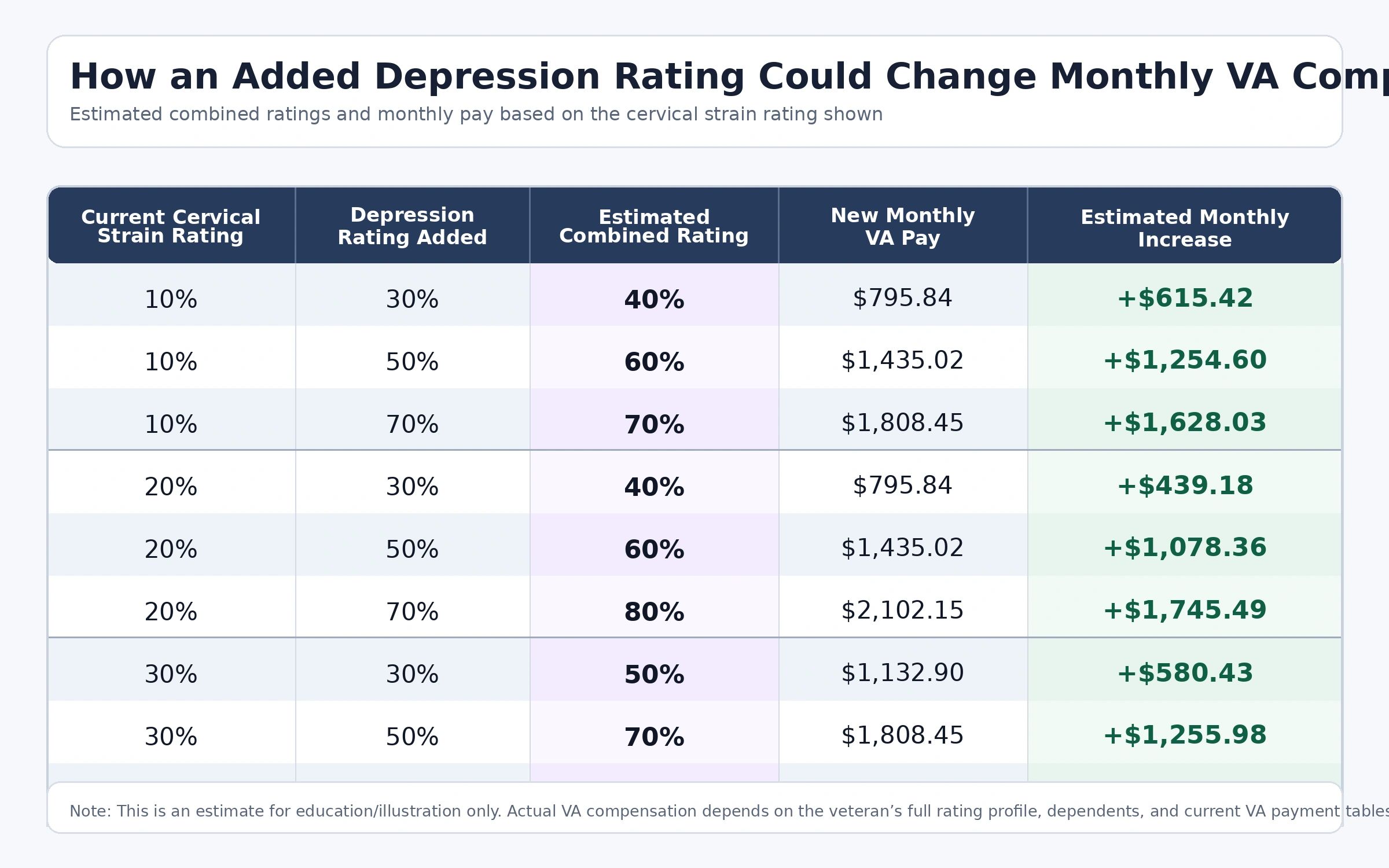
The Financial Impact of Adding a Depression Rating Secondary to Cervical Strain
For many veterans, a successful secondary claim for Major Depressive Disorder secondary to cervical strain can change more than the disability percentage on paper. It may also meaningfully increase monthly VA compensation.
Cervical strain is commonly rated under VA’s spine rating criteria. Many cervical strain ratings fall at 10%, 20%, or 30%, depending on range of motion, pain, muscle spasm, guarding, abnormal spinal contour, or ankylosis. Under the General Rating Formula for Diseases and Injuries of the Spine, VA assigns a 10% rating for certain mild cervical range-of-motion limitations or localized tenderness, a 20% rating for more restricted cervical motion or certain muscle spasm/guarding findings, and a 30% rating when cervical forward flexion is 15 degrees or less or there is favorable ankylosis of the entire cervical spine. VA also notes that associated objective neurologic abnormalities may be evaluated separately.
When depression is added as a secondary condition, VA does not simply add the percentages together. VA uses combined-ratings math. That means a veteran with a 20% cervical strain rating and a new 50% depression rating would usually combine to 60%, not 70%.
Ready to Discuss a Nexus Letter for Depression Secondary to Cervical Strain?
If you are service connected for cervical strain and believe your chronic neck pain has contributed to depression, sleep problems, social withdrawal, loss of motivation, or difficulty working, Brightview Psychiatry Solutions can review whether a nexus letter for depression secondary to cervical strain may be appropriate for your VA claim.
Schedule a free phone consultation to discuss your records and whether a psychiatric nexus letter could help support your claim.
Call: (984) 237-8044 Website: ptsdnc.com
Frequently Asked Questions About Depression Secondary to Cervical Strain Nexus Letters
Can I claim depression secondary to cervical strain?
Yes. If you are already service connected for cervical strain and have been diagnosed with Major Depressive Disorder, you may be able to claim depression as secondary to cervical strain if the evidence supports that chronic neck pain caused or aggravated your depression.
Do I need a nexus letter for depression secondary to cervical strain?
A nexus letter is not always legally required, but it can be very helpful if VA needs a medical explanation connecting your service-connected cervical strain to Major Depressive Disorder. This is especially true if VA has denied the claim or questioned the relationship between neck pain and depression.
What should a nexus letter for depression secondary to cervical strain say?
A strong nexus letter should explain the veteran’s diagnosis, history of cervical strain, chronic pain symptoms, sleep disruption, functional limitations, occupational impairment, and how those factors caused or aggravated Major Depressive Disorder. It should also address other possible causes when relevant.
Can chronic neck pain cause depression?
Chronic neck pain can contribute to depression in some veterans by disrupting sleep, limiting activity, reducing independence, interfering with work, and worsening quality of life. For VA purposes, the question is whether the evidence supports that the service-connected cervical strain at least as likely as not caused or aggravated the depressive disorder.
What if my depression started years after service?
That can still be consistent with a secondary claim. For depression secondary to cervical strain, the key issue is not whether depression began during military service. The key issue is whether the service-connected cervical strain later caused or worsened the depression.
What if I have other causes of depression?
Other causes do not automatically prevent secondary service connection. Many veterans have more than one factor contributing to depression. A strong medical opinion can explain whether cervical strain remains a clinically significant cause or aggravating factor.
Can cervical strain aggravate pre-existing depression?
Yes. Even if depression existed for another reason, service-connected cervical strain may aggravate the condition if chronic neck pain, sleep disruption, and functional decline made the depression worse.
What evidence helps support a depression secondary to cervical strain claim?
Helpful evidence may include a current mental health diagnosis, VA rating decision for cervical strain, records documenting chronic neck pain, treatment notes, pain management records, physical therapy records, medication lists, mental health records, lay statements, and a well-reasoned nexus letter.
Can I file a supplemental claim after VA denies depression secondary to cervical strain?
Yes. If VA denied the claim, a veteran may be able to file a supplemental claim with new and relevant evidence. A psychiatric nexus letter may serve as new and relevant evidence if it addresses the reason VA denied the claim.
Can Dr. Jessica Allen write a nexus letter for depression secondary to cervical strain?
Brightview Psychiatry Solutions can review your records and symptoms to determine whether a psychiatric nexus letter is clinically supportable. Not every case will support a positive opinion, but if the evidence supports the connection, Dr. Jessica Allen can provide a detailed, individualized opinion.
Sources
- 38 C.F.R. § 3.310 — Disabilities proximately due to, or aggravated by, service-connected disease or injury. https://www.ecfr.gov/current/title-38/chapter-I/part-3/subpart-A/subject-group-ECFR39056aee4e9ff13/section-3.310
- VA/DoD Clinical Practice Guideline for the Management of Major Depressive Disorder. https://www.healthquality.va.gov/guidelines/MH/mdd/
- VA Mental Disorders Disability Benefits Questionnaire. https://www.benefits.va.gov/compensation/docs/Mental_Disorders.pdf
- BMC Musculoskeletal Disorders — Systematic review on cervical spine pain, radiculopathy, and mental health symptoms. https://link.springer.com/article/10.1186/s12891-023-06343-8
- Scientific Reports — Research on chronic neck pain and depressive symptoms. https://www.nature.com/articles/s41598-025-18868-0
Disclaimer
This blog is for general educational purposes only and does not provide medical advice, legal advice, or a guarantee of any VA claim outcome. Veterans should consult with an appropriate medical, legal, or accredited VA claims professional about their individual circumstances.