
Headache Nexus Letters for Veterans: The Complete Guide
Author: Jessica R. Allen, M.D., physician and former C&P examiner
If you would like to speak with Dr. Allen to discuss your VA disability case, please book a phone consultation at this link: Free Phone Consultation Booking
Headache Nexus Letters for Veterans: The Complete Guide to Service Connection, Secondary Conditions, and Medical Evidence
Veterans can use a headache nexus letter to support VA disability claims for migraines, tension headaches, sinus headaches, cervicogenic headaches, and headaches secondary to PTSD, tinnitus, sleep apnea, sinusitis, rhinitis, or neck injuries.
Headache Nexus Letters for Veterans: What You Need to Know
Headaches are one of the most common disabling conditions among veterans, yet they are often misunderstood, underdeveloped, or denied in VA disability claims. Many veterans experience chronic migraines, tension-type headaches, sinus headaches, cervicogenic headaches, occipital headaches, or morning headaches without realizing that these conditions may be connected to military service or to an already service-connected disability.
A headache nexus letter is a medical opinion letter that explains whether a veteran’s headache condition is at least as likely as not related to military service, caused by a service-connected condition, or aggravated beyond its natural progression by a service-connected condition.
For many veterans, the issue is not whether the headaches are real. The issue is whether the evidence clearly explains the medical pathway between the veteran’s service, current symptoms, diagnosis, and disability.
This guide explains how headache nexus letters work, which service-connected conditions commonly contribute to headaches, what evidence matters, and how veterans can strengthen a VA claim for headaches.
What Is a Headache Nexus Letter?
A headache nexus letter is an independent medical opinion that connects a veteran’s current headache diagnosis to a medically supportable cause.
In VA disability claims, a nexus letter may help explain that a veteran’s headaches are:
- Directly related to military service, such as headaches that began after an in-service injury, blast exposure, deployment stressor, toxic exposure, or documented medical event.
- Secondary to a service-connected condition, meaning an already service-connected disability caused the headache disorder.
- Aggravated by a service-connected condition, meaning the service-connected disability made the headache condition worse, more frequent, longer-lasting, or more functionally impairing.
A strong headache nexus letter does more than simply state that headaches are “related” to service. It should provide a clear medical rationale explaining how and why the connection is medically plausible for that specific veteran.
If you would like to speak with Dr. Allen to discuss your VA disability case, please book a phone consultation at this link: Free Phone Consultation Booking
Why Veterans Often Need a Nexus Letter for Headache Claims
The VA may deny headache claims when the record does not clearly show a connection between the headaches and military service or a service-connected disability. This can happen even when the veteran has a formal diagnosis and significant symptoms.
Common reasons headache claims are denied include:
- The VA states there is no documented headache treatment during service.
- The VA finds no “chronicity” or continuity of symptoms.
- The VA examiner concludes the headaches are unrelated to PTSD, tinnitus, sinusitis, rhinitis, sleep apnea, or neck pain.
- The VA attributes the headaches to non-service-connected causes.
- The veteran has symptoms but lacks a detailed diagnosis.
- The medical opinion does not explain the mechanism linking the service-connected condition to the headaches.
- The VA examiner overlooks aggravation.
A well-written nexus letter can help address these gaps by explaining the medical relationship in detail and applying the correct VA standard: at least as likely as not, meaning the evidence is at least approximately balanced or nearly equal, if not higher.
Common Headache Conditions in Veterans
Veterans may experience several different types of headaches. Correctly identifying the headache type is important because different headache conditions may have different medical pathways.
.png)
Migraine Headaches
Migraines are often severe, recurrent headaches that may involve throbbing pain, nausea, vomiting, light sensitivity, sound sensitivity, visual symptoms, dizziness, and the need to lie down in a dark room. In VA claims, migraines are especially important because they may cause prostrating attacks, which can significantly affect disability ratings.
Migraines may be associated with PTSD, tinnitus, traumatic brain injury, sleep disturbance, obstructive sleep apnea, chronic pain, cervical spine conditions, and other service-connected disabilities.
Tension-Type Headaches
Tension-type headaches often feel like pressure, tightness, or a band-like sensation around the head. They may be associated with chronic stress, anxiety, PTSD-related hyperarousal, poor sleep, muscle tension, or cervical strain.
Morning Headaches
Morning headaches are commonly reported by veterans with obstructive sleep apnea, sleep fragmentation, nocturnal oxygen desaturation, insomnia, or poor sleep quality. They may also occur when sleep is disrupted by PTSD nightmares, tinnitus, pain, or other conditions.
Sinus Headaches
Sinus headaches may be associated with sinusitis, rhinitis, nasal obstruction, congestion, facial pressure, and inflammation of the upper airway. Veterans who are service-connected for chronic sinusitis or allergic rhinitis may have a medically supportable pathway to secondary headaches.
Cervicogenic Headaches
Cervicogenic headaches originate from the cervical spine or neck structures. These headaches may be linked to service-connected cervicalgia, cervical strain, degenerative disc disease, cervical radiculopathy, whiplash injury, or other neck injuries.
Occipital Headaches
Occipital headaches often involve pain in the back of the head or upper neck. They may be associated with nerve irritation, cervical muscle spasm, occipital neuralgia, or cervical spine pathology.
If you would like to speak with Dr. Allen to discuss your VA disability case, please book a phone consultation at this link: Free Phone Consultation Booking
Service-Connected Conditions That May Contribute to Headaches
.png)
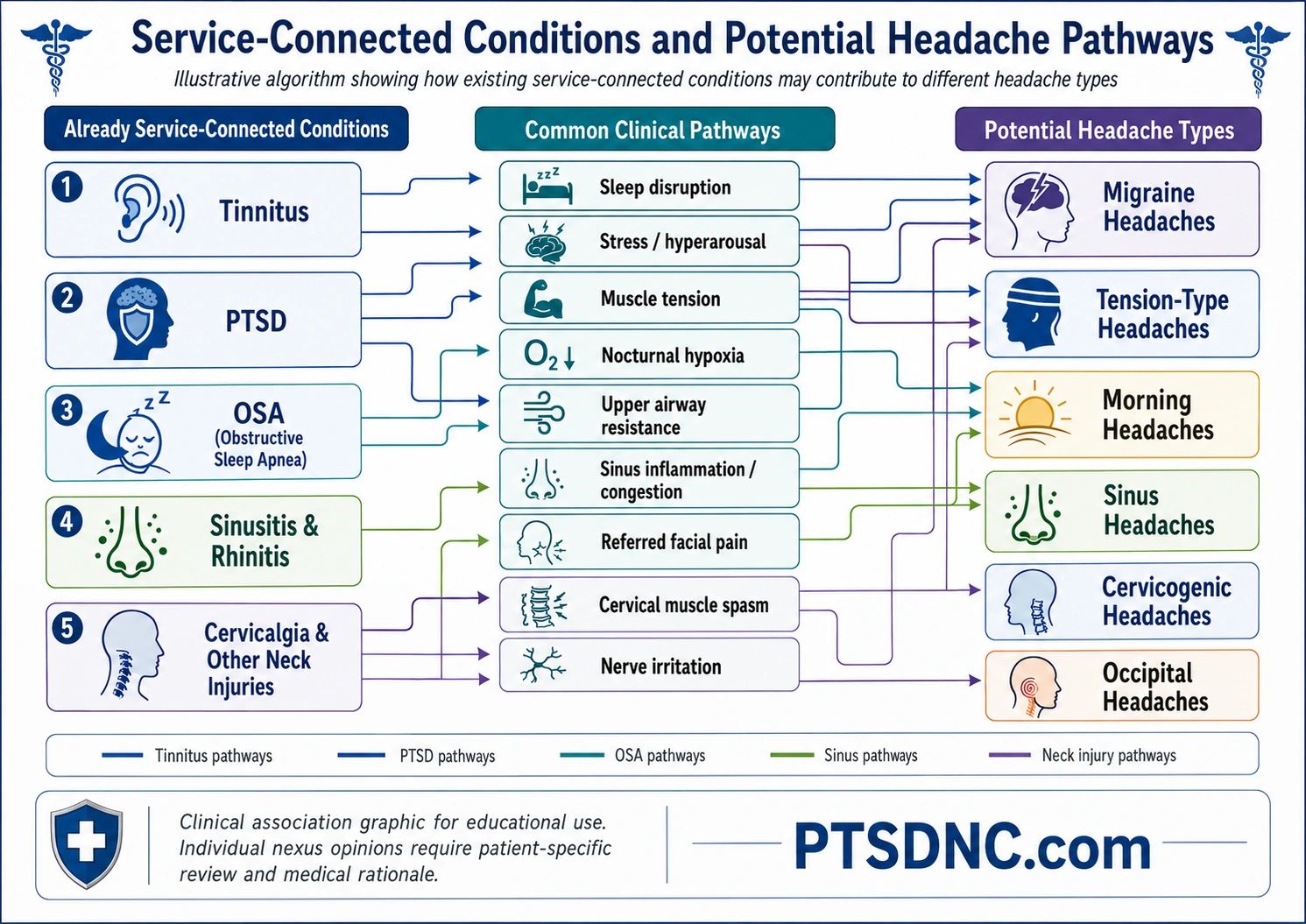
The graphic above illustrates how several already service-connected conditions may contribute to different headache types through common clinical pathways.
These relationships are not automatic. Each veteran’s case requires individualized review, diagnosis, and medical rationale. However, the following pathways are frequently relevant in VA headache nexus letters.
Tinnitus and Headaches
Tinnitus is a common service-connected condition among veterans. Many veterans with tinnitus report that the constant ringing, buzzing, or high-pitched noise interferes with sleep, concentration, stress tolerance, and emotional regulation.
Tinnitus may contribute to headaches through several mechanisms:
- Sleep disruption
- Chronic stress
- Hyperarousal
- Increased muscle tension
- Reduced restorative sleep
- Irritability and nervous system sensitization
For some veterans, tinnitus-related sleep impairment and stress may increase the frequency or severity of migraines or tension-type headaches. A nexus letter should explain how tinnitus affects that specific veteran, including whether the headaches worsened after tinnitus became chronic or severe.
Learn about other conditions that can be claimed secondary to tinnitus: Depression and Insomnia Secondary to Tinnitus
If you would like to speak with Dr. Allen to discuss your VA disability case, please book a phone consultation at this link: Free Phone Consultation Booking
PTSD and Headaches
PTSD is another common service-connected condition that may be relevant to headache claims. PTSD can affect the body through chronic activation of the stress response, sleep disruption, hypervigilance, nightmares, irritability, and muscle tension.
PTSD may contribute to headaches through:
- Stress and hyperarousal
- Sleep fragmentation
- Nightmares and insomnia
- Muscle tension in the jaw, neck, and shoulders
- Autonomic nervous system dysregulation
- Increased sensitivity to pain
- Emotional stress that triggers migraines
For veterans with PTSD, headaches may become more frequent during periods of increased anxiety, poor sleep, panic symptoms, anger, trauma reminders, or emotional distress.
A strong PTSD-related headache nexus letter should explain not just that PTSD and headaches coexist, but how PTSD symptoms physiologically and functionally contribute to the veteran’s headache disorder.
Learn about other conditions that can be claimed secondary to PTSD: PTSD Secondary Conditions
If you would like to speak with Dr. Allen to discuss your VA disability case, please book a phone consultation at this link: Free Phone Consultation Booking
Obstructive Sleep Apnea and Headaches
Obstructive sleep apnea, also known as OSA, is frequently associated with morning headaches, poor sleep quality, daytime fatigue, cognitive problems, and mood symptoms.
OSA may contribute to headaches through:
- Nocturnal hypoxia
- Repeated oxygen desaturation
- Sleep fragmentation
- Carbon dioxide retention
- Upper airway resistance
- Non-restorative sleep
- Increased vascular and inflammatory stress
Veterans with OSA may report waking up with headaches, experiencing fatigue-related headaches during the day, or having migraines worsened by poor sleep.
A headache nexus letter related to OSA should review the veteran’s sleep study, CPAP use, morning headache pattern, sleep quality, daytime fatigue, and whether headaches improved, persisted, or worsened with treatment.
Learn about other conditions that can be claimed secondary to sleep apnea: OSA secondary conditions
If you would like to speak with Dr. Allen to discuss your VA disability case, please book a phone consultation at this link: Free Phone Consultation Booking
Sinusitis, Rhinitis, and Headaches
Chronic sinusitis and allergic rhinitis can contribute to headaches through inflammation, congestion, nasal obstruction, facial pressure, and upper airway irritation.
These conditions may contribute to:
- Sinus headaches
- Facial pain
- Pressure behind the eyes
- Morning headaches
- Headaches worsened by congestion
- Headaches associated with weather changes or flare-ups
For veterans already service-connected for sinusitis or rhinitis, a headache nexus letter may explain how chronic inflammation and congestion contribute to recurring headache symptoms.
The strongest claims typically include documentation of sinus symptoms, nasal obstruction, congestion, facial pressure, imaging if available, medication use, and the timing of headache flare-ups.
Learn about claiming other condition secondary to sinusitis and rhinitis: Claiming Obstructive Sleep Apnea Secondary to Sinusitis
If you would like to speak with Dr. Allen to discuss your VA disability case, please book a phone consultation at this link: Free Phone Consultation Booking
Direct Service Connection for Headaches
Some veterans pursue headache claims based on direct service connection. This may apply when headaches began during service or after a specific in-service event.
Examples may include:
- Headaches documented in service treatment records
- Headaches after a blast exposure
- Headaches after a traumatic brain injury
- Headaches after a vehicle accident
- Headaches after a fall, assault, or head injury
- Headaches after toxic exposure or deployment-related illness
- Headaches that began during active duty and continued after discharge
For direct service connection, the nexus letter should discuss the veteran’s in-service event, onset of symptoms, continuity of headache problems, current diagnosis, and why the current headache condition is medically consistent with the service history.
Secondary Service Connection for Headaches
Many headache claims are filed as secondary claims. This means the veteran is already service-connected for one condition, and the headache disorder developed because of that condition.
Examples include:
- Migraines secondary to PTSD
- Headaches secondary to tinnitus
- Morning headaches secondary to obstructive sleep apnea
- Sinus headaches secondary to chronic sinusitis or rhinitis
- Cervicogenic headaches secondary to cervical spine conditions
- Tension headaches secondary to chronic pain or mental health conditions
Secondary service connection can be especially important when headaches were not clearly documented during service but later developed as a result of an already service-connected disability.
If you would like to speak with Dr. Allen to discuss your VA disability case, please book a phone consultation at this link: Free Phone Consultation Booking
Aggravation of Headaches by a Service-Connected Condition
Aggravation is often overlooked. A veteran does not always have to prove that a service-connected condition originally caused the headaches. In some cases, the service-connected condition may have materially worsened the headache disorder.
For example:
- PTSD may increase migraine frequency.
- Tinnitus may worsen sleep and trigger more headaches.
- OSA may aggravate morning headaches through poor sleep and oxygen desaturation.
- Cervical spine pain may intensify cervicogenic headaches.
- Sinusitis may worsen headache flare-ups during periods of congestion.
- Chronic pain may increase muscle tension and headache severity.
A strong nexus letter should address whether the headaches would not have developed, or would not have been aggravated to their current degree of severity, but for the effects of the service-connected condition.
VA Ratings for Migraine Headaches
.png)
Migraine headaches are commonly rated under VA diagnostic criteria that focus heavily on the frequency and severity of prostrating attacks and whether the condition causes severe economic inadaptability.
Veterans should understand that the VA rating does not depend only on having a migraine diagnosis. The rating often depends on how often the headaches are severe enough to require the veteran to stop activity, lie down, isolate, miss work, leave work early, or be unable to function.
Important evidence may include:
- Frequency of migraine attacks
- Duration of attacks
- Whether attacks are prostrating
- Nausea, vomiting, photophobia, or phonophobia
- Need to lie down in a dark room
- Missed work or reduced productivity
- Emergency treatment or urgent care visits
- Medication use
- Headache logs
- Lay statements from family, coworkers, or supervisors
Veterans seeking a higher rating should document not only pain, but also functional impairment.
If you would like to speak with Dr. Allen to discuss your VA disability case, please book a phone consultation at this link: Free Phone Consultation Booking
What Does “Prostrating” Mean for VA Headache Claims?
In practical terms, a prostrating headache is one that forces the veteran to stop normal activity because the symptoms are too severe to continue functioning.
A veteran experiencing a prostrating migraine may need to:
- Lie down
- Turn off lights
- Avoid sound
- Sleep for several hours
- Stop working
- Leave a social or family activity
- Avoid driving
- Take medication and wait for symptoms to pass
The word “prostrating” is important because VA migraine ratings often depend on whether attacks are prostrating and how often they occur.
Evidence That Helps Support a Headache Nexus Letter
.png)
A headache nexus letter is strongest when supported by medical records, symptom history, and functional evidence. Veterans should gather as much relevant documentation as possible.
Helpful evidence may include:
- Current headache diagnosis
- Neurology records
- Primary care records
- VA treatment records
- Private treatment records
- Medication history
- Migraine logs or headache diaries
- Sleep study results
- CPAP records
- Service treatment records
- VA rating decisions
- List of service-connected conditions
- Imaging reports, if relevant
- Sinus imaging or ENT records
- Cervical spine imaging
- Physical therapy records
- Mental health treatment records
- Lay statements
- Work attendance records
- FMLA records or employer statements
The more specific the evidence, the stronger the medical rationale can be.
What Should Be Included in a Strong Headache Nexus Letter?
.png)
A high-quality headache nexus letter should include several key elements.
It should identify the veteran, list relevant records reviewed, describe the current headache diagnosis, summarize the veteran’s symptom history, and explain the medical relationship between the headaches and service or a service-connected condition.
The letter should also use the proper VA evidentiary standard, such as:
“It is at least as likely as not — meaning the likelihood is at least approximately balanced or nearly equal, if not higher — that the veteran’s headache condition is proximately due to, the result of, and/or aggravated by the service-connected condition.”
The medical rationale should be specific to the veteran. Generic statements are usually less persuasive. The opinion should explain the actual pathway, such as sleep disruption, hyperarousal, nocturnal hypoxia, sinus inflammation, cervical muscle spasm, or nerve irritation.
f you would like to speak with Dr. Allen to discuss your VA disability case, please book a phone consultation at this link: Free Phone Consultation Booking
Common Mistakes Veterans Make in Headache Claims
.png)
Many veterans unintentionally weaken their headache claims by submitting incomplete or unclear evidence.
Common mistakes include:
- Filing headaches without a clear diagnosis
- Not explaining how often headaches occur
- Failing to document prostrating attacks
- Not keeping a headache log
- Assuming the VA will connect headaches to PTSD, tinnitus, OSA, sinusitis, or neck pain automatically
- Submitting a nexus letter with little or no rationale
- Ignoring aggravation
- Not explaining occupational impairment
- Failing to describe medication side effects
- Not connecting symptoms to an already service-connected condition
A strong claim usually requires both medical evidence and a clear explanation of functional impairment.
If you would like to speak with Dr. Allen to discuss your VA disability case, please book a phone consultation at this link: Free Phone Consultation Booking
Headache Logs: Why They Matter
A headache log can be one of the most useful pieces of evidence in a VA headache claim. It helps show the frequency, severity, duration, triggers, and functional effects of headaches.
A good headache log should include:
- Date of headache
- Start and end time
- Pain severity
- Location of pain
- Associated symptoms
- Possible triggers
- Medication taken
- Whether the veteran had to lie down
- Whether work or daily activities were affected
- Whether light or sound sensitivity occurred
- Whether nausea or vomiting occurred
Veterans should be honest and consistent. The goal is not to exaggerate symptoms, but to clearly document the true pattern of impairment.
Lay Statements for Headache Claims
Lay statements can help explain how headaches affect a veteran’s daily life. Family members, friends, coworkers, or supervisors may observe the veteran lying down, missing activities, leaving work, avoiding light, or becoming unable to function during headache episodes.
A strong lay statement may describe:
- How often the veteran has headaches
- What the veteran does during a headache
- Whether the veteran must isolate
- Whether the veteran misses work or family events
- How long the headaches last
- Whether the headaches have worsened over time
- How the headaches affect mood, concentration, and reliability
Lay evidence cannot replace medical evidence, but it can help show the real-world severity of the condition.
Headaches Secondary to PTSD: What Veterans Should Document
Veterans claiming headaches secondary to PTSD should document how PTSD symptoms affect their headache pattern.
Important details include:
- Nightmares
- Insomnia
- Panic attacks
- Hypervigilance
- Irritability
- Muscle tension
- Jaw clenching
- Stress-triggered migraines
- Headaches after poor sleep
- Headaches during trauma reminders
- Increased headache frequency during PTSD flare-ups
A strong nexus letter should explain the pathway between PTSD-related hyperarousal, sleep disruption, muscle tension, and headache symptoms.
Headaches Secondary to Tinnitus: What Veterans Should Document
Veterans claiming headaches secondary to tinnitus should document how tinnitus affects sleep, stress, concentration, and headache triggers.
Important details include:
- Whether tinnitus interferes with sleep
- Whether headaches are worse after poor sleep
- Whether tinnitus increases stress or irritability
- Whether headaches occur during severe tinnitus flare-ups
- Whether tinnitus contributes to concentration problems
- Whether the veteran uses sound machines or other coping methods
The nexus letter should explain why tinnitus-related sleep disruption and stress are medically relevant to the veteran’s headache condition.
Headaches Secondary to Sleep Apnea: What Veterans Should Document
Veterans with OSA and headaches should document morning headache patterns and sleep-related symptoms.
Important evidence includes:
- Sleep study results
- CPAP prescription
- CPAP compliance records
- Morning headaches
- Daytime fatigue
- Brain fog
- Poor concentration
- Non-restorative sleep
- Oxygen desaturation findings
- Headaches after poor sleep
- Whether CPAP improves, partially improves, or does not improve headaches
The medical opinion should discuss sleep fragmentation, nocturnal hypoxia, and the relationship between poor sleep and headache symptoms.
Headaches Secondary to Sinusitis or Rhinitis: What Veterans Should Document
Veterans with sinus-related headaches should document congestion, facial pressure, nasal obstruction, and headache timing.
Helpful evidence includes:
- ENT records
- Sinus imaging
- Allergy treatment
- Nasal sprays
- Antibiotic use
- Steroid use
- Chronic congestion
- Facial pain
- Pressure behind the eyes
- Headaches during sinus flare-ups
- Headaches associated with weather changes or allergens
The nexus letter should explain how inflammation, congestion, and upper airway resistance may contribute to the headache condition.
Questions Veterans Should Be Ready to Answer
Before requesting a headache nexus letter, veterans should be prepared to answer questions such as:
- When did your headaches begin?
- How often do they occur?
- How long do they last?
- Where is the pain located?
- What symptoms occur with the headaches?
- Do you experience nausea, vomiting, light sensitivity, or sound sensitivity?
- Do you have to lie down during headaches?
- Do headaches interfere with work?
- What medications do you take?
- Are you service-connected for PTSD, tinnitus, OSA, sinusitis, rhinitis, or neck conditions?
- Do headaches worsen after poor sleep, stress, sinus flare-ups, or neck pain?
- Have you had a sleep study?
- Have you seen neurology, ENT, primary care, or pain management?
The more complete the history, the more precise the nexus opinion can be.
If you would like to speak with Dr. Allen to discuss your VA disability case, please book a phone consultation at this link: Free Phone Consultation Booking
Can a Veteran Get Service Connection for Headaches Without In-Service Treatment?
Yes, in some cases. Lack of in-service headache treatment does not automatically mean a claim cannot be supported. Many veterans did not seek treatment during service because of military culture, deployment tempo, limited access to care, stigma, or the belief that headaches were temporary.
However, when service treatment records are limited, the claim may need stronger post-service evidence, lay statements, continuity of symptoms, and a detailed medical opinion explaining why the condition is still related to service or to a service-connected disability.
Can Headaches Be Claimed as Secondary to More Than One Condition?
Yes. Many veterans have multiple service-connected conditions that may contribute to headaches at the same time.
For example, a veteran may have:
- PTSD causing hyperarousal and insomnia
- Tinnitus worsening sleep quality
- OSA causing morning headaches
- Cervicalgia causing neck-related headaches
- Rhinitis causing congestion-related headaches
A well-developed nexus letter can discuss multiple contributing pathways when medically appropriate. The key is to avoid overstatement and explain the specific role each condition plays.
What Makes a Headache Nexus Letter Persuasive?
A persuasive headache nexus letter is clear, evidence-based, and individualized. It should not rely on conclusory statements or unsupported claims.
A strong letter typically includes:
- A current headache diagnosis
- A clear explanation of the veteran’s symptoms
- Review of relevant medical records
- Discussion of service-connected conditions
- Explanation of causation and/or aggravation
- Medical literature support where appropriate
- Application of the “at least as likely as not” standard
- Specific rationale connecting the veteran’s history to the opinion
- Discussion of alternative causes when relevant
- Functional impact and severity
The most important part is the rationale. The VA needs to understand why the medical conclusion follows from the evidence.
Final Thoughts: Headache Nexus Letters Can Help Clarify the Medical Pathway
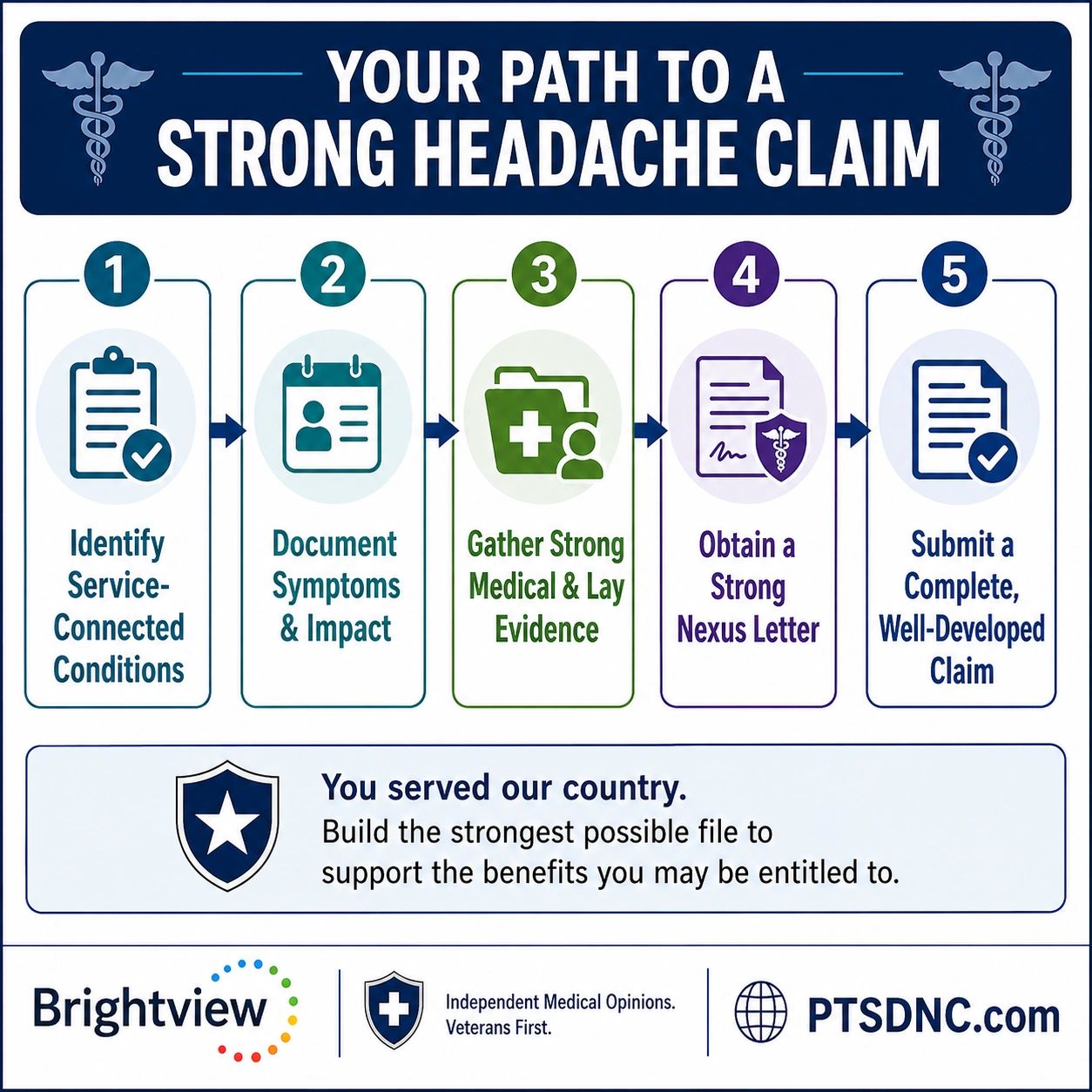
Headache claims can be complex because headaches may have multiple causes and contributing factors. Veterans may experience migraines, tension headaches, sinus headaches, cervicogenic headaches, occipital headaches, or morning headaches related to service or to already service-connected conditions.
A strong headache nexus letter can help explain the relationship between a veteran’s headache disorder and conditions such as PTSD, tinnitus, obstructive sleep apnea, sinusitis, rhinitis, cervicalgia, or neck injuries.
The goal is not to guarantee an outcome. The goal is to provide a clear, medically reasoned opinion that helps support the veteran’s VA claim using patient-specific evidence and an appropriate medical-legal rationale.
Need a Headache Nexus Letter?
Dr. provides independent medical opinions to help veterans support VA disability claims involving headaches, migraines, sleep apnea, PTSD, tinnitus, sinusitis, rhinitis, cervical spine conditions, and related medical issues.
If you would like to speak with Dr. Allen to discuss your VA disability case, please book a phone consultation at this link: Free Phone Consultation Booking
Why Veterans Choose Dr. Allen for Headache Nexus Letters
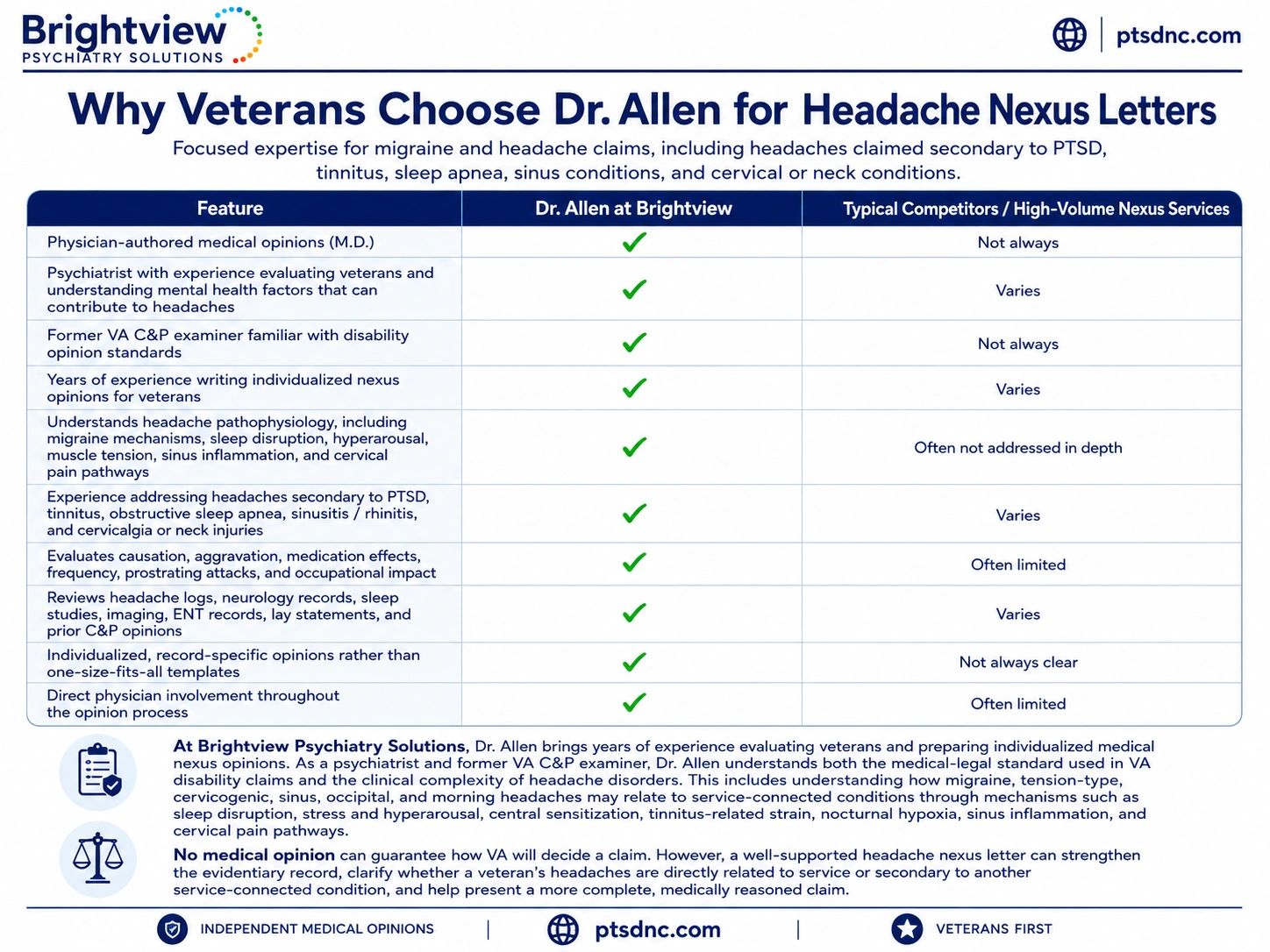
When a veteran is pursuing a VA disability claim for headaches, the medical opinion should do more than simply state that the veteran has headaches. A strong headache nexus letter should explain the medical pathway between the veteran’s current headache disorder and the service-connected condition or in-service event that may have caused or aggravated it. This is where Dr. Allen’s background is especially valuable.
At Brightview Psychiatry Solutions, headache nexus letters are prepared with careful attention to the veteran’s full medical picture, including service-connected conditions, symptom history, treatment records, prior VA decisions, and the specific theory of service connection. Dr. Allen brings years of experience evaluating veterans and preparing individualized medical nexus opinions. As a physician and psychiatrist, she understands how mental health conditions, sleep disturbance, chronic stress, hyperarousal, medication effects, and pain pathways can contribute to or worsen headache disorders.
Many headache claims involve overlapping medical factors. For example, a veteran’s migraines may be influenced by PTSD-related hyperarousal, tinnitus-related sleep disruption, obstructive sleep apnea, chronic sinus inflammation, cervical spine pain, or a combination of these conditions. Dr. Allen’s experience allows her to evaluate these relationships in a detailed and clinically reasoned way rather than relying on a generic template.
This is particularly important for veterans claiming headaches secondary to conditions such as PTSD, depression, anxiety, insomnia, tinnitus, obstructive sleep apnea, sinusitis, rhinitis, cervicalgia, or neck injuries. These claims often require a clear explanation of pathophysiology, including how poor sleep, nocturnal hypoxia, stress response activation, muscle tension, central sensitization, sinus congestion, referred pain, and nerve irritation may contribute to migraine headaches, tension-type headaches, morning headaches, sinus headaches, cervicogenic headaches, or occipital headaches.
Dr. Allen also has experience as a former VA C&P examiner, which gives her familiarity with the medical-legal standards used in VA disability claims. A persuasive nexus letter must apply the correct evidentiary standard, address causation and aggravation where appropriate, and explain why the veteran’s condition is at least as likely as not related to service or to an already service-connected disability. This level of detail can be especially important when the VA has previously denied a claim, relied on an incomplete examiner opinion, or failed to fully consider secondary service connection or aggravation.
Unlike high-volume nexus letter services that may rely heavily on standardized language, Brightview focuses on individualized, record-specific medical opinions. Each opinion is tailored to the veteran’s medical history, headache pattern, service-connected disabilities, treatment records, and functional impairment. The goal is to clarify the medical relationship at issue and help the veteran submit a more complete, medically reasoned claim.
No medical opinion can guarantee how the VA will decide a claim. However, a well-supported headache nexus letter can strengthen the evidentiary record, explain the clinical basis for service connection, and help ensure that the veteran’s headache condition is evaluated in light of the full medical context.
For veterans dealing with chronic migraines, tension headaches, morning headaches, sinus headaches, cervicogenic headaches, or occipital headaches, Dr. Allen’s combination of medical training, psychiatric expertise, VA disability experience, and understanding of headache pathophysiology makes Brightview Psychiatry Solutions a strong choice for an independent headache nexus letter. Visit PTSDNC.com to learn more.
Frequently Asked Questions About Headache Nexus Letters
What is a headache nexus letter?
A headache nexus letter is a medical opinion that explains whether a veteran’s headache condition is at least as likely as not related to military service, caused by a service-connected condition, or aggravated by a service-connected condition.
Can migraines be secondary to PTSD?
Migraines may be medically associated with PTSD-related sleep disruption, stress, hyperarousal, and nervous system sensitization. A nexus letter should explain the specific pathway in the individual veteran’s case.
Can tinnitus cause headaches?
Tinnitus may contribute to headaches indirectly through sleep disruption, chronic stress, hyperarousal, and reduced concentration. The connection should be explained with patient-specific evidence.
Can sleep apnea cause morning headaches?
Obstructive sleep apnea may contribute to morning headaches through sleep fragmentation, nocturnal hypoxia, oxygen desaturation, and poor sleep quality.
Can sinusitis or rhinitis cause headaches?
Chronic sinusitis and rhinitis may contribute to headaches through congestion, sinus inflammation, facial pressure, nasal obstruction, and upper airway irritation.
Can neck injuries cause headaches?
Cervical spine conditions may contribute to cervicogenic or occipital headaches through muscle spasm, nerve irritation, restricted motion, and referred pain.
What evidence helps a VA headache claim?
Helpful evidence includes a diagnosis, treatment records, headache logs, medication history, lay statements, work impairment documentation, service-connected condition records, sleep studies, sinus records, and cervical spine records.
Do I need a nexus letter for a VA headache claim?
Not every claim requires a nexus letter, but a nexus letter may help when the VA needs a clearer explanation connecting the headache condition to service or to an already service-connected disability.
If you would like to speak with Dr. Allen to discuss your VA disability case, please book a phone consultation at this link: Free Phone Consultation Booking