
How to Track Your PTSD Symptoms to Support a VA Rating Increase
Author: Dr. Jessica Allen, Psychiatrist, Nexus Letter Doctor, and Former C&P Examiner
To contact Dr. Allen, please schedule a free phone consultation or call our office at (984) 237-8044.
Reviewed and Updated: July 3, 2026
How to Track Your PTSD Symptoms to Support a VA Rating Increase (and Strengthen Your Nexus Letter)
If your PTSD has gotten worse since your last rating, you already know the hardest part isn't living it — it's proving it. Veterans file for an increase every day and get denied, not because their symptoms aren't real, but because the file doesn't show the VA what changed. The single most effective thing you can do before you file is start tracking your symptoms in a way that maps to how the VA actually rates PTSD.
This guide covers the symptom trackers and screeners that build that evidence, how a nexus letter (or independent medical opinion) fits an increase claim, and how to turn months of scattered bad days into documentation a rating official can't ignore.
What the VA Is Actually Rating When You File for a PTSD Increase
Here's the piece most veterans miss: the VA is not scoring your symptom checklist. Under the current regulation — 38 CFR § 4.130, the General Rating Formula for Mental Disorders — PTSD is rated at 0%, 10%, 30%, 50%, 70%, or 100% based on your occupational and social impairment: how much your symptoms interfere with holding a job and maintaining relationships and daily functioning.
That's why a veteran with severe symptoms can still be underrated if the record only shows a diagnosis and a medication list. The rating turns on impact — frequency, severity, and how the condition shows up at work, at home, and in public.
What about the "new PTSD rating changes" you've heard about? The VA has proposed a new five-domain model for mental health, but as of July 3, 2026 it is still a proposed rule with no effective date, and 38 CFR § 4.130 remains the controlling law. Existing ratings are grandfathered and can't be reduced simply because the rules change. The good news: documenting how PTSD affects your functioning strengthens your claim under both the current formula and the proposed one — so tracking is never wasted effort.
Nexus Letter, IMO, or DBQ: Which One Does an Increase Claim Actually Need?
"Nexus letter" is the phrase most veterans search for, so let's clear up the terminology, because using the right document matters:
- A true nexus letter links a condition to your service (or to another service-connected condition). You need this to establish service connection — for example, a nexus letter for sleep apnea secondary to PTSD, or depression secondary to PTSD.
- For an increase on a condition that's already service-connected, the nexus is usually already established. What moves the needle is a strong medical opinion on your current severity — often called an Independent Medical Opinion (IMO) — that documents how bad things are now and ties your symptoms to specific functional impairment.
- A DBQ (Disability Benefits Questionnaire) is the VA's standardized form a provider can complete to report your diagnosis and severity in the VA's own language.
In plain terms: if you're claiming a new secondary condition, you likely need a nexus letter. If you're claiming that your existing PTSD got worse, you likely need a strong severity opinion or DBQ. A good evaluating psychiatrist will tell you which one your situation calls for — and the symptom tracking below feeds directly into all three.
The Best PTSD Symptom Trackers and Screeners (Beyond the PCL-5)
Most veterans know the PCL-5 (the 20-item PTSD Checklist). It's a great baseline, but it's stronger when paired with tools that capture the associated symptoms and functional impairment the rating criteria actually name. Here are the ones worth using.
PTSD-Specific Self-Report Measures
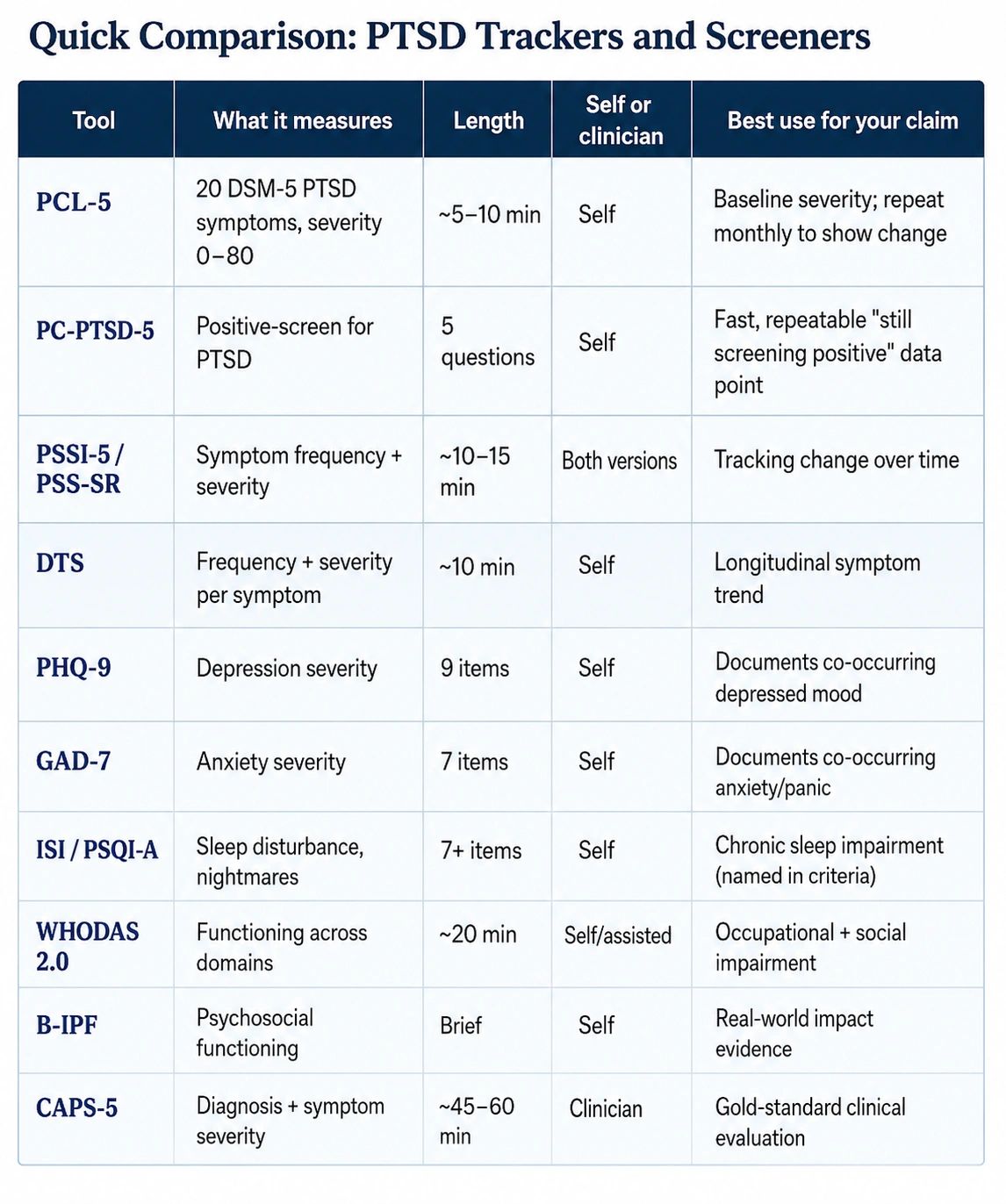
- PC-PTSD-5 (Primary Care PTSD Screen). A quick five-question screen used across the VA and DoD; a score of 3 or higher signals the need for further evaluation. Best as a fast, repeatable "am I still screening positive" data point.
- PSSI-5 / PSS-SR (PTSD Symptom Scale). Captures the frequency and severity of symptoms, which makes it excellent for showing change over time.
- Davidson Trauma Scale (DTS). A 17-item measure rating both frequency and severity of each symptom — another solid longitudinal tracker.
- CAPS-5 (Clinician-Administered PTSD Scale). The clinical gold standard, done by a trained provider. You can't self-administer it, but it's essentially what a strong evaluation is built around — and understanding it helps you see why a self-screener alone isn't a diagnosis.
Trackers for the "Associated" Symptoms the Rating Criteria Name
The rating formula specifically references things like chronic sleep impairment, panic, depressed mood, irritability, and concentration problems. Documenting the conditions that travel with PTSD paints the full picture:
- PHQ-9 — depression (its final item also flags suicidal thoughts, which speaks to severity).
- GAD-7 — anxiety.
- Insomnia Severity Index (ISI) or PSQI-A — sleep disturbance and nightmares.
- AUDIT-C — alcohol use, which frequently co-occurs with PTSD.
Functional-Impairment Measures — the Ones That Matter Most for a Rating
- WHODAS 2.0 (WHO Disability Assessment Schedule) — measures functioning across life domains and speaks directly to occupational and social impairment. (It's also the backbone of the VA's proposed new model.)
- Brief Inventory of Psychosocial Functioning (B-IPF) — built by the VA's National Center for PTSD specifically to capture functioning.
- A dated symptom journal — often the single most persuasive lay evidence. Tie each episode to a concrete impact: a shift missed, a fight with your spouse, a store you walked out of, a night with two hours of sleep.
Free VA Apps That Track for You
- PTSD Coach (free, from the VA's National Center for PTSD) includes the PCL and PC-PTSD-5 self-assessments plus trackers for mood, triggers, and medication. Crucially, you can export and share your data — and once you send it to a provider, they handle it under HIPAA, so it can land in your medical record.
- Insomnia Coach has a built-in sleep diary. Mindfulness Coach, AIMS (anger), and VetChange (alcohol) all include self-tracking.
- CPT Coach and PE Coach track symptoms across the course of therapy and let you export worksheets and assessments — useful if you're already in treatment with a trained clinician.
Quick Comparison: PTSD Trackers and Screeners
How to Turn Tracking Into Evidence That Actually Helps
Collecting scores isn't the goal — getting them into your record in a credible, consistent form is. A few rules:
- Be consistent and date everything. A steady monthly PCL-5 plus a running journal beats a single dramatic snapshot. Trends are persuasive.
- Get it into your medical record. Share your logs and app exports with your treating provider so they appear in your clinical notes. Self-tracking supports a claim; it doesn't replace clinical documentation.
- Connect symptoms to function. "Nightmares 5 nights this week" is data. "Nightmares 5 nights this week, so I called out of work twice and slept in a separate room from my spouse" is evidence.
- Add lay/buddy statements. A spouse, coworker, or battle buddy describing what they witness fills gaps your own records can't.
- Don't over-read a screener. A high PC-PTSD-5 is a flag, not a diagnosis. The strongest files pair self-tracking with a thorough clinical evaluation.
To contact Dr. Allen, please schedule a free phone consultation or call our office at (984) 237-8044.
Why Work With Dr. Jessica Allen for Your PTSD Increase Nexus Letter?
A PTSD increase claim often depends on more than listing symptoms. The strongest evidence explains how those symptoms affect your ability to work, maintain relationships, manage stress, complete daily tasks, and function consistently over time. A nexus letter or severity opinion is only as strong as the clinician behind it, and Dr. Jessica Allen brings the psychiatric training and VA disability experience needed to write opinions that are clinically meaningful and claim-focused.
As a licensed psychiatrist with specialized training in adult and addiction psychiatry, and as a former VA C&P examiner, Dr. Allen understands both the medical side of PTSD and the way VA evaluates mental health claims.
A real psychiatric evaluation — not a rubber stamp. Every opinion is grounded in a DSM-5 clinical assessment, a careful review of your records, and a detailed understanding of your symptoms, treatment history, trauma history, and day-to-day impairment. The goal is not to simply repeat what is already in your file, but to explain the clinical significance of the evidence in a way VA raters can understand.
A focus on occupational and social impairment. PTSD ratings are driven by how symptoms affect real-world functioning. Dr. Allen’s opinions connect symptoms such as panic, irritability, avoidance, hypervigilance, impaired concentration, sleep disruption, emotional numbing, and difficulty adapting to stress with the occupational and social impairment that VA considers when assigning a rating. Her reports address the frequency, severity, and duration of symptoms and explain how those symptoms affect work, relationships, reliability, productivity, and daily functioning.
Support for secondary conditions when appropriate. PTSD rarely affects only one area of life. For some veterans, PTSD may contribute to or aggravate other conditions such as depression, anxiety, insomnia, sleep apnea, weight gain, hypertension, or substance-use-related complications. When medically supportable, Dr. Allen can evaluate whether a secondary nexus exists and explain the clinical pathway clearly and responsibly.
Experience with the language VA uses. Because Dr. Allen has experience as a former C&P examiner, she understands the importance of writing opinions that are medically sound, well-reasoned, and aligned with VA’s rating framework. A strong PTSD increase opinion should not be vague. It should clearly explain what symptoms are present, how often they occur, how severe they are, how long they have persisted, and how they impair the veteran’s life.
Ready to strengthen your PTSD increase claim? Schedule a free phone consultation or call (984) 237-8044 to talk through your records and determine whether a nexus letter, independent medical opinion, or DBQ is the right fit for your case.
Frequently Asked Questions
Do I need a nexus letter to increase my PTSD rating? Not always. If your PTSD is already service-connected, the nexus is usually established, and what you need is a strong medical opinion or DBQ documenting that your condition has worsened. A true nexus letter is most important when you're claiming a new secondary condition — like sleep apnea or depression secondary to PTSD.
What's the difference between a nexus letter and an Independent Medical Opinion (IMO)? They overlap. A nexus letter focuses on linking a condition to service or to another condition. An IMO is a broader private medical opinion that can address the link, the current severity, or both. For an increase, the severity opinion is usually what matters most.
How do I prove my PTSD got worse? Show change over time. Repeat a validated measure like the PCL-5 on a schedule, keep a dated symptom journal, get your logs into your medical record, add lay statements from people who see your symptoms, and obtain a current clinical evaluation that ties everything to your functioning.
Can I use an app to track my PTSD symptoms for my VA claim? Yes. The VA's free PTSD Coach app includes validated self-assessments and lets you export your data to share with a provider, who then handles it under HIPAA. App exports are a convenient way to build a consistent, dated record.
Is the PCL-5 enough on its own? It's a strong baseline but rarely enough alone. Pair it with measures of associated symptoms (sleep, depression, anxiety) and functional impairment, plus a clinical evaluation. A screener flags a problem; it doesn't diagnose or rate one.
Are PTSD ratings automatically going up in 2026?No. The proposed five-domain mental health model is not finalized and has no effective date; 38 CFR § 4.130 still controls. A higher rating still depends on evidence of impairment, not on the rule changing.
Does working with a private psychiatrist replace my VSO or attorney? No — they play different roles. A psychiatrist like Dr. Allen provides the medical evidence. An accredited VSO, agent, or attorney helps you file and represent your claim. The strongest cases use both.
This article is for educational purposes only and is not legal advice, benefits advice, or a guarantee of any VA outcome. Every claim depends on your individual records and circumstances. If you are in crisis, dial 988 and press 1, or text 838255, to reach the Veterans Crisis Line.
Sources and Further Reading
All sources are official government or peer-reviewed publications. Accessed July 2026.
VA rating regulation and proposed changes
- U.S. Department of Veterans Affairs. 38 CFR § 4.130 — Schedule of Ratings, Mental Disorders (General Rating Formula for Mental Disorders). Electronic Code of Federal Regulations. https://www.ecfr.gov/current/title-38/chapter-I/part-4/subpart-B/subject-group-ECFRfa64377db09ae97/section-4.130
- U.S. Department of Veterans Affairs. Schedule for Rating Disabilities: Mental Disorders (proposed rule establishing the five-domain functional model). Federal Register, Feb. 15, 2022. https://www.federalregister.gov/documents/2022/02/15/2022-02051/schedule-for-rating-disabilities-mental-disorders
PTSD screening and assessment instruments (VA National Center for PTSD)
- National Center for PTSD. PTSD Checklist for DSM-5 (PCL-5). https://www.ptsd.va.gov/professional/assessment/adult-sr/ptsd-checklist.asp
- National Center for PTSD. Primary Care PTSD Screen for DSM-5 (PC-PTSD-5). https://www.ptsd.va.gov/professional/assessment/screens/pc-ptsd.asp
- National Center for PTSD. PTSD Screening Instruments (overview of validated screens). https://www.ptsd.va.gov/professional/assessment/screens/index.asp
- National Center for PTSD. PTSD Screening and Referral: For Health Care Providers. https://www.ptsd.va.gov/professional/treat/care/screening_referral.asp
Peer-reviewed literature
- Forkus, S. R., et al. The Posttraumatic Stress Disorder (PTSD) Checklist for DSM-5: A Systematic Review of Existing Psychometric Evidence. PMC. https://pmc.ncbi.nlm.nih.gov/articles/PMC10292741/
- Prins, A., et al. The Primary Care PTSD Screen for DSM-5 (PC-PTSD-5): Development and Evaluation Within a Veteran Primary Care Sample. Journal of General Internal Medicine, 2016. https://pmc.ncbi.nlm.nih.gov/articles/PMC5023594/
VA self-management and symptom-tracking apps
- VA Mobile. PTSD Coach. https://mobile.va.gov/app/ptsd-coach
- National Center for PTSD. PTSD Coach (app overview and features). https://www.ptsd.va.gov/appvid/mobile/ptsdcoach_app.asp
- National Center for PTSD. CPT Coach. https://www.ptsd.va.gov/appvid/mobile/cptcoach_app_public.asp
- National Center for PTSD. PE Coach. https://www.ptsd.va.gov/appvid/mobile/pecoach_app_pro.asp
- Kuhn, E., et al. VA Mobile Apps for PTSD and Related Problems (describes PTSD Coach, Insomnia Coach, Mindfulness Coach, AIMS, and VetChange). PMC. https://pmc.ncbi.nlm.nih.gov/articles/PMC6087876/
- VA News. VA Virtual Tools to Support Your Mental Health Care (Insomnia Coach sleep diary, Mindfulness Coach). https://news.va.gov/108960/virtual-tools-support-mental-health-care/