
Claiming GERD Secondary to Chronic NSAID Use
Author: Dr. Jessica Allen, M.D., physician and former C&P examiner
To discuss your case with Dr. Allen, please call our office at (984) 237-8044 or book a free phone consultation at this link.
Claiming GERD Secondary to Chronic NSAID Use for a Service-Connected Condition
Many veterans live with chronic pain from service-connected orthopedic, joint, spine, headache, or inflammatory conditions. To manage that pain, they may be prescribed or regularly use nonsteroidal anti-inflammatory drugs, commonly known as NSAIDs. These medications include ibuprofen, naproxen, aspirin, meloxicam, diclofenac, celecoxib, and similar anti-inflammatory medications.
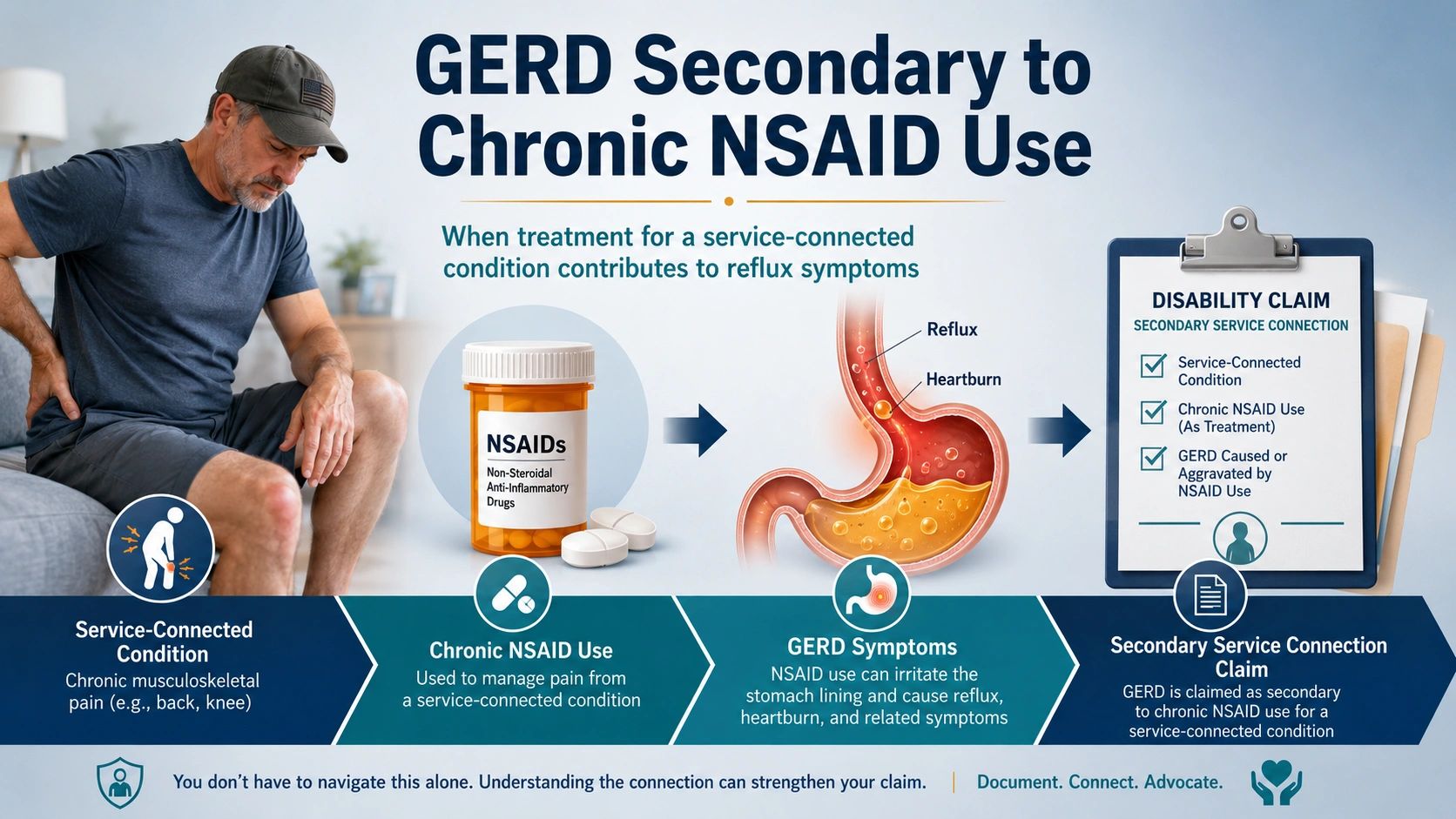
While NSAIDs can be helpful for pain and inflammation, long-term or frequent use may contribute to gastrointestinal problems. Some veterans develop chronic heartburn, reflux, indigestion, gastritis, or gastroesophageal reflux disease, also known as GERD. When GERD develops because of medication used to treat a service-connected condition, the veteran may have a basis to pursue GERD as a secondary service-connected disability.
Under VA rules, a condition may be service connected on a secondary basis when it is proximately due to, the result of, or aggravated by an already service-connected disability. In this type of claim, the key issue is not whether GERD began during military service. Instead, the question is whether the veteran’s service-connected condition required chronic NSAID use, and whether that medication use at least as likely as not caused or materially worsened the veteran’s GERD.
For example, a veteran may be service connected for lumbar spine disease, knee arthritis, shoulder injury, radiculopathy, or another painful musculoskeletal condition. If that condition required years of NSAID use and the veteran later developed persistent GERD symptoms requiring treatment with antacids, H2 blockers, proton pump inhibitors, or dietary restrictions, the medical evidence may support a secondary relationship.
Strong evidence for this type of claim may include VA or private treatment records documenting the service-connected pain condition, medication lists showing chronic NSAID use, medical records diagnosing GERD, and a medical nexus opinion explaining the connection. A well-supported nexus letter should discuss the veteran’s medication history, timing of symptom development, known gastrointestinal effects of NSAIDs, and why the veteran’s GERD is at least as likely as not related to treatment for the service-connected condition.
It is also important to address other possible risk factors, such as obesity, diet, smoking history, hiatal hernia, or other medical conditions. The presence of other risk factors does not automatically rule out secondary service connection. VA claims often turn on whether the evidence shows that the service-connected condition and its required treatment played a medically significant role in causing or worsening GERD.
Veterans who believe their GERD is related to chronic NSAID use should gather their medication history, document the service-connected condition requiring pain treatment, and consider obtaining a medical opinion that clearly explains the relationship. A carefully written GERD nexus letter can help connect the dots between the original service-connected disability, the necessary use of NSAIDs, and the development or aggravation of GERD.
If you are a veteran with GERD and a history of chronic NSAID use for a service-connected migraines, back, neck, knee, hip, shoulder, foot, ankle, arthritis, radiculopathy, or other chronic pain condition, you may have a valid basis to pursue GERD as a secondary service-connected disability. However, these claims are often denied when the medical connection is not clearly explained. A strong nexus letter can be critical because it helps connect the evidence in your record to the medical reasoning VA needs to evaluate the claim.
To discuss your case with Dr. Allen, please call our office at (984) 237-8044 or book a free phone consultation at this link.
Does Brightview Psychiatry Solutions have a doctor who can write my GERD nexus letter when I'm claiming it secondary to NSAIDs?
The answer is yes!
Veterans who need a medical nexus letter for GERD secondary to chronic NSAID use may benefit from an opinion written by a physician with expertise in pain medicine, musculoskeletal conditions, and VA disability evaluations. At Brightview Psychiatry Solutions, Robert J. Allen, Jr., M.D. provides nexus letters for veterans with claims involving chronic pain, orthopedic conditions, medication-related complications, and secondary service connection. Dr. Allen is board certified in Physical Medicine and Rehabilitation, fellowship trained in Pain Medicine, and has performed thousands of veteran Compensation and Pension examinations since 2016 as an independent medical examiner for VES, QTC, and Optum Serve. He has also worked at the Hampton VA Medical Center and Naval Medical Center Portsmouth.
For veterans claiming GERD secondary to NSAID use, Dr. Allen can review the relevant medical records, service-connected pain conditions, medication history, GERD diagnosis, and VA claim evidence to determine whether a well-supported nexus opinion can be provided. His goal is to prepare clear, detailed, medically grounded opinions that help explain the connection between a veteran’s service-connected disability, the treatment required for that disability, and the development or worsening of GERD.
To discuss your case with Dr. Allen, please call our office at (984) 237-8044 or book a free phone consultation at this link.
Related reading
Educational information only. This article is provided for general educational purposes and does not constitute medical advice, legal advice, or a treatment relationship. Reading it does not establish a physician–patient relationship with Dr. Allen or Brightview Psychiatry Solutions PLLC. No outcome in any VA claim is promised or implied; the VA determines service connection and assigns all disability evaluations. Veterans should consult their own treating providers regarding medical care and an accredited representative, agent, or attorney regarding claims. If you are in crisis, the Veterans Crisis Line is available 24/7: dial 988 and press 1, or text 838255.